
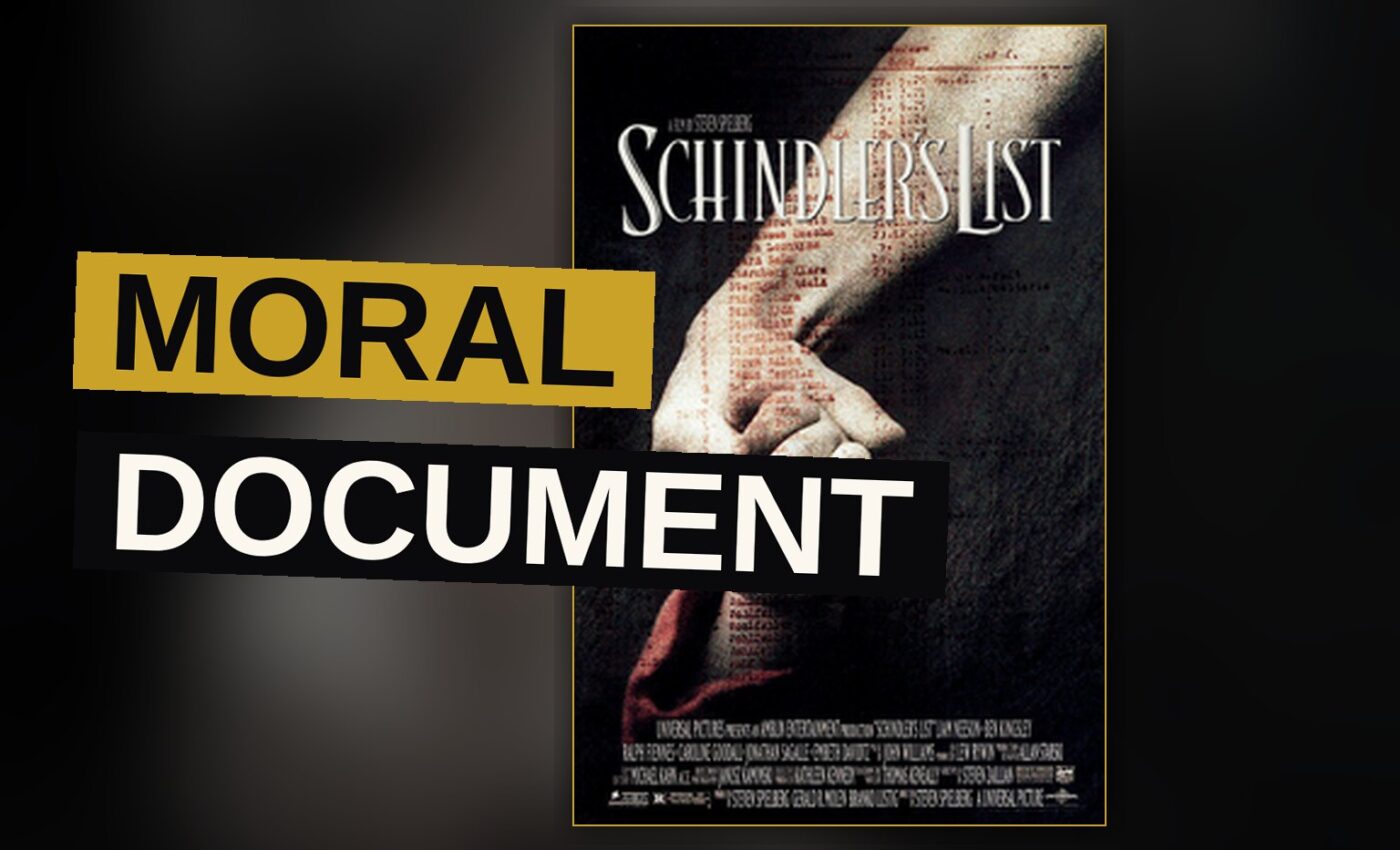
Steven Spielberg’s Schindler’s List runs 195 minutes and carries a tagline that states its whole argument: “Whoever saves one life, saves the world entire.” The film follows Oskar Schindler, a German industrialist and Nazi Party member from Czechoslovakia, who saved more than a thousand mostly Polish–Jewish refugees from the Holocaust by employing them in his factories during World War II. It premiered on November 30, 1993, in Washington, D.C., and opened in the United States on December 15, 1993.
Trailer, via Universal Pictures At Home.
A Factory in Kraków
The film opens in German-occupied Kraków, where the Nazis force local Polish Jews into the overcrowded Kraków Ghetto. Schindler arrives hoping to make his fortune. He bribes Wehrmacht and SS officials and acquires a factory to produce enamelware.
Liam Neeson plays Schindler. Spielberg cast him in December 1992 after seeing him perform in Anna Christie on Broadway. Neeson had auditioned early in the film’s development. Warren Beatty participated in a script reading, but Spielberg worried he could not disguise his accent and would bring what the director called “movie star baggage.” Kevin Costner and Mel Gibson expressed interest. Spielberg preferred the relatively unknown Neeson so the actor’s star quality would not overpower the character.
Neeson’s read on Schindler is that the man enjoyed outsmarting the Nazis, who regarded him as somewhat naïve. “They don’t quite take him seriously, and he used that to full effect,” Neeson said.
Stern, Göth, and the Ghetto
Schindler hires Itzhak Stern, a Jewish official with contacts among black marketeers and the Jewish business community. Ben Kingsley plays Stern, who handles administration and helps arrange financing. Stern makes sure that as many Jewish workers as possible are counted as essential to the German war effort, which keeps the SS from taking them to concentration camps or killing them.
Ralph Fiennes plays SS officer Amon Göth. He was cast after Spielberg viewed his performances in A Dangerous Man: Lawrence After Arabia and Emily Brontë’s Wuthering Heights. Spielberg described Fiennes’ audition this way: “I saw sexual evil. It is all about subtlety: there were moments of kindness that would move across his eyes and then instantly run cold.”
Fiennes put on 28 pounds (13 kg) for the role. He watched historic newsreels and talked to Holocaust survivors who knew Göth.
The Red Coat
Göth’s arrival in Kraków comes with a job attached: he is there to run the building of the Płaszów concentration camp. Once it is finished, he gives the order to clear the ghetto. Two thousand Jews are sent to Płaszów. Another two thousand are shot in the streets by the SS.
Schindler witnesses the massacre and is profoundly affected. He notices a young girl in a red coat who hides from the Nazis, and later sees her body on a wagonload of corpses. That image is the hinge of the film. Everything before it is a man enjoying his wealth and status as an industrialist. Everything after it is a man spending that wealth to buy lives.
Schindler keeps up his friendship with Göth and continues to enjoy SS support, mostly through bribery. Göth brutalizes his Jewish maid, Helen Hirsch, played by Embeth Davidtz, and randomly shoots people from the balcony of his villa. The prisoners live in constant fear.
What Fiennes Built
Fiennes did not play Göth as a monster from the first frame. He said he got close to the man’s pain. “Inside him is a fractured, miserable human being,” Fiennes said. “I feel split about him, sorry for him. He’s like some dirty, battered doll I was given and that I came to feel peculiarly attached to.”
Doctors Samuel J. Leistedt and Paul Linkowski of the Université libre de Bruxelles describe Göth’s character in the film as a classic psychopath. That clinical label is accurate and also insufficient. What makes Göth unbearable on screen is the ordinary boredom behind the killing. He shoots from a balcony the way another man might smoke.
“I saw sexual evil. It is all about subtlety: there were moments of kindness that would move across his eyes and then instantly run cold.”
Black and White, 72 Days
Spielberg shot the film in black and white and approached it as a documentary. Principal photography took place in Kraków, Poland, over 72 days in 1993. Cinematographer Janusz Kamiński wanted to create a sense of timelessness.
The choice has aged well. Color would have made the red coat a stunt. In black and white, it is the only thing in the frame that looks alive, and then it is on a cart.
John Williams composed the score, and violinist Itzhak Perlman performed the main theme. The music never begs. It sits under the images and lets them work.
Steven Zaillian wrote the screenplay, based on the historical novel Schindler’s Ark (1982) by Thomas Keneally. Ideas for a film about the Schindlerjuden were proposed as early as 1963. Poldek Pfefferberg, one of the Schindlerjuden, made it his life’s mission to tell Schindler’s story. Jonathan Sagall plays Pfefferberg in the film.
Spielberg became interested when executive Sidney Sheinberg sent him a book review of the novel. Universal Pictures bought the rights, but Spielberg was unsure he was ready to make a film about the Holocaust and tried to pass the project to several directors before deciding to direct it himself.
Why It Still Holds
The supporting cast does quiet work that keeps the film from becoming a two-man contest. Caroline Goodall plays Emilie Schindler. Małgorzata Gebel plays Viktoria Klonowska. Shmuel Levy plays Wilek Chilowicz. Mark Ivanir plays Marcel Goldberg. Béatrice Macola plays Ingrid. Andrzej Seweryn plays Julian Scherner. Friedrich von Thun plays Rolf Czurda.
The film’s real subject is not Schindler’s conscience. It is the machinery that made a conscience necessary, and the bribes that made one effective. Schindler does not save anyone by arguing with the SS. He saves them by paying the SS, by building a sub-camp at his factory so his workers are harder to take, and by staying friendly with men he despises. The movie is honest about that. Rescue here is a transaction, repeated more than a thousand times.
That is why the tagline lands. It is not a sentiment. It is a description of the accounting.
Schindler’s List runs 195 minutes. It is a drama, a history, and a war film at once, and it earns all three labels without leaning on any of them. Spielberg had already made his fortune with entertainments. Here he spent some of that credit on something else.
The film’s place in the culture has not softened its edges. If anything, the distance helps. A viewer arriving now knows the ending, knows the survivor lists, knows the factory. What remains is the middle: the liquidation, the balcony, the girl in the red coat, and a man deciding, without a speech, to stop counting his money and start counting people.
9.5 of 10.
Get the Notebook.
The day's best stories and every fresh verdict, in plain English, in your inbox by seven. One email a day, no more.


