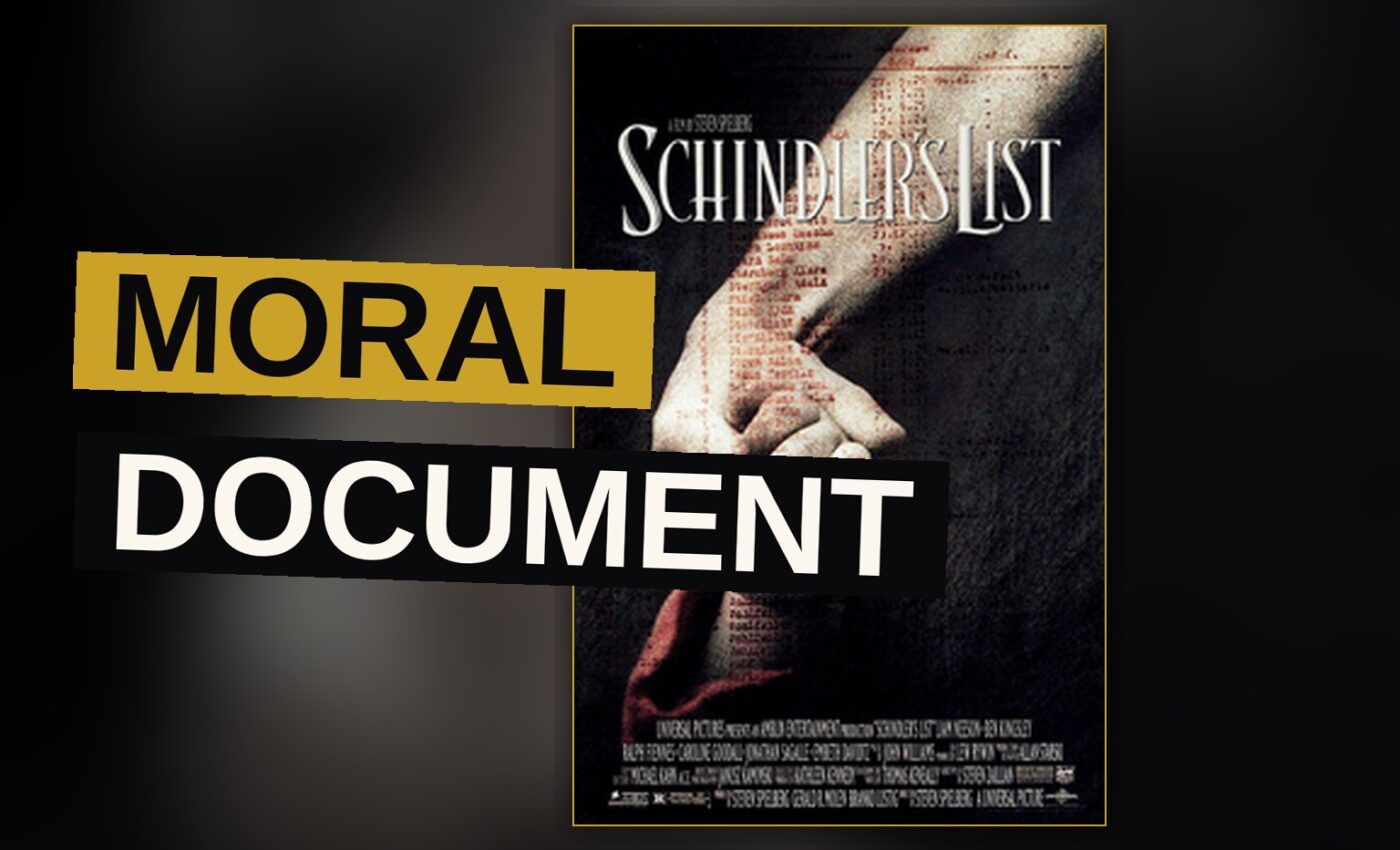
Steven Spielberg’s Schindler’s List does not feel like a film from 1993. It feels like a document that has always existed, a black-and-white record of the Holocaust that happens to move. The story follows Oskar Schindler, a German businessman who arrives in Krakow to make money off the war and ends up saving more than a thousand Jewish lives. It is not a comfortable film, and it was never meant to be. It is a masterpiece that earns its reputation every single minute of its three-hour run.
The film opens with Schindler dressing for a night out, pinning a Nazi party badge to his lapel. He is charming, greedy, and entirely cynical. He bribes his way into a factory, hires Jewish workers because they are cheaper than Poles, and throws money at anyone who can help him. Liam Neeson plays him with a quiet, growing bewilderment that never tips into sentimentality. Schindler is not a hero at first. He is a profiteer who happens to be there.
Trailer, via Universal Pictures At Home.
Inside the Factory
The central engine of the film is the factory itself. Schindler’s enamelware plant becomes a refuge, not because Schindler is righteous, but because his workers are useful. The turning point comes slowly. He sees the liquidation of the Krakow ghetto from a hilltop, a sequence of such brutal efficiency that it is hard to watch. The red coat of a small girl is the only color in the frame, a choice that has become justly famous. Later, he sees her body on a cart. That is the moment the film changes.
Schindler begins to compile a list of workers he claims are essential to his factory. The list is a bureaucratic fiction, a way to pull people out of the death camps. The film’s title refers to that document, and the film treats it with the weight of scripture. Every name on the list is a life. The film never lets you forget that.
Ralph Fiennes plays Amon Goeth, the commandant of the Plaszow labor camp. He is the film’s antagonist, a man who shoots prisoners from his balcony for sport. Fiennes gives him a lazy, bored cruelty that is more frightening than any screaming villain. One scene has him weighing the decision to forgive a young boy who has failed to clean a bathtub. He forgives him. Then he shoots him anyway. It is a small moment that captures the randomness of evil.
Filming the Horror
The film is shot in black and white, with a handheld camera that feels like newsreel footage. Janusz Kaminski’s cinematography is stark, grainy, and immediate. The shadows are deep, the faces are worn, and the smoke from the crematoria hangs in the air. Spielberg does not flinch from the horror. The piles of bodies, the showers, the casual murder of children — all of it is shown. The film is rated R, and it earns that rating. It is not a film for the faint of heart.
The score, by John Williams, is spare and mournful. The main theme is played on a solo violin by Itzhak Perlman, and it sounds like a lament for the dead. There is also a recurring motif of a little girl singing a lullaby in Polish. Both are used sparingly, which makes them land harder. Spielberg trusts the images to carry the weight, and they do.
The performances are uniformly strong. Ben Kingsley plays Itzhak Stern, Schindler’s accountant and conscience, with a quiet dignity that anchors the film. Embeth Davidtz plays Helen Hirsch, Goeth’s maid, who lives in constant fear. The supporting cast is filled with faces you will recognize and faces you will not, and every one of them feels real. There is no acting in this film. There is only being.
The Final Reel
The final act is devastating. The war ends, and Schindler’s workers are free. He gives a speech to them, then breaks down. He looks at his car and his pin and says he could have sold them, could have saved more people. Neeson’s performance in that scene is raw and unguarded. He is not a hero. He is a man who did good things for bad reasons and is haunted by the good things he did not do.
The film ends in color. The survivors walk to Schindler’s grave in Jerusalem, and the actors who played them place stones on the monument. The real survivors appear beside them. It is a direct link between the film and the history it depicts. It is not a happy ending. It is a true one.
| Scene | Time (approx.) | Key Moment |
|---|---|---|
| Opening | 0:00–0:10 | Schindler dresses, pins Nazi badge |
| Ghetto liquidation | 0:45–1:00 | Red coat girl, turning point |
| List compilation | 1:45–2:00 | Stern types names, lives saved |
| Schindler’s speech | 2:45–2:55 | Breakdown, “I could have saved more” |
| Grave scene | 3:05–3:15 | Survivors place stones in color |
Schindler’s List is not entertainment. It is a moral document, a reminder of what human beings are capable of, both in cruelty and in mercy. Spielberg made a film that is impossible to forget and impossible to dismiss. It is the best work of his career.
The film is long, and it is hard, and it is necessary.