
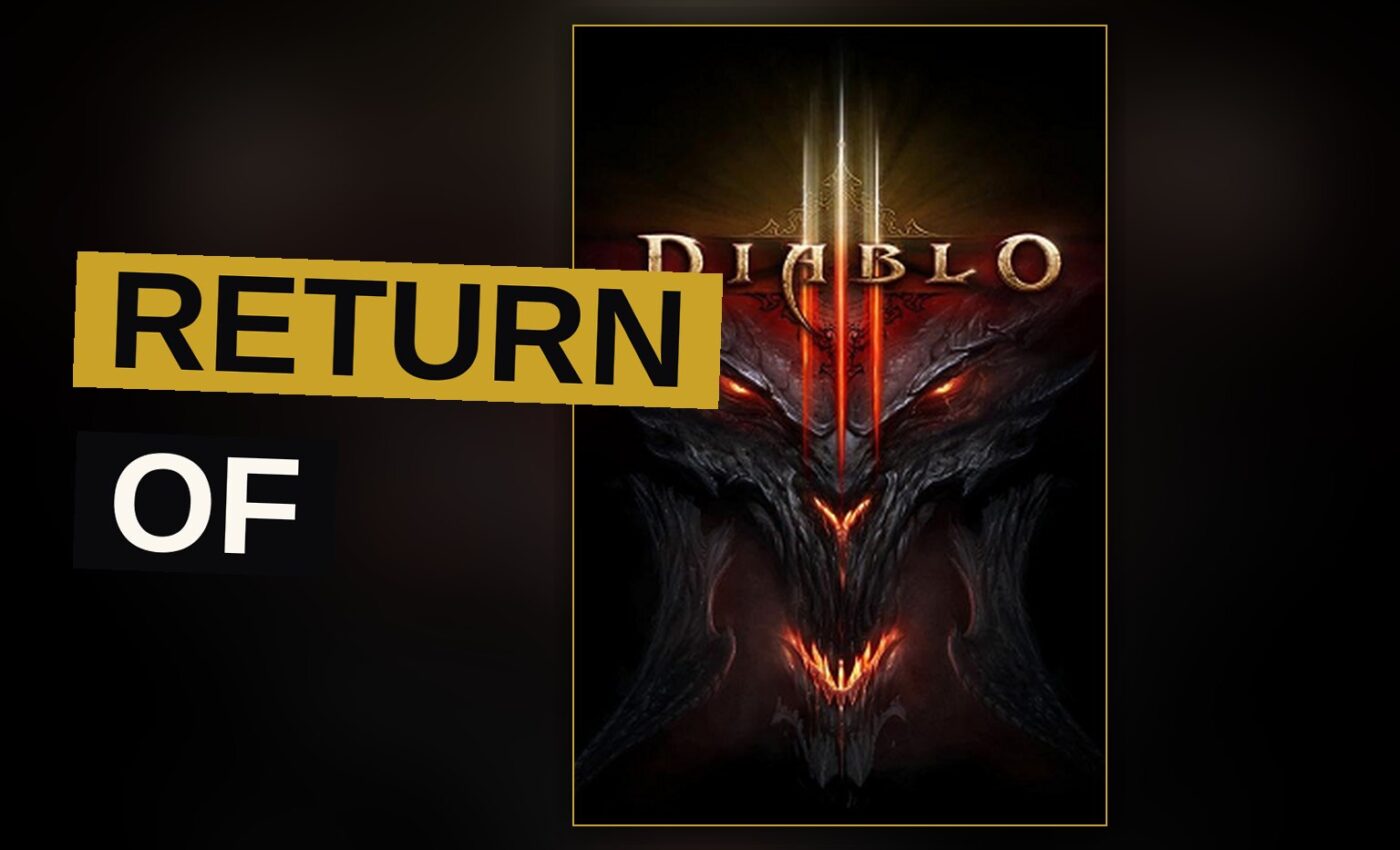
Diablo III arrived in May 2012 as the third entry in Blizzard’s dungeon-crawling franchise, and it sold more than 3.5 million copies in its first 24 hours, a record for fastest-selling PC game. It is a fast, dark, isometric action RPG set in Sanctuary, and in this paper’s view it is very good at almost everything it attempts. The auction house is the part that has aged worst.
Trailer, via FlashQC.
Seven Classes, Four Difficulty Levels
The structure is faithful to Diablo and Diablo II. Players pick one of seven classes — Barbarian, Crusader, Demon Hunter, Monk, Necromancer, Witch Doctor or Wizard — and are tasked with defeating Diablo. Combat is real-time and fast-paced, viewed from an overhead isometric angle through Blizzard’s custom 3D engine. The engine handles destructible environments with an in-game damage effect, and enemies use the 3D space in ways the older games could not, crawling up the side of a wall from below into the combat area.
Progression is the usual loop, done with unusual care. Characters gain experience, level up and acquire more powerful equipment. Item quality and attributes are randomized. Magic-quality items carry up to three random properties, rare-quality items up to six, and legendary-quality items typically up to eight. Set items, a subtype of legendary, stack cumulative bonuses when multiple pieces from the same set are equipped. Higher-level monsters tend to drop higher-level items with higher base stats and bonuses.
Four acts, two game modes (normal and hardcore) and four difficulty levels — Normal, Nightmare, Hell and Inferno — give the campaign a long spine. Achievements trigger on meeting certain requirements. The game runs in single player, multiplayer and co-operative modes.
A Crater in Tristram Cathedral
The plot picks up twenty years after Diablo II. Deckard Cain and his ward Leah are in Tristram Cathedral — the same cathedral that was the setting of the first Diablo — investigating ancient texts about an ominous prophecy. A mysterious star falls from the sky, strikes the cathedral and carves a deep crater. Cain disappears into it.
The player’s character, the Nephalem, arrives in New Tristram to investigate the fallen star and accompanies Leah to the cathedral to rescue Cain. Getting to the star requires defeating the Skeleton King, once called King Leoric. Where the star landed, the Nephalem finds a stranger whose only memory is of a sword that shattered into three pieces as he fell. Two pieces are recovered. Maghda, leader of the Dark Coven, takes the third and tries to force Cain to repair the sword.
Leah kills the cultists with a surge of magical power; Maghda fatally wounds Cain and flees with the stranger. Cain repairs the sword before dying and finds it is of angelic origin. The stranger, freed from the Butcher in the dungeons beneath Leoric’s manor, recovers his memory: he is the Archangel Tyrael, the Aspect of Justice, who cast aside his divinity to become mortal and warn Sanctuary of the coming demon lords.
The Auction House
Here is the objection that has followed Diablo III for more than a decade, and it is deserved. The auction house is a new addition to the series. It lets players exchange items for in-game gold or real money, and the same currency is usable to purchase Blizzard merchandise. It puts a market in the middle of a game whose entire pleasure is the drop — the moment a rare item hits the floor.
That pleasure is the point. Randomized properties mean every legendary is a small argument with yourself about whether it beats what you have. Set bonuses reward commitment. When a real-money exchange sits beside that, the drop stops being a reward and becomes a valuation. The always-on DRM feature drew criticism too. Neither flaw is fatal. Both are self-inflicted, and in this paper’s view the auction house is the heavier of the two.
What Held Up
Ranked by what still works, the case for Diablo III is straightforward:
- The combat loop — real-time, fast, isometric, built for repetition without boredom.
- The item system — randomized properties, set bonuses, and a drop table that scales with monster level.
- The engine — destructible environments and enemies that use the 3D space rather than sitting in it.
- The difficulty ladder — Normal through Inferno, plus hardcore mode for players who want the character to stay dead.
- The auction house — the newest system in the game, and the one that sits least easily beside the four above.
The expansion Reaper of Souls followed on PC in March 2014 and on consoles that August inside the Ultimate Evil Edition. The Rise of the Necromancer pack came to Windows, macOS, PlayStation 4 and Xbox One in June 2017. The Eternal Collection, bundling both, reached PlayStation 4 and Xbox One in June 2017 and Nintendo Switch in November 2018. Sales passed 12 million by the end of 2012, making it the best-selling PC game of that year, and grew past 30 million by August 2015. Diablo IV was announced in 2019 and released on June 5, 2023.
The Numbers on the Box
- Release: May 2012 (Microsoft Windows, OS X)
- Later platforms: PlayStation 3 and Xbox 360, September 2013; PlayStation 4 and Xbox One, August 2014; Nintendo Switch, November 2018
- Launch sales: over 3.5 million copies in 24 hours
- 2012 sales: over 12 million copies
- Sales as of August 2015: over 30 million
- Critic aggregate: 8.3/10 from 15 outlets
The auction house is the detail that has drawn the most criticism, but it is not the detail that decides the game. What decides it is that the fighting is fast, the loot is worth chasing and the difficulty ladder gives the whole thing a shape. The dungeon crawl underneath the market is what still holds up.
Get the Notebook.
The day's best stories and every fresh verdict, in plain English, in your inbox by seven. One email a day, no more.


