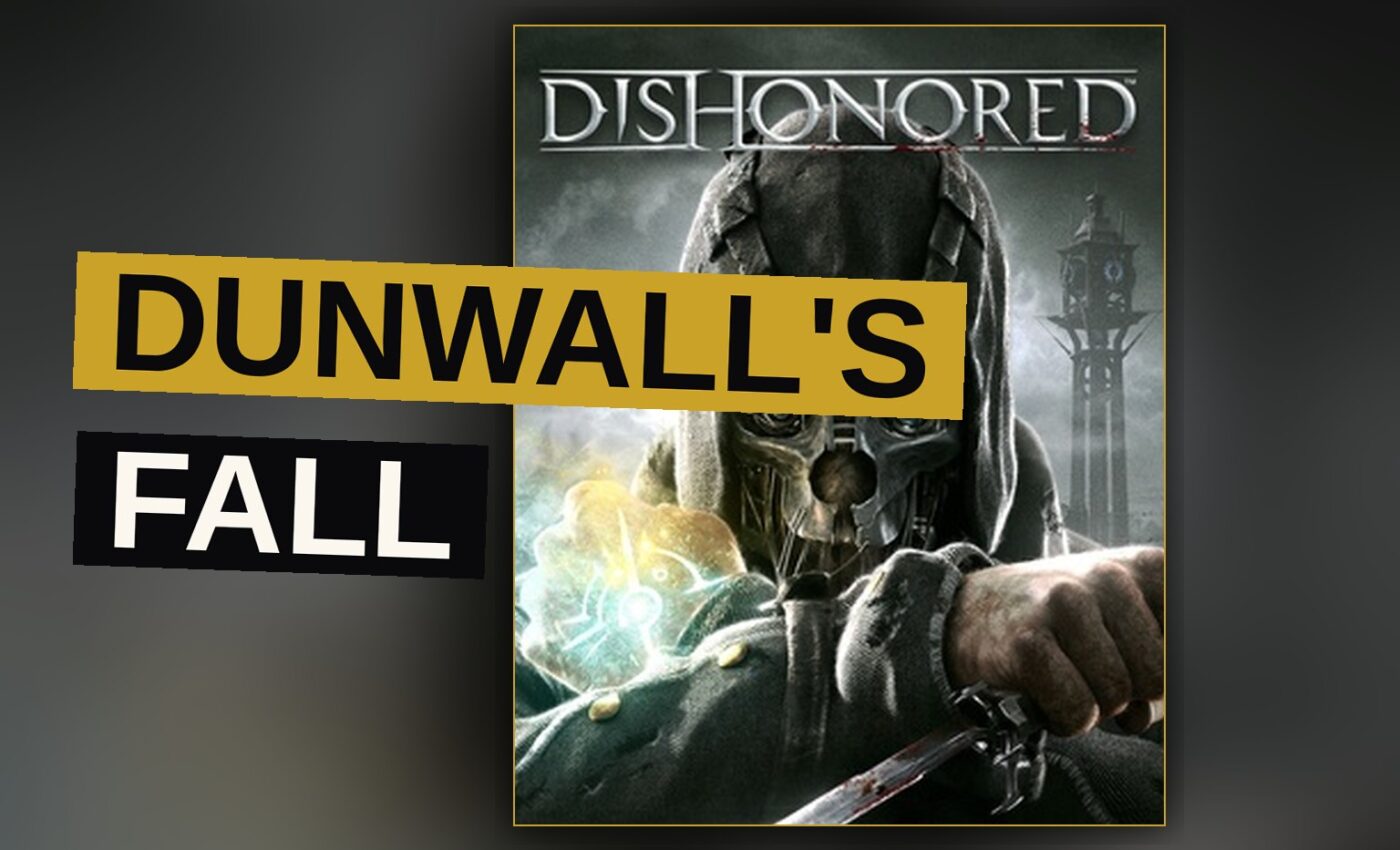
Dishonored arrived in 2012 with a simple pitch: you are an assassin named Corvo Attis, and the city of Dunwall is yours to break or fix. Arkane Studios built a stealth game around a mechanical system that rewards both violence and subtlety, and the result is one of the most distinctive games of its generation. The game asks you to choose how you play, and it rarely tells you that your choice matters. That ambiguity is its greatest strength.
Trailer, via IGDBcom.
Corvo Attis and the Fall of Dunwall
Corvo is a man of few words and fewer scruples. He is framed for the assassination of the Empress, and he spends most of the game hunting the men who betrayed him. His story is grim and personal, and the game trusts you to sit with that grief without constant exposition. The plot moves through a series of missions that take you across Dunwall’s rain-swept streets, from the dank wharfs to the grand halls of the imperial palace.
The setting is the game’s star. Dunwall is a city of fog, oil lamps, and rats, and it feels alive even when you’re not moving. The game’s lore is woven into the environment: posters, signs, and conversations that hint at a world of political corruption, industrial decay, and supernatural dread. It is a city that deserves to be saved, even if the people in it are mostly miserable.
The Dual Paths of Stealth and Violence
Dishonored’s core mechanic is the ability to bend the world to your will. You can blink across gaps, summon a swarm of crows to attack enemies, or become incorporeal to pass through walls. These powers are not optional. They are essential, and they make every encounter feel like a puzzle with multiple solutions.
The game presents two broad approaches:
| Approach | Focus | Reward |
|---|---|---|
| Stealth | Avoid detection, use shadows | Calm, unseen victory |
| Violence | Overpower enemies, kill freely | Brutal, loud chaos |
Neither path is better in a vacuum. The game tracks your actions and lets you see the consequences later, but it never forces you to play one way or the other. This freedom is rare in mainstream games, and it gives Dishonored a replay value that few titles share.
Level Design That Rewards Exploration
The levels in Dishonored are dense and vertical. Each mission offers multiple routes, and the game encourages you to find them. There are hidden rooms, secret switches, and alternate exits that reward curiosity. The level design is also thematic: the waterfront district feels wet and oppressive, while the high nobility districts are cold and sterile.
The pacing holds up across the campaign. Missions rarely drag, and the game’s difficulty curve is gentle enough that new players can enjoy it without feeling lost. The game’s best moments come when you combine several abilities in a single maneuver, and the satisfaction of a perfect run is hard to beat.
The Cast of Dunwall
The supporting cast is memorable. Lady Emily Kaldwin, Corvo’s adopted daughter, becomes a driving force in the story. Her fate hangs over every mission, and her presence gives the game an emotional anchor. Other characters, like the aristocrat Lord Slate and the revolutionary Daud, are drawn with enough depth that you care about their fates, even when you disagree with their methods.
The voice acting is strong across the board. Travis Willmore’s performance as Corvo is restrained and effective, and the supporting actors carry their weight. The music, composed by Gerald Fried, is a mix of industrial noise and orchestral strings that fits the setting perfectly.
The Weak Points
Dishonored is not without flaws. The combat can feel imprecise, especially when you are surrounded by enemies. Some enemies have poor hit detection, and the game’s AI can sometimes ignore you when you want it to engage. These issues are minor compared to the strengths, but they are noticeable.
The game’s narrative is also thin in places. Some missions feel like filler, and the middle stretch drags slightly. The ending, while satisfying, leaves some threads unresolved. None of these problems sink the game, but they keep it from greatness.
Replay Value and Legacy
Dishonored’s replay value comes from its dual paths. Playing through the game a second time with a different approach changes the experience significantly. The game remembers your choices, and you can see the consequences of your actions in the world itself.
The game also spawned a sequel, Dishonored 2, which continued Corvo’s story and introduced a new protagonist. The legacy of Dishonored is visible in other games that borrow its mechanics. Its influence on the stealth genre is undeniable.
Final Score
Dishonored is a game about choices, and it respects those choices. It is a game that trusts the player to find their own fun, and it delivers on that trust. The level design, the abilities, and the setting all work together to create a game that feels unique.
It is not a perfect game, but it is a very good one. The combat stumbles, and the story occasionally loses focus, but the core loop is brilliant. If you have not played it, you owe it to yourself to give it a try.
Dishonored earns an 8.6 out of 10.
Get the Notebook.
The day's best stories and every fresh verdict, in plain English, in your inbox by seven. One email a day, no more.