
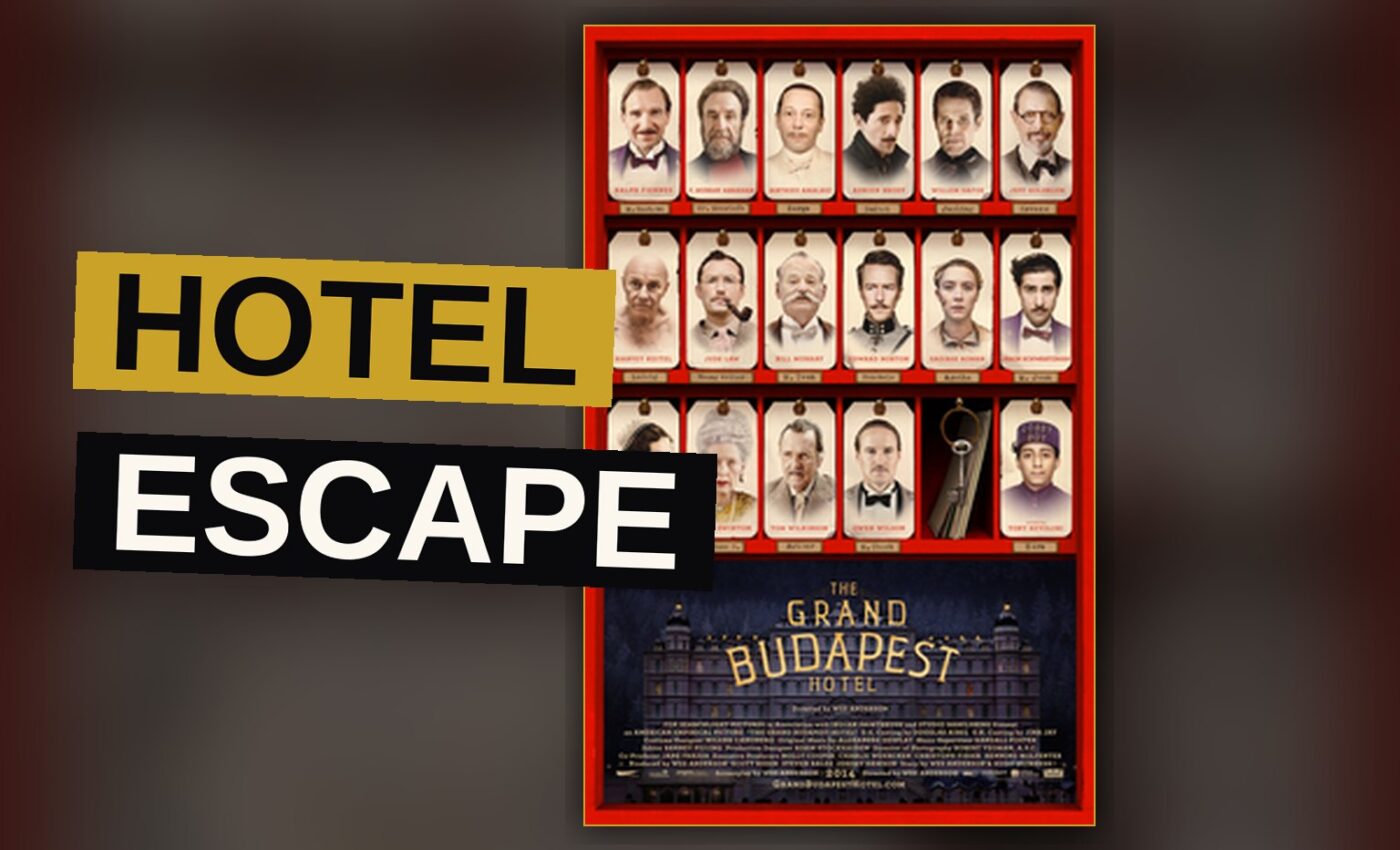
Wes Anderson’s The Grand Budapest Hotel opens in a cemetery in the former nation of Zubrowka. A young woman carries a copy of a bestselling novel to the shrine of a writer known only as “Author.” That book, written in 1985, holds the story we are about to watch.
The film runs 100 minutes. It is a comedy and a drama, and it earns both labels. Our score: 8.8 of 10.
Trailer, via SearchlightPictures.
Monsieur Gustave H. and the Lobby Boy
Ralph Fiennes leads the ensemble as Monsieur Gustave H., the famed concierge of a twentieth-century mountainside resort in Zubrowka. Gustave is a philanderer who seduces the hotel’s old, wealthy residents, including dowager Madame D. Their affair has run nearly two decades.
Tony Revolori plays Zero, who flees his war-ravaged country to work as a lobby boy. Gustave takes him on as a protégé. Their friendship is the spine of the picture, and it is why the film’s later sorrows land.
The tagline sells the plot as a murder case involving enormous wealth and outrageous events. That is accurate, and also too small. Anderson and co-writer Hugo Guinness are after something larger: a stolen Renaissance painting, a fight over a family fortune, and the upheavals that transformed Europe in the first half of the twentieth century.
Boy with Apple and a Will Reading at Schloss Lutz
Gustave learns from Zero that Madame D. has died. The two travel to Schloss Lutz, her estate, to pay their respects. There they sit through the reading of her will by her attorney, Deputy Vilmos Kovacs, played by Jeff Goldblum.
Kovacs announces that Madame D. has left a famous Renaissance painting, Boy with Apple, to Gustave. Her son Dmitri, played by Adrien Brody, is outraged and demands Gustave’s arrest. The film’s answer to that demand is Gustave’s arrest on suspicion of murder, and the plot’s whole engine is his effort to clear his name.
Gustave and Zero take the painting and leave. Then the butler, Serge, played by Mathieu Amalric, makes a deposition implicating Gustave in Madame D.’s death. Gustave goes into hiding.
The plot turns here, and this is where Anderson’s comic machinery does its most efficient work. The painting is a prize worth chasing. The will reading is a set piece of pure farce. The murder charge is what turns a caper into an elegy.
Checkpoint Nineteen, Mendl’s Pastries, and a Prison Break
In prison, Gustave befriends a gang and the men plot their escape. Harvey Keitel plays Ludwig, the leader of the prison gang at Checkpoint Nineteen. The breakout runs on pastry.
Gustave has Zero place digging tools inside pastries made by Mendl’s apprentice baker, Agatha — Zero’s girlfriend, played by Saoirse Ronan. The men dig their way out and disperse. It is the film’s funniest sequence and its most improbable, and it works because Anderson never winks at it.
Dmitri deploys his hitman, J. G. Jopling, played by Willem Dafoe, to kill Kovacs and Serge’s sister, who conceals her brother’s whereabouts. Jopling is a ruthless piece of work, and Dafoe plays him with a stillness that is genuinely unsettling.
When Zero and Gustave are reunited, they set out to prove Gustave’s innocence. The help they get comes through the Society of the Crossed Keys, a network of concierges played by Bill Murray, Owen Wilson, Jason Schwartzman, Bob Balaban, Fisher Stevens, Wallace Wolodarsky, and Waris Ahluwalia.
A Cast Built From Anderson’s Troupe
Anderson customarily employs a troupe of longtime collaborators. Bill Murray, Adrien Brody, Edward Norton, Owen Wilson, Tilda Swinton, Harvey Keitel, Willem Dafoe, Jeff Goldblum, and Jason Schwartzman have each worked on one or more of his projects. Norton and Murray signed immediately when sent the script.
The ensemble is mostly bit cameos. Because of the limitations of such roles, Brody said the most significant challenge was balancing the film’s comedy with the otherwise solemn subject matter. That tension is the whole movie in miniature.
All were the filmmakers’ first casting choices save for Swinton, whom they pursued for Madame D. when Angela Lansbury dropped out because of a prior commitment to a Driving Miss Daisy theater production. Swinton is unrecognizable under the makeup, and she is very funny.
The cast list runs long:
- Ralph Fiennes as Monsieur Gustave H., the hotel’s renowned concierge
- Tony Revolori as Zero Moustafa, the newly hired bellhop
- F. Murray Abraham as the elderly Zero
- Adrien Brody as Dmitri Desgoffe-und-Taxis, Madame D.’s son
- Willem Dafoe as J. G. Jopling, Dmitri’s hitman
- Saoirse Ronan as Agatha, an apprentice baker and Zero’s love interest
- Tilda Swinton as Céline Villeneuve Desgoffe-und-Taxis, known as Madame D.
- Edward Norton as Albert Henckels, the police inspector
- Jeff Goldblum as Deputy Vilmos Kovacs, Madame D.’s lawyer
- Harvey Keitel as Ludwig, leader of the prison gang at Checkpoint Nineteen
F. Murray Abraham plays the elderly Zero, who tells the story over dinner to Jude Law’s young Author during a 1968 visit to the hotel. Tom Wilkinson plays the Author as an older man. That frame tells us from the first minute that this world is already gone.
Zubrowka, Zweig, and a Photochrom Look
Anderson and Guinness conceived The Grand Budapest Hotel as a fragmented tale following a character inspired by a mutual friend. They initially struggled in brainstorming. Touring Europe and researching the literature of Austrian novelist Stefan Zweig shaped their vision for the film.
Visually, the film draws from Europe-set mid-century Hollywood films and the United States Library of Congress’s photochrom print collection of alpine resorts. You can feel both. The hotel is pink and absurd and entirely convincing. The mountains look like postcards left in the sun.
Filming took place in eastern Germany from January to March 2013. Anderson’s American Empirical Pictures produced the film in association with Studio Babelsberg, Fox Searchlight Pictures, and Indian Paintbrush’s Scott Rudin and Steven Rales. Fox Searchlight supervised commercial distribution. Funding came from Indian Paintbrush and German government-funded tax rebates.
What the Film Is Actually About
The Grand Budapest Hotel is not, in the end, about a painting or a will or a murder. It is about the encroaching fascist regime that closes over Zubrowka while Gustave is busy being Gustave. The upheavals arrive slowly, then suddenly. Anderson stages them almost as an afterthought, which is exactly how they would have felt to people who thought their world was permanent.
A murder case of Madam D. with enormous wealth and the most outrageous events surrounding her sudden death!
That is how the film was sold. It is not what the film is. The film is a friendship — a vain, fussy, oddly honorable concierge and a refugee boy who becomes his trusted protégé — set against a Europe that will not hold still.
Fiennes is the reason it holds. He plays Gustave as a man who believes in manners as a moral system, and the performance never condescends to him. Revolori holds his own opposite him, which is no small thing for a first major role.
The frame story with Abraham and Law is the film’s weakest layer. It explains more than it needs to. But it also gives the ending its weight, and by the time the 1968 hotel — once lavish, then drab — appears on screen, the loss is legible without a word of explanation.
Anderson has made colder films and busier ones. This one has a beating heart under the pastry boxes and the pink façade. It is his best, and it is the one that will last.
Get the Notebook.
The day's best stories and every fresh verdict, in plain English, in your inbox by seven. One email a day, no more.


