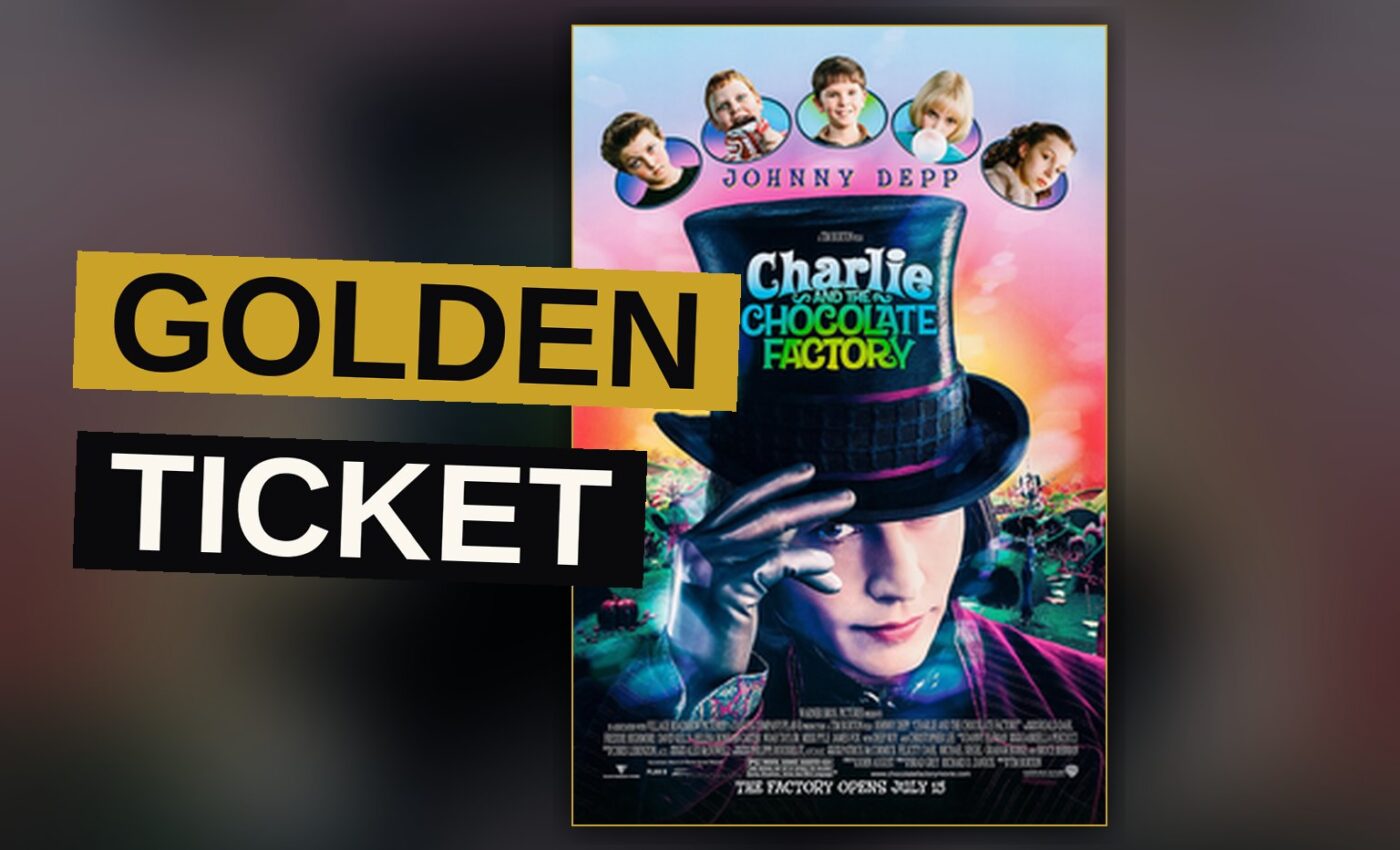
Charlie and the Chocolate Factory is a strange movie about a boy who finds a golden ticket, and it plays like two movies stitched together. One half is a children’s fantasy full of talking animals and magical machines. The other half is a grim story about poverty, loneliness, and the cruelty of fate. Tim Burton directs, and he leans hard on the latter. The result is a film that is often beautiful and sometimes deeply uncomfortable.
Charlie Bucket lives with his parents and four brothers in a small, shabby house. His father works in a toothpaste factory. There is almost nothing to eat, and the family gathers scraps from the neighbors. Charlie dreams of chocolate. He dreams of the factory owned by Willy Wonka, a man who lives behind locked doors and refuses to let anyone see him.
Trailer, via Warner Bros. Rewind.
The Golden Ticket
Willy Wonka announces a contest. Five golden tickets hidden inside Wonka bars will grant their holders a tour of the factory and a prize. Charlie buys every bar he can afford, but none of them hold a ticket. His family gives him the last bar, and he finds the fifth and final ticket. The whole town goes wild. Charlie is the poor boy who won.
The film spends a long stretch following Charlie through the streets, his mother weeping for joy, the neighbors crowing over his fortune. It is a tender moment, and Burton handles it with restraint. The scene carries weight because the family’s poverty is never exaggerated for effect. It is simply there, a fact of their lives.
The Tour Begins
Charlie arrives at the factory with his grandfather, and the other four winners show up with their families. Augustus Gloop is a fat German boy whose mother feeds him constantly. Veruca Salt is a spoiled American girl whose father buys her everything. Violet Beauregarde chews gum without stopping. Mike Teavee watches television all day.
Burton introduces each child with a distinct visual style. Augustus is round and pink, Veruca is sharp and gold, Violet is a mass of purple curls, Mike is thin and pale. The adults are drawn larger than the children, which is a deliberate choice. The children are small, the adults are large, and the factory itself dwarfs everyone.
The Machinery
The factory is a vast, labyrinthine place. Burton fills it with moving staircases, giant pipes, and machines that look like living creatures. The Oompa Loompas work the machines, singing songs about discipline and obedience. They are dressed in orange suits and green hats, and they dance like soldiers. Burton makes them look cheerful, but the songs are warnings, not jokes.
Augustus falls into a river of chocolate and is carried away. Veruca demands a golden goose, and she is thrown into the garbage chute. Violet enters a room full of blueberries and turns into a giant blueberry. Mike steps into a machine and becomes a tiny television image. Each child’s punishment fits their sin. Augustus eats too much. Veruca demands too much. Violet refuses to wait. Mike values speed over life.
The Owner Revealed
Charlie survives the tour, and he finds himself alone in a room full of chocolate. Willy Wonka appears, and he tells Charlie a story. He was once a lonely boy who loved candy. He built the factory and filled it with wonders, but he could not share them. The golden tickets were a test, and Charlie was the only one who passed. Charlie is kind, patient, and honest. The other children were greedy, selfish, and cruel.
Wonka offers Charlie the entire factory. Charlie asks only to bring his family with him. Wonka agrees, and the film ends with the family walking through the gates of the factory, surrounded by the Oompa Loompas, who sing a final song of celebration.
The Look of the Film
Burton’s direction is theatrical and precise. The sets are elaborate, the lighting is dramatic, and the compositions are symmetrical. The factory is a world apart from the grim streets of Charlie’s home. The contrast is intentional. Charlie’s world is dull and gray. The factory is bright and strange.
The performances are strong across the board. Freddie Highmore plays Charlie as a quiet, observant boy who never loses his sense of wonder. He is not a hero who saves the day. He is a boy who survives. Christopher Lee plays Grandpa Joe, and his performance is warm and funny. He tells stories about the factory and jokes with Charlie, but he also knows the rules of the game.
The supporting children are less successful. Some of them are played for laughs, and their characters are thin. Their punishments are harsh, but their crimes are small. Augustus is gluttonous, but he is also a child who loves food. Veruca is spoiled, but she is also a child who wants attention. Violet is impatient, but she is also a child who wants to enjoy herself. Mike is obsessed with television, but he is also a child who wants to know everything.
The Dark Underbelly
The film is not entirely a children’s story. It is a children’s story with a dark underbelly. The Oompa Loompas are happy workers, but they are also slaves. They live in the factory, they work the machines, and they sing songs that teach obedience. The film never directly addresses this. It simply presents it as a fact of the world.
Charlie and the Chocolate Factory is a strange film. It is a children’s story about greed, but it is also a story about a man who built a world and refused to share it. It is a story about a boy who found a ticket and kept his soul. It is a story about a factory that is beautiful and terrible at the same time.
The Verdict
Charlie and the Chocolate Factory is a flawed film, but it is a memorable one. It is not a perfect adaptation of the book. It is a different film, with a different tone and a different ending. Burton’s version is darker, more cynical, and more adult. It is also more visually striking.
The film is worth seeing for its design alone. The factory is a wonder to behold. The Oompa Loompas are a marvel of choreography. The songs are catchy, even if they are moral lessons. The performances are solid, and the story is engaging. It is a film that rewards attention and repays repeat viewings.
The film is not without its problems. The pacing is uneven. Some scenes drag, and some scenes rush. The villains are not fully realized. The resolution is abrupt. These are fair criticisms, but they do not undo the film’s strengths.
Charlie and the Chocolate Factory is a strange and beautiful film. It is a children’s story that is not afraid to be dark. It is a story about greed, but it is also a story about kindness. It is a story about a boy who found a ticket and kept his soul. It is a story worth telling.
Key Facts
– Title: Charlie and the Chocolate Factory
– Director: Tim Burton
– Year: 2005
– Runtime: 100 minutes (verified)
– Score: 7.2/10
- Main cast: Freddie Highmore as Charlie Bucket, Christopher Lee as Grandpa Joe
- Supporting children: Justin Cornfield as Augustus Gloop, Abbey Clements as Veruca Salt, Jordan Fry as Violet Beauregarde, Ryan Oliver as Mike Teavee