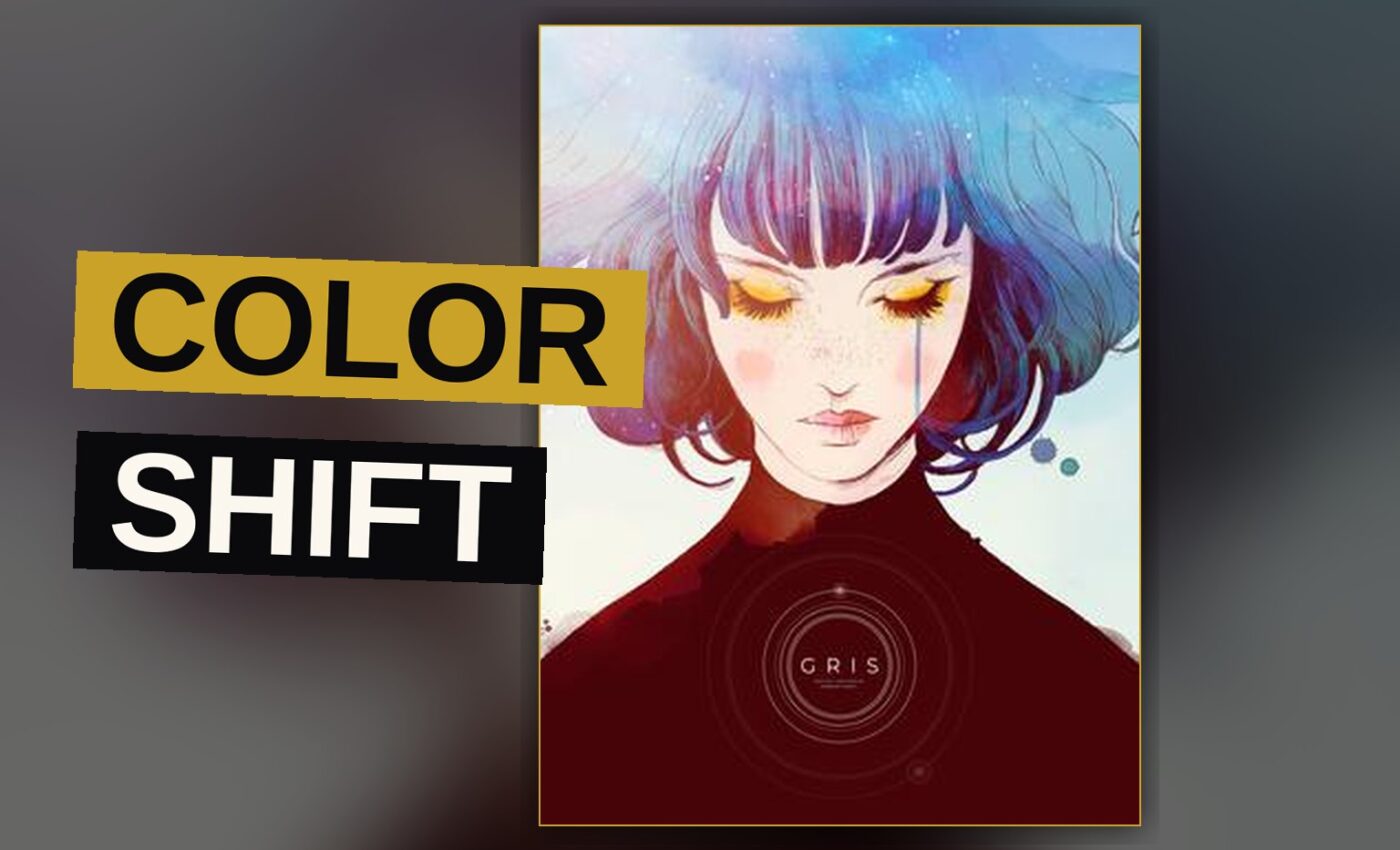
Gris is a game about grief, and it says almost nothing. Nomada Studio’s 2018 platformer follows a young woman through a faded world, and it tells its story without a single line of dialogue — no narration, no text boxes, no voice acting. What it has instead is hand-painted art, an evocative score, and environmental storytelling that lets the player piece the meaning together. The result is one of the most striking games of its decade, and a puzzle-platformer that trusts its audience to feel its way forward.
Trailer, via DevolverDigital.
A Girl Who Wakes in a Broken Hand
Gris opens with its title character waking up in the palm of a crumbling statue of a woman. She tries to sing, but the sound catches in her throat, and the statue’s hands break apart, dropping her to a colourless earth below. That opening is the whole game in miniature: a loss she cannot voice, a fall she did not choose, and a world drained of colour.
The game’s story follows Gris as she deals with a painful experience, and her journey through sorrow is made visible in her dress. The garment grants her new abilities as she moves, letting her better navigate her faded reality. As the story unfolds, Gris grows emotionally and begins to see her world in a different way, revealing new paths she can only reach with the powers she has picked up.
Nomada Studio built the game as a 2D platformer with a side view, and Devolver Digital published it. It arrived first in December 2018 for macOS, Nintendo Switch, and Windows. Since then it has spread widely: iOS in August 2019, PlayStation 4 in November 2019, Android in April 2020, Amazon Luna in November 2021, and PlayStation 5, Xbox One and Xbox Series X/S in December 2022. It has sold over 3 million copies.
Stars, Statues and the Four Regions
The structure of Gris is built on light. She discovers strange structures that seem to be powered by mysterious points of light resembling stars, and she collects those lights to gain new abilities. One turns her into a heavy block of stone. Another lets her create pathways made of constellations.
After she reaches a central tower, Gris can travel to four locations to collect lights and restore colour to her world at statues that resemble the broken one from the beginning. Those areas are a desert filled with windmills, a lush forest, underwater caverns, and a world with buildings made of light. Each one asks her to use what she has learned in a new way.
Along the route she meets various living beings, some of which help her. She also meets an inky black monster that manifests as large creatures and threatens to consume her. That creature is the counterweight to everything the game’s art does. Where the world is soft and open, the monster is a hard interruption.
The Power to Sing Again
The final power Gris obtains is the ability to sing again, and that voice brings life to various plants and mechanical animals. The game has been building to that note from its first scene, when her voice failed her in the statue’s palm.
Hints scattered through the story, delivered by other statues like the first, reveal that the woman Gris constantly grieves in front of is her deceased mother. The game never states this outright. It lets the player find it.
Gris collects enough stars to form a constellation path to the heavens, but the final pathway is blocked by the creature, which morphs into a monstrous form of herself and swallows her whole. She wakes in an ocean of toxic black sludge and swims to the surface. As she climbs a tower rising out of that ocean, the creature tries to pull her back. Then Gris begins singing, and her mother’s statue starts to reform itself through the power of her voice.
Gris is a hopeful young girl lost in her own world, dealing with a painful experience in her life.
That is how the game’s summary describes her, and it is accurate without giving away how the ending lands. The climax is not a boss fight in any usual sense. It is a girl finding the sound that grief took from her, and the game earns it because it spent hours showing us the silence first.
What the Dress Actually Does
Gris is often filed under puzzle-platformer, and the label is fair but incomplete. The platforming is light. The puzzles are gentle. The abilities arrive on a schedule that keeps the four regions from blurring together, and each one changes how Gris moves through space rather than simply unlocking a door.
The stone form makes her heavy. The constellation paths let her build routes where none existed. The dress is the mechanic and the metaphor at once — the thing she carries is the thing that carries her.
| Region | Ability the source confirms |
|---|---|
| Desert of windmills | Traversal with the abilities gathered so far |
| Lush forest | Traversal with the abilities gathered so far |
| Underwater caverns | Traversal with the abilities gathered so far |
| World of light buildings | Traversal with the abilities gathered so far |
The table is not a walkthrough. It is a way of seeing how tightly Nomada tied its level themes to its emotional arc. Each region is a stage of mourning, and each ability is a way of handling it. None of this is explained. All of it is legible.
Where the Silence Costs Something
The no-dialogue choice is the game’s signature and also the source of its one real limitation. Without words, Gris has to carry every emotional beat through colour, music and motion, and it mostly does. But there are stretches where the player is moving through beautiful space without a clear sense of what any of it means yet.
That is a deliberate bet, and it pays off in the back half. The statues that hint at Gris’s mother, the monster that mirrors her, the tower rising from the sludge — these land harder because the game withheld explanation early. A player who wants a story told to them will find Gris slow. A player willing to read a room will find it dense.
The art is the reason the bet works. Hand-painted backgrounds shift from grey to saturated as colour returns, and the shift is the storytelling. The music carries the rest, and the source credits that score with conveying the game’s themes alongside the art.
3 Million Copies and a Wide Net
The commercial run of Gris is worth noting because it says something about what a small Spanish studio can do with a wordless game. Over 3 million copies sold across a platform list that now includes Xbox Series X|S, PlayStation 4, Android, PC, iOS, PlayStation 5, Mac, Xbox One and Nintendo Switch. Nomada Studio started with this, and Devolver Digital put it everywhere.
The breadth matters. A game with no dialogue and no text travels without translation. Gris can be sold in any market because there is nothing to localise beyond a store page. That is not the reason it succeeded, but it is a reason it could reach the scale it did.
The critical reception matched the reach. The published aggregate sits at 8.1 out of 10 across 12 outlets, and the source records acclaim for the game’s artistic design and emotional depth. That is the consensus on offer: praise for how it looks and how it feels.
The Verdict on Gris
Gris is not a game that will satisfy everyone, and it does not try to. It is a 2D platformer with light puzzles, a side view, and a single-player focus, and it spends its entire runtime on mood rather than mechanics. What it does, it does better than almost anything else in its genre.
The comparison that matters is not to other platformers. It is to other games that try to render grief as a system. Gris makes the dress the mechanic, the colour the progress bar, and the voice the final key. That is clean design, and it holds up.
The 8.1 is right. Not because the game is flawless — the middle stretch can drift, and the refusal to explain will lose some players — but because the things Gris gets right are the things most games never attempt. The statue in the palm, the constellation paths, the song at the end. Those images stay.
Get the Notebook.
The day's best stories and every fresh verdict, in plain English, in your inbox by seven. One email a day, no more.