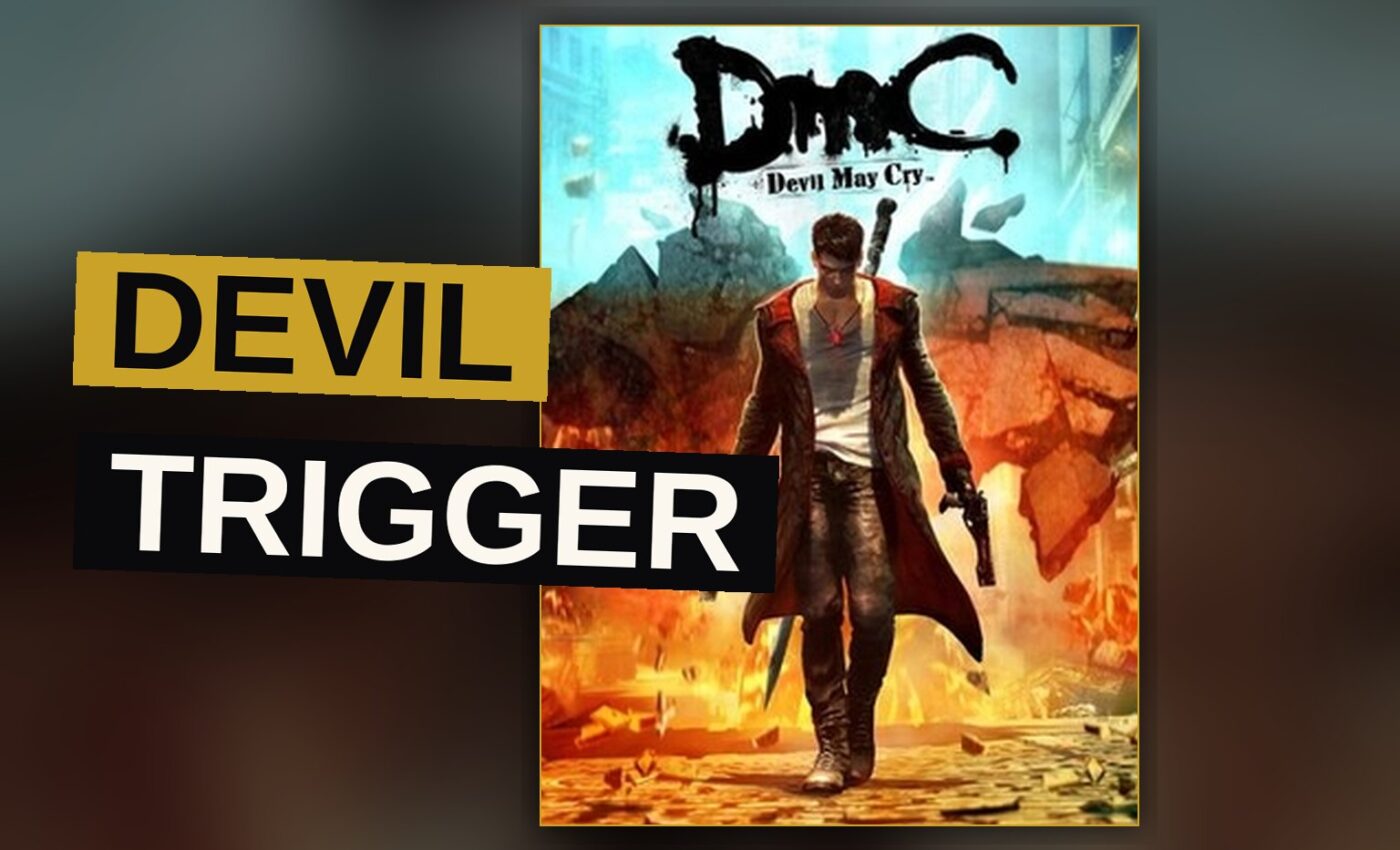
DmC: Devil May Cry does not look like the game that came before it, and that is the point. Capcom recruited Ninja Theory to reboot its hack-and-slash series, and the 2013 result keeps Dante, keeps his swords and pistols, and keeps the combat loop intact. The white hair is gone. In its place is Limbo City, a modern metropolis where demons run the show from behind the scenes. The gamble pays off.
Trailer, via VG247.com.
Limbo City and the demons who run it
The setting is the sharpest break from the earlier games. DmC: Devil May Cry takes place in a separate continuity, in a city secretly controlled by all-powerful demons. They keep humanity docile by handing out the comforts of life, and they do it from a parallel plane called Limbo. When Dante gets pulled into that plane, the streets of his world twist and rearrange around him.
That idea gives Ninja Theory room to build a world with a Western influence, and the game uses it. Limbo is not a backdrop. It is the place where the fighting happens, and it changes shape while you fight.
Dante himself is the other big change. He is a young demon hunter who lives on the fringes of society, aware that demons exist and spending his time fighting them in secret. The rest of his life, as the game tells it, he wastes on junk food and sex. This is not the cool, quiet Dante of the older titles. He is messier, and the game wants you to notice.
Kat, Vergil, and the Order
The story gets moving when a young woman named Kat warns Dante that he is in danger. A Hunter demon drags him into Limbo, and Dante grabs his weapons and kills it with Kat’s help. Her psychic powers let her see into Limbo, which makes her useful in a fight she cannot physically join.
Kat then brings Dante to meet her boss, Vergil. Vergil leads an organization called The Order, which wants to expose the demons and free the world from their control. He also drops the game’s biggest reveal: he and Dante are long-lost twin brothers, and both are Nephilim, the children of an angel and a demon.
That makes them the only beings capable of killing Mundus, the demon king. The backstory is worth laying out:
- Their father, Sparda, was Mundus’s chief lieutenant in the war against the angels.
- Sparda betrayed Mundus by fathering twins with the angel Eva.
- Mundus killed Eva and condemned Sparda to eternal torture.
- Mundus vowed to hunt down Dante, and never learned that Vergil existed.
Dante learns all of this by visiting his family’s decrepit mansion, and the visit settles him. He resolves to help Vergil bring Mundus down.
Rebellion, Ebony and Ivory, and the score that pushes back
The combat is still the reason to play. DmC: Devil May Cry is a third-person hack-and-slash game, and as Dante you use melee weapons and firearms to cut through enemies and cross a hostile city. His main sword is Rebellion. His dual pistols are Ebony and Ivory.
You string attacks into combos, launch enemies into the air with the sword, parry incoming hits, and dodge fast. Occasionally you can trigger Devil Trigger, which makes Dante faster and stronger, regenerates his health, and throws weaker enemies into the air.
Two new modifiers sit on top of that moveset, and they are the best addition the series has made in years. Angel Mode gives Dante a scythe with fast, long-ranged attacks that grow more powerful as they land. Devil Mode gives him a slower, heavier axe that does serious damage to a single target. More weapons unlock later, including a flaming gauntlet and a pair of throwing blades.
The game also drops the manual lock-on system that older Devil May Cry games used. The camera tracks enemies automatically instead. That is a real change in how the game feels, and it works in DmC’s favor. Fights stay fluid because you are never fighting the camera for a target.
The ranking system that fights back
Performance is scored and rated, and the ranks are not just decoration. You climb by fighting with style, varying your combos, and avoiding hits. Getting struck resets the score. Higher ratings give Dante more attack power, which means the game rewards you with the tools to keep the streak going.
The enemies adapt to how you are doing. Their artificial intelligence gets more aggressive when your score is high and backs off when it is low. Scores can be shared online through a leaderboard.
This is the part of DmC: Devil May Cry that separates it from a dozen other action games. The difficulty is not a setting you pick at the start. It is a conversation the game has with you while you play. Play well and the game comes at you harder.
A reboot that had a reason to exist
DmC was conceived as a reboot to increase the series’ commercial appeal after Devil May Cry 4 in 2008. Capcom recruited Ninja Theory after being impressed by the studio’s work on Heavenly Sword in 2007.
The team had more than ninety members, and nearly ten of them came from Capcom. Those Capcom staffers helped build the combat system and, just as importantly, gave Ninja Theory freedom to invent the world and the characters. Tameem Antoniades directed. Alex Garland served as narrative consultant. Hideaki Itsuno was the project’s overall supervisor.
Dante’s redesign was not the studio’s idea alone. Capcom asked for it, and the new look drew on Hollywood movies. The game’s tone was more mature than that of its predecessor. You can feel both decisions in the finished product, for better and worse.
What the reboot gets right, and what it gives up
The case for DmC: Devil May Cry is that it solves a problem the series had been carrying. By the fourth game, Devil May Cry was a known quantity, and Capcom wanted a wider audience for it. Ninja Theory brought a visual identity the series never had, and the Angel and Devil Mode split gives combat a layer that older entries did not.
The case against it is smaller but real. Dante’s new personality is a deliberate provocation, and the game leans on it. The junk food and the attitude are meant to read as a younger, rougher hero. Sometimes they read as a costume.
Neither complaint changes the outcome. The combat is fast, the ranking system keeps you honest, and Limbo City gives every fight a stage worth looking at. Vergil and Kat give Dante something to care about beyond the next combo, and the Nephilim reveal gives the whole story a spine.
Ranked by what actually decides whether you keep playing, the game’s strengths stack up this way:
- The Angel Mode and Devil Mode split, which gives every fight two distinct gears.
- The scoring system, which resets on a hit and hands out attack power for clean play.
- The adaptive enemy AI, which raises the pressure as your rank climbs.
- Limbo City itself, which turns traversal into part of the combat.
The strongest argument for this game is that it does not play safe. A reboot that keeps everything is just a sequel with a new coat of paint. DmC: Devil May Cry changes the hero, the city, and the tone, and it still plays like a Devil May Cry game when the swords come out. That balance is hard to hit, and Ninja Theory hit it.
The weakest argument against it is that it is not the game some fans wanted. That is true, and it is not a flaw. The series needed a version of itself that could reach people who had never picked up a Devil May Cry title, and this is that version.
Where DmC: Devil May Cry lands
DmC: Devil May Cry stands as the best kind of reboot: one that understands what made the original worth rebooting and is willing to throw out the rest. The Angel Mode and Devil Mode system gives the combat a second gear. The adaptive enemies and the score-reset rule make every fight a test rather than a chore. Limbo City gives the whole thing a look that no earlier entry had.
It is not perfect. The new Dante will not win over everyone, and the mature tone occasionally tries too hard. But those are the costs of a swing this big, and the swing connects.
For PlayStation 3, PC, and Xbox 360, this is a hack-and-slash game with a point of view, and it is the strongest entry the series has offered in years.
Get the Notebook.
The day's best stories and every fresh verdict, in plain English, in your inbox by seven. One email a day, no more.