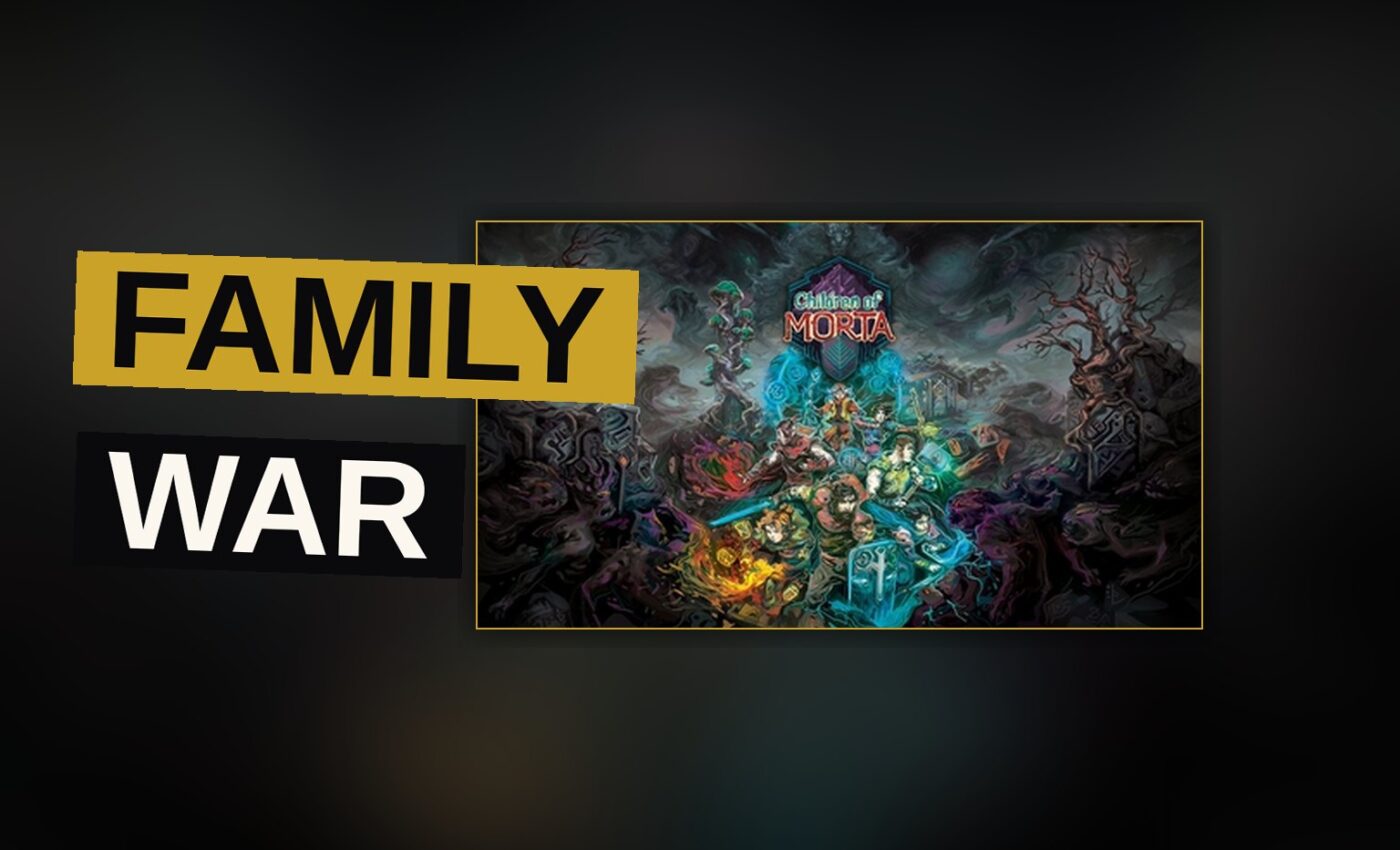
Children of Morta asks a simple question: what if the family that saves the world actually had to live together while doing it? Dead Mage’s action role-playing game with roguelike elements came out in September 2019, published by 11 bit studios, and it has spent the years since building a quiet reputation as one of the smarter takes on a crowded genre. It is available on PlayStation 4, Linux, Android, PC, iOS, Mac, Xbox One and Nintendo Switch. The published critical score sits at 8.3 out of 10 across 11 outlets, and that number holds up.
Trailer, via Nintendo of America.
The Bergson family and Mount Morta
Children of Morta follows the Bergson family, the custodians of Mount Morta. An evil called the Corruption is spreading, and the Bergsons are the ones standing against it. The story takes place in a distant land, but the game is not really about the land. It is about love and hope, longing and uncertainty, loss, and the sacrifice people are willing to make for the ones they care about most.
That is the pitch, and Children of Morta means it. The Bergson home is not a menu screen dressed up as a house. It is the place where the family eats, argues, remembers and waits. Individual runs of the dungeon are bookended with returns to that home, and those returns sometimes move the narrative forward or unlock additional dialogue. Some parts of the story take place after events in the game, which gives the whole thing a sense of time passing rather than a plot that pauses whenever you die.
The result is a roguelike that treats death as a family event. You go into the caverns. You come back. Someone has something to say about it.
Seven playable Bergsons, seven ways to fight
Players take on the role of members of the Bergson family, and more family members unlock as you progress, up to a total of seven playable characters. Each one has its own playstyle and its own gameplay mechanics. Each one levels up as it is played, and those levels grant improvements to the character and to other family members too.
That last part is the design decision that separates Children of Morta from most of its peers. A roguelike usually asks you to invest in a run. Children of Morta asks you to invest in a household. Time spent on one Bergson makes the others better, which means the game rewards you for spreading your attention instead of finding one build and grinding it into the floor.
The roster is not a costume rack. Seven characters with distinct mechanics is a real amount of work, and the differences matter because the dungeons are procedurally generated. You cannot memorize a layout. You can only learn your character and learn the family.
Caverns, bosses, and the Corruption
The player must traverse a number of procedurally generated dungeons within the caverns of Mount Morta to clear them of various enemies and bosses. The perspective is bird view, or isometric, and the action is hack and slash. You fight desperately, because that is the tone the game sets and the tone it keeps.
The Corruption is not a villain with a speech. It is a condition, a thing spreading through the mountain the Bergsons are sworn to protect, and the game’s fantasy themes stay grounded because the stakes are domestic. The mountain is the family’s job. The family is the mountain’s memory. When the caverns get worse, the house gets quieter.
Children of Morta is also built for company. It supports single player, multiplayer and co-operative play, which fits a game about a family better than it fits most things. Two players working through the caverns as two Bergsons is the most natural expression of what the game is arguing.
Here is how the two halves of Children of Morta compare, because the tension between them is the whole review:
| The Bergson home | The caverns of Mount Morta | |
|---|---|---|
| What happens there | Narrative progression, additional dialogue, family scenes | Combat against enemies and bosses |
| Structure | Fixed, returns between runs | Procedurally generated |
| Stakes | Love, hope, loss, sacrifice | Survival, clearing the Corruption |
| Who it serves | The story | The roguelike |
The table is not a gimmick. It is the argument. Children of Morta works because those two columns keep feeding each other, and it stumbles when one column starts to feel like a waiting room for the other.
Where the loop grinds
The honest criticism is that a procedurally generated dungeon is still a procedurally generated dungeon. Children of Morta dresses its runs in excellent art and a genuine narrative frame, but the moment-to-moment work of clearing a floor is familiar. If you have played this genre, you have cleared these rooms. The Corruption is a better idea than it is an opponent.
The game also asks a lot of its players before it shows them everything. Seven playable characters unlock over time, and the family improvements come from playing them. That is generous in the long run and slow in the short one. A player who wants to meet the whole Bergson family has to earn the introductions.
None of this breaks the game. It does mean Children of Morta is better remembered for its structure than for any single fight. The bosses are there. The enemies are various. The thing you describe to a friend afterward is the house.
Why the Bergson house is the whole game
The narrative-driven approach is the reason Children of Morta still gets recommended years after release. Roguelikes are thick on the ground. Games that treat a family as a mechanic rather than a cutscene are not. Dead Mage built a game where unlocking a sister is both a gameplay reward and a story beat, and where the improvements you earn are shared, because that is what a family does.
The themes are stated plainly in the game’s own framing: love and hope, longing and uncertainty, loss, and the sacrifice we are willing to make to save the ones we care about most. Those are large words. Children of Morta earns most of them by keeping the scale small. The mountain is enormous. The kitchen table is where the game actually happens.
It is also, notably, a game that respects its own premise across platforms. Whether you play on PlayStation 4, PC, Xbox One or Nintendo Switch, the Bergsons come with you. That sounds like a small thing. For a game about a family that bears the weight of the mountain together, portability is not nothing.
The 8.3 verdict
Children of Morta is an 8.3 out of 10, and the score is not a compromise between two halves that fail to meet. It is a recognition that the game’s best idea, the family as the unit of progression and the unit of feeling, is executed well enough to carry a familiar combat loop.
What matters here is the shared upgrade system and the returns to the house. What is noise is the genre furniture: the procedurally generated rooms, the bosses, the grind between unlocks. Those parts are competent. They are not the reason to play.
The next move belongs to Dead Mage, not to the genre. A studio that built a roguelike around a family now has to decide whether the family was the trick or the foundation. Children of Morta suggests it was the foundation. A sequel that keeps the shared upgrades and pushes the house further toward the center of the game would be a stranger, harder thing than this one, and a better one. Children of Morta: 8.3 of 10.
Get the Notebook.
The day's best stories and every fresh verdict, in plain English, in your inbox by seven. One email a day, no more.