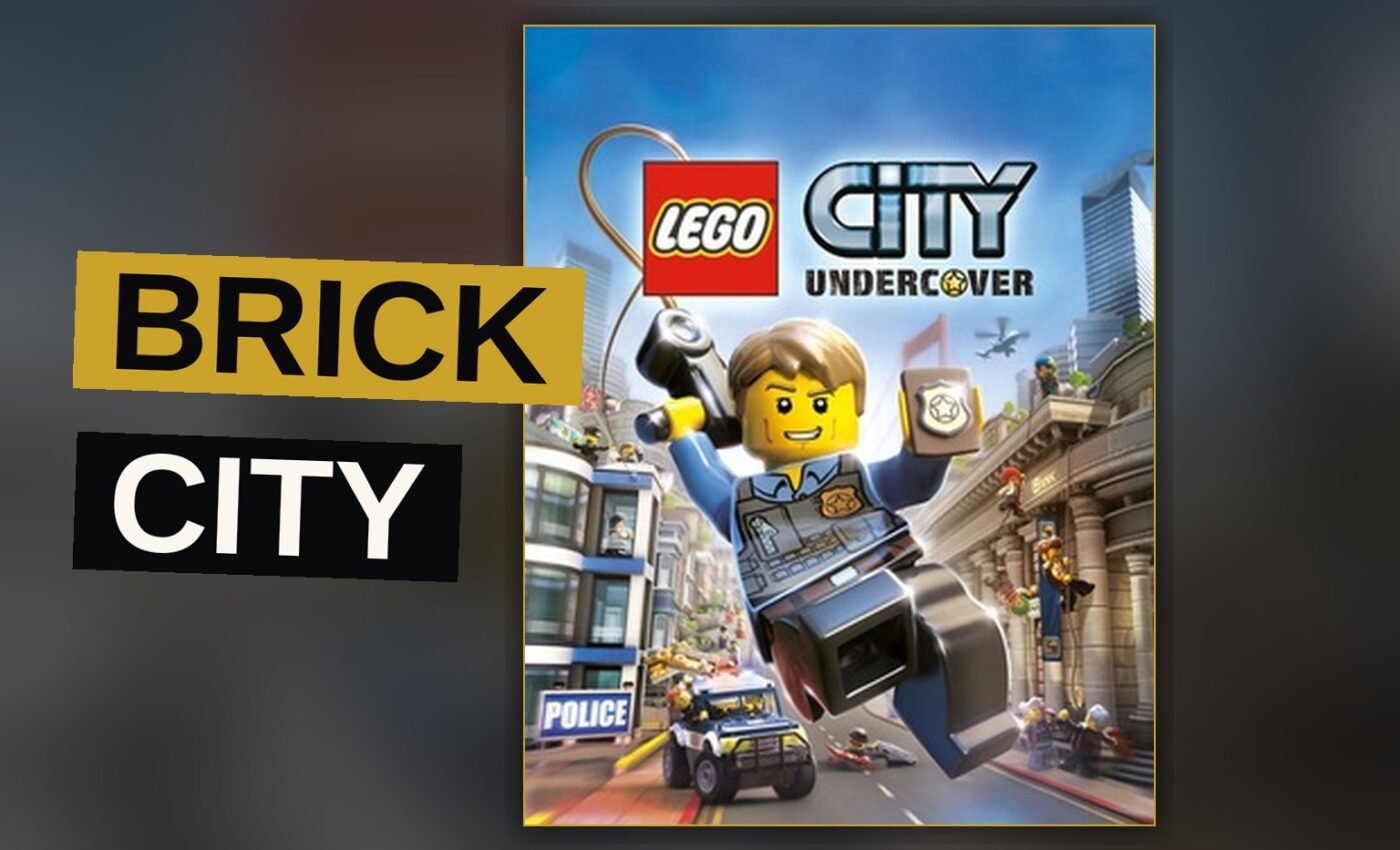
Lego City Undercover arrived on the Wii U in 2013 as something the Lego games had rarely been: an original story. No movie tie-in, no comic license, no blockbuster franchise to lean on. Just a cop, a crime boss and a city built from scratch.
TT Fusion developed it, Nintendo published it, and the game follows police officer Chase McCain as he returns to Lego City to pursue escaped crime boss Rex Fury. It was re-released in 2017 for the Nintendo Switch, PlayStation 4, Windows and Xbox One by Warner Bros. Interactive Entertainment.
Trailer, via GameSpot.
Chase McCain and the Rex Fury Problem
You play as McCain, an undercover cop tasked with detaining Rex Fury. The plot opens with McCain coming back to Lego City after being exiled two years prior. He learns from Mayor Gleeson that Rex recently escaped from prison, where he had been serving time after Chase helped put him away.
He is joined by dim-witted rookie Frank Honey and assisted by police technician Ellie Phillips. His ex-girlfriend Natalia Kowalski is less pleased to see him. Chase inadvertently revealed her as the witness in Rex’s trial, which forced her into witness protection. Chief of Police Marion Dunby sent Chase away because of that mistake.
That is a lot of backstory for a Lego game, and it gives the story actual weight. Chase is not just running around breaking bricks. He is a man with a record of failure trying to fix it.
Disguises, Super Bricks and a City of 20 Districts
The gameplay splits into two halves. There is the open-world hub of Lego City, and there are self-contained levels with linear objectives. Each level involves puzzles, building and breaking Lego bricks, and platforming challenges.
Chase learns abilities through “disguises” that replicate occupations. The miner disguise smashes boulders with a pickaxe and pulls dynamite from a machine. The criminal disguise breaks through doors with a crowbar and cracks safes. These abilities unlock previously inaccessible areas in the overworld.
The city is split into 20 districts, each with its own environment. Lego studs serve as currency. You find them in the environment or by solving puzzles, then spend them on new vehicles you can summon at will. A rarer currency, Super Bricks, often requires harder platforming or puzzle-solving. They complete “superbuilds” that vary in use.
Combat requires button combinations. You fight criminals hand-to-hand, wrestle them to the ground and slap on the cuffs. Chase can swing across poles, perform wall jumps and traverse the city on special blue and white bricks.
A City Built From New York, San Francisco and London
The setting is a collage. The team used elements from New York City, San Francisco and London. The game references Times Square, the Statue of Liberty, the Golden Gate Bridge and Alcatraz Federal Penitentiary. The space station on Apollo Island draws heavily from the John F. Kennedy Space Center in Florida.
Because it was a Nintendo console, the team packed in Nintendo-themed Easter eggs. The script, written by Graham Goring, leans hard on parody and references to other media.
The team had to build a new game engine from scratch. Previous engines could not handle the scale of the environments. The new one handled memory, object and vehicle physics, and traffic systems. Executive producer Loz Doyle called this the most difficult part of development, because they kept hitting the console’s memory limit.
That detail matters. The memory limit shaped what the team could build, and it is the clearest technical constraint behind the finished city.
The Parody Lands, the Pacing Does Not
The story moves through a chain of criminal organizations. After dealing with a number of minor cases, Chase gathers clues that lead him to Rex at Bluebell Mine. Rex defeats him there, and the arrest never happens.
Pressure from Mayor Gleeson forces Dunby to send Chase undercover at a limousine company owned by Chan Chuang, head of a crime gang.
Chase works as a driver for billionaire Forrest Blackwell and steals a car for Chan. He learns from Natalia that Chan works for a crime boss named Vinnie Pappalardo, who distrusts strangers. To gain Vinnie’s trust, Chase breaks Vinnie’s cousin Moe DeLuca out of prison using a stolen transport truck. Moe gets him into the gang by having him steal a truck full of color guns and deliver it to Vinnie’s ice cream parlor.
Then Chase steals the Bell Pepper Emerald and a Moon buggy for Chan. Chan later captures Natalia while she investigates her father’s disappearance. Chase rescues her, and she accepts his help finding her father.
That is a lot of plot for a game about plastic bricks. In this paper’s view, it mostly works because the game does not take itself seriously. The parody is the point. But the pacing sags in the middle, and the fetch-quest structure of the gang missions starts to feel like padding.
The best officers are also pros at free running, jumping, climbing, and traversing the city on special blue and white bricks.
What the Wii U Version Gets Right
The writing has more personality than most Lego games, in this paper’s view. Graham Goring’s script is funny, and the voice acting gives the characters actual presence. At the time production began, it was to be the first Lego video game featuring voice acting, though others were released ahead of it. Chase is a decent straight man. Frank Honey is a reliable idiot. Natalia is more than a damsel.
The collectibles are plentiful, and the game lets you summon vehicles anywhere. The Super Bricks are the best part. They often require more difficult platforming or puzzle-solving, and the superbuilds they unlock vary in use.
Where the Bricks Come Apart
The combat is shallow. Button combinations sound good on paper, but in practice you mash the same two buttons until the criminal falls over. It never becomes interesting, and the game keeps throwing enemies at you anyway.
The camera fights you in tight spaces. The open world is impressive for the hardware, but it is not seamless. The memory limit Doyle described is the clearest explanation for where the city holds back.
The story also loses track of its own stakes. Rex Fury is the villain you are chasing, but he disappears for long stretches while you run errands for gangsters. By the time you get back to him, the momentum is gone.
The Verdict on Lego City Undercover
Lego City Undercover is one of the more ambitious Lego games of its era. It built an original world and wrote an original script. The disguises are clever. The city is dense. The writing has teeth.
It is also uneven. The combat is a chore. The pacing drags. The technical limits of the Wii U are always present. But the good parts are good enough to carry it.
This is a game that understood something the licensed Lego games rarely managed: that a Lego city can be a place, not just a set. It has districts, landmarks, a mayor and a police chief with a grudge. It has a hero who screwed up and has to live with it.
The 2017 re-release on Nintendo Switch, PlayStation 4, Windows and Xbox One by Warner Bros. Interactive Entertainment brought the game to new platforms, but the Wii U original is where this game made its case. It is worth playing today, especially if you have a Wii U and want to remember why the console mattered.
It is not a perfect game. It is a game with a clear point of view and the nerve to build something original in a franchise that usually rents its stories. That counts for something.
Get the Notebook.
The day's best stories and every fresh verdict, in plain English, in your inbox by seven. One email a day, no more.