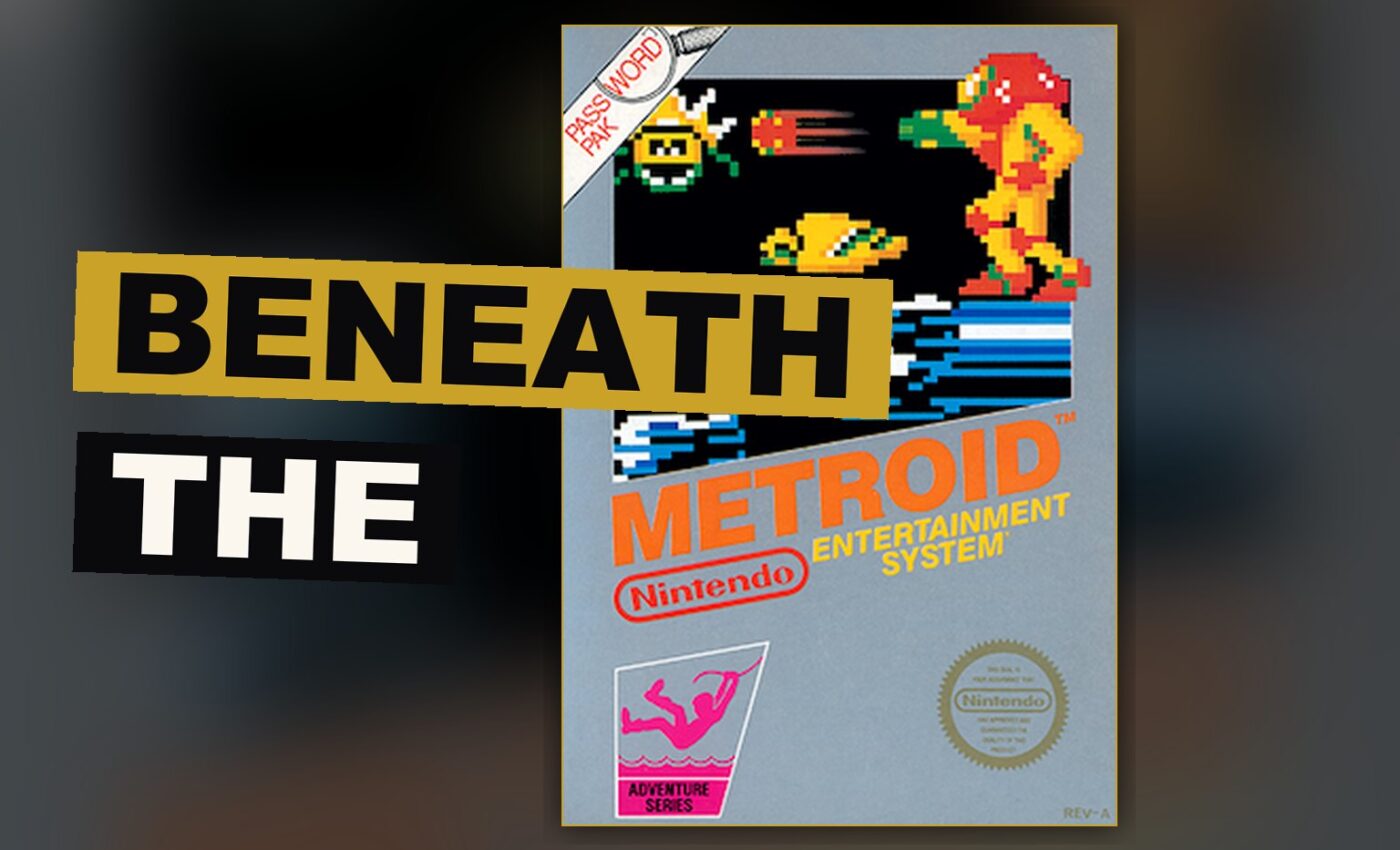
Metroid is a game about being alone on a hostile planet, and it never lets you forget it. Nintendo R&D1 built the 1986 action-adventure around Samus Aran, a lone bounty hunter sent to the planet Zebes after the Galactic Federation fails to take it by force. The setup is grim and the game knows it.
Zebes and the Space Pirates
The story starts in the year 20X5, when Space Pirates attack a Galactic Federation research vessel and steal samples of Metroid creatures. Those Metroids were discovered on the planet SR388, and they can latch onto any organism and drain its life energy until it dies. The Pirates plan to replicate them by exposing them to beta rays, then use them as biological weapons against anyone who opposes them.
The Federation finds the Pirates’ base on Zebes and assaults the planet. The Pirates hold, and the Federation pulls back. So the Federation sends one hunter instead of a fleet.
Samus lands her gunship on the surface and goes in alone. Her target is Mother Brain, the biomechanical life-form that runs the fortress and its defenses. That is the whole mission, and the game rarely interrupts it.
A Beam and a Jump
You start with almost nothing. Samus carries a weak power beam and can jump. That is the opening hand, and Metroid makes you earn every upgrade from there. The power-ups are the spine of the game:
- The Morph Ball, which curls Samus into a ball so she can roll into tunnels
- The Bomb, usable only in ball form, which opens hidden floor and wall paths
- The Screw Attack, a somersault that destroys enemies in its path
- The Ice Beam, the Wave Beam, the High Jump Boots and the Varia suit upgrade
- Missiles, energy tanks and storage tanks that raise Samus’s carrying capacity
Each one opens ground you could see but not reach before. That loop — look, fail, find, return — is the reason Metroid matters.
Kraid, Ridley, and the Statues
Two bosses stand between Samus and Mother Brain. Kraid is an ally of the Space Pirates. Ridley is their commander. Beat them both, and their statues become the lock: shoot the statues and the path to the final area opens.
Ordinary enemies drop energy or ammunition when destroyed, so the caverns double as a supply line. The doors and elevators stitch the planet together into one connected map rather than a run of separate stages. That structure is the game’s real invention, and it is still the template.
A Female Protagonist in 1986
Metroid was lauded as one of the first video games to showcase a female protagonist. Samus is not announced as one. The game simply lets you finish and shows you who was inside the suit.
That restraint is the smartest thing in Metroid. It never asks for credit. It also produced varied endings tied to how fast you completed the game, which made Metroid an early popular title for speedrunning — players racing the clock to see a different result.
Graphics, Sound, and Control
Reviewers at the time praised the graphics, the soundtrack, and the tight controls. Hirokazu Tanaka scored it, and the music does more work than the sprite art. Zebes is mostly dark corridors and repeating tile, and the sound is what gives those corridors a mood.
The controls hold up better than the visuals. Samus moves with weight, and the jump has a commitment to it that makes the Screw Attack feel earned rather than handed over. Gunpei Yokoi produced, with Satoru Okada and Masao Yamamoto directing and Intelligent Systems co-developing.
The 1986 Release and What Followed
Metroid arrived in Japan for the Family Computer Disk System in August 1986. North America got it on the Nintendo Entertainment System in August 1987, and Europe followed in January 1988. It was the first installment in the Metroid series.
The reception was strong on both counts — critical and commercial. Nintendo Power ranked it 11th among the best games for a Nintendo console. Game Informer put it 7th on its Top 100 Games list, and Electronic Gaming Monthly ranked it 69th.
Where Metroid Stands
The case for Metroid is not nostalgia. It is that the game solved a problem most of its contemporaries did not: how to make a world feel like a place instead of a level select. Zebes is open-ended, and the power-ups are keys you find rather than keys you are given. Nothing about that design has gone stale.
The case against it is honest too. The beam starts weak and stays weak for a long stretch. The map is easy to get lost in, and the game offers little help. Backtracking is the point, but it is still backtracking. Some of the caverns repeat themselves, and the difficulty curve leans on patience as much as skill.
What tips it is the ending. Samus is a bounty hunter the Federation sends because a fleet could not do the job, and the game treats her as exactly that — capable, unremarked, alone. The reveal lands because Metroid never sold it. That is a confident piece of design from 1986, and it is why the game still gets cited as the start of the Metroidvania genre.
Eight point one out of 10.
Get the Notebook.
The day's best stories and every fresh verdict, in plain English, in your inbox by seven. One email a day, no more.