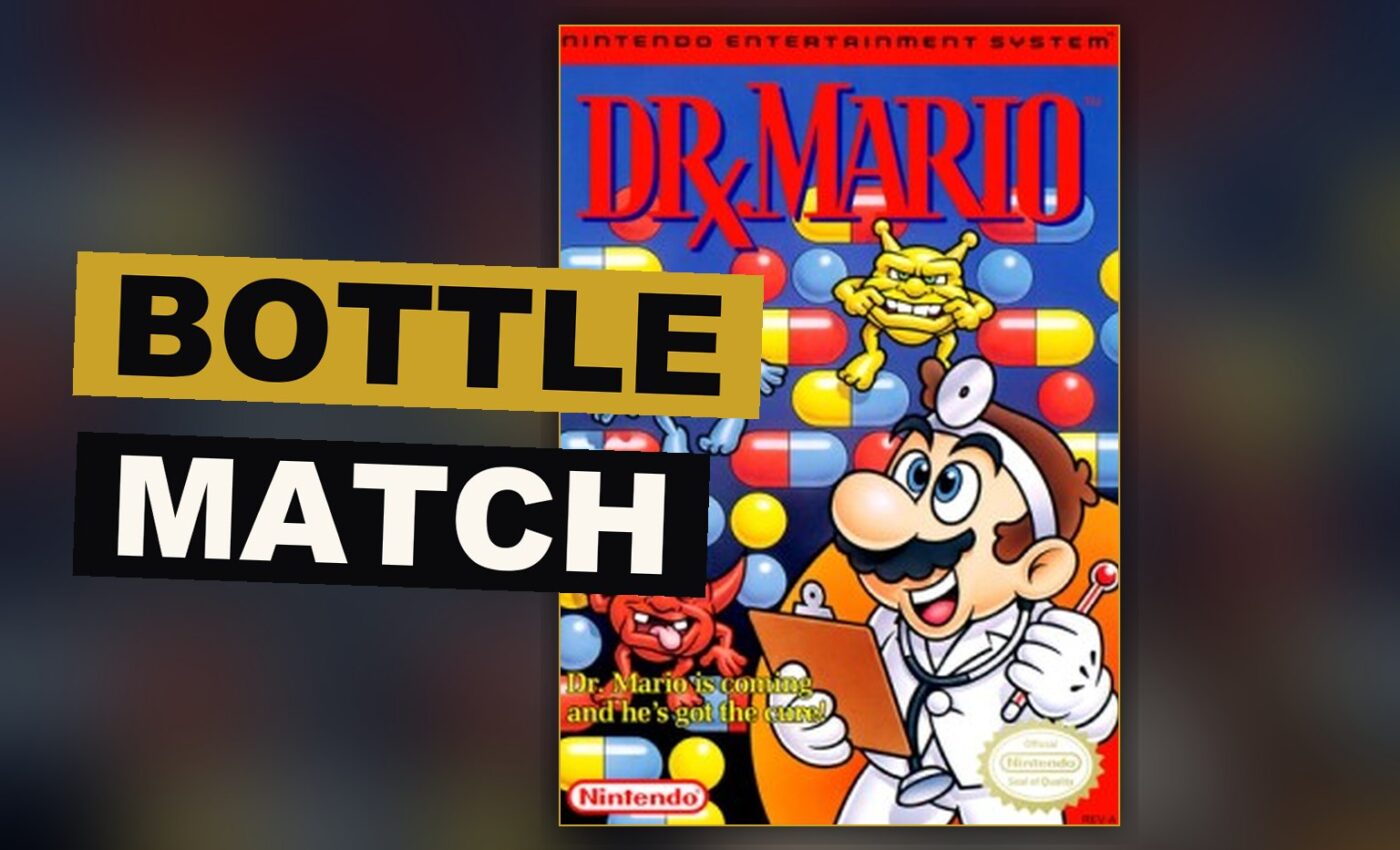
Dr. Mario lands on the NES with a simple idea: clear the bottles, kill the viruses, keep your hands busy. The puzzle game removes plumbing and platforms and asks players to match colors instead. It works, mostly, and it keeps working long after the cartridge should have worn out its welcome.
The Design
Pieces drop into a bottle two at a time. Each half carries a color — red, yellow or blue — and players turn and push the pieces to line them up with matching viruses. Four of a color in a row, and they disappear. Clear every virus in the bottle and the level ends.
The rules are easy to state and hard to master.
That space between simple and hard is where the game earns its keep.
Dr. Mario offers three paces — low, medium and high — and a virus count that rises as players choose higher levels. The early stages feel forgiving. The later ones do not. A single bad drop near the top of the bottle can end a run that took several minutes to build.
Playing with another player changes the game’s character entirely. Clearing lines sends other pieces into the other player’s bottle, and the pace turns quick fast. It is the best part of the package, and it holds up better than the mode played alone.
What Holds It Back
The mode played alone runs out of ideas once the design is clear. Higher levels do not add new rules; they add more viruses and less room for error. That is a fair test of reaction time, but it is not much of a surprise after the first hour.
The presentation is plain. Music repeats without change for as long as a level lasts, which can be a while at the higher paces. None of this breaks the game. None of it raises it either.
Session Lengths
A rough sense of how a sitting with Dr. Mario tends to break down:
| Part | Approximate Time | Focus |
|---|---|---|
| Early rounds | 5–10 minutes | Low pace, low virus count |
| Middle runs | 10–20 minutes | Medium pace, design building |
| Higher attempts | 20+ minutes | High pace, staying power |
| Match with another player | 5–15 minutes | Piece exchanges with another player |
None of these numbers come from an official source. They are simply how a usual session tends to feel, run to run.
The Verdict
Dr. Mario is a tight, sound puzzle game that does one thing and does it without much fuss. It will not surprise anyone who has spent time with a puzzle game where pieces drop before, but the design at its core is sound, the mode with another player has real force, and the rise in difficulty is fair even when it is hard.
It is not a game that grows. It is a game that repeats what already works, plainly, on a cartridge built for the NES.
Dr. Mario earns a score of 6.6 of 10.