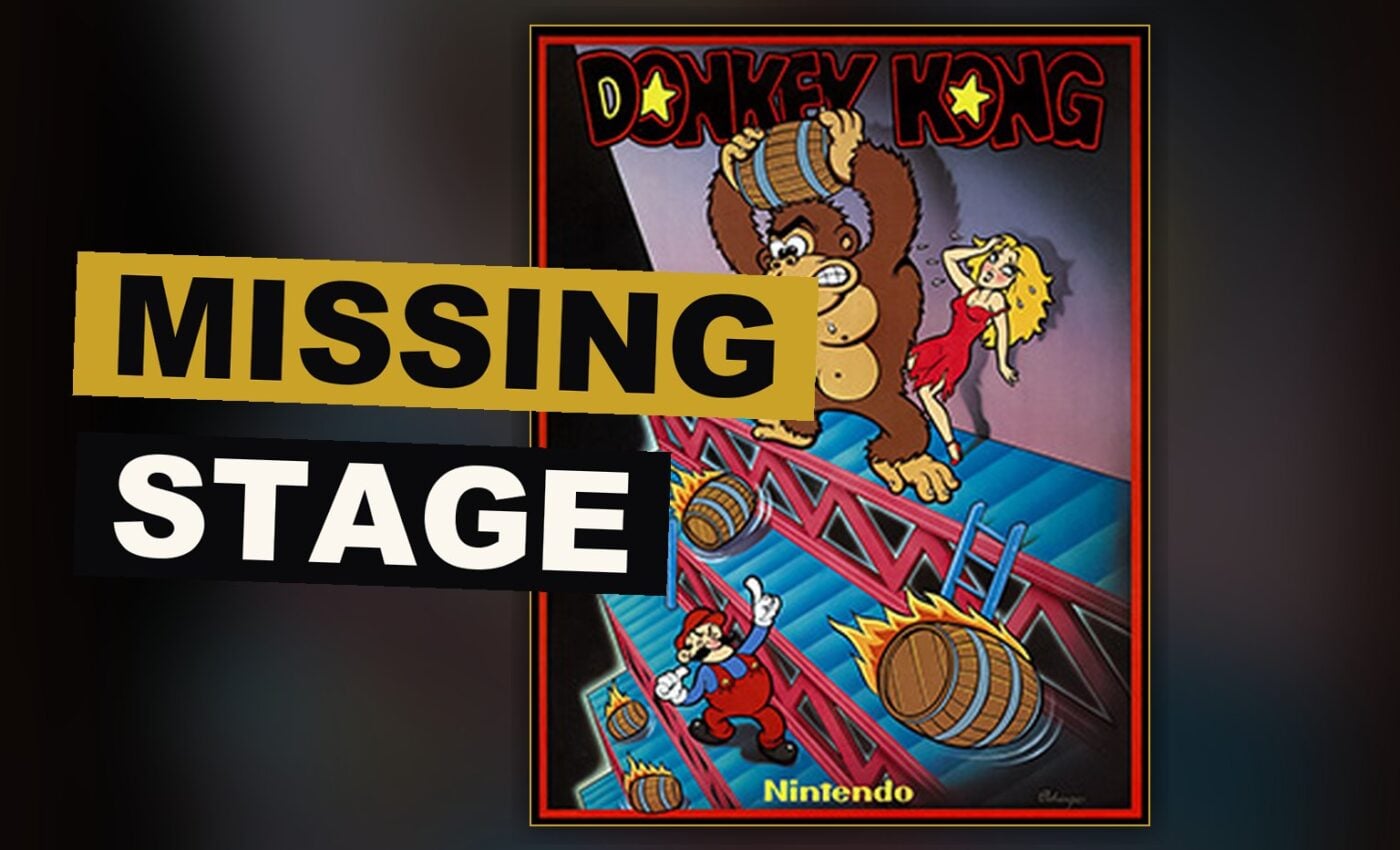
Donkey Kong arrives on the NES as a launch title, and it plays like a careful copy of an arcade classic: faithful in feel, small in scope, and already behind what the arcade cabinet once offered.
Three Stages, Not Four
Donkey Kong on NES carries over three stages from the arcade original: the first stage, where objects roll down at Mario from above; the elevator and spring stage, which asks for patience and steady hands on the way up; and the final stage, where Mario removes the last supports that hold the platform together and Donkey Kong falls. Mario runs, moves up ladders, and passes obstacles to reach the top. The controls answer fast and feel precise, and that matters, because one wrong step ends a life at once.
The trouble is the arcade version had four stages, not three. The cement stage, built around moving platforms that carry hazards toward Mario, is left out here entirely. Its absence is felt. The game instead repeats its three stages with rising difficulty. Anyone who has played the arcade original will notice the omission at once.
That cut hurts more the longer a player stays with the game. The first stage, full of rolling hazards, is well made and demanding. The elevator and spring stage tests timing and patience. The final stage still delivers the finale, with Mario removing the last supports and Donkey Kong falling, just as in the arcade cabinet. But without the cement stage, the whole package feels like a smaller version of something bigger, not the full arcade experience many players already knew. It appears complete at first, yet anyone familiar with the source material will sense what has been left behind.
Look and Sound
Graphics are plain but readable for the time, and the sound effects are familiar and clear. Nothing here is broken. It is simply thin. The music that plays between stages is short and repeats often, which some players may find wearing after a long session. None of this is made without care; it is only limited by what the console and the design were willing to include.
Judged against its arcade source, Donkey Kong on NES is a fair but incomplete copy. Judged on its own, it is short, and its three stages repeat within an hour or two of play. It works best in small doses, as a game built for repeated attempts rather than one long adventure. Players who care most about a high number on the screen may return to it often; players looking for a long adventure will find little to hold them here. There is enough here to enjoy for an evening, but not enough to hold attention for much longer than that.
Comparing the Two Versions
| Feature | Arcade Donkey Kong | NES Donkey Kong |
|---|---|---|
| Number of stages | 4 | 3 |
| Cement stage included | Yes | No |
| Final stage included | Yes | Yes |
| Controls | Precise | Precise |
| Graphics | Full arcade detail | Reduced for the console |
The difference is not close. Whatever the NES version does well, it does with less material than the arcade cabinet once held. A player who has spent time with the arcade original will notice the missing cement stage right away, and no amount of polish elsewhere fully makes up for it.
This is still a game worth returning to, for short periods at a time.
Hard Numbers
- Platform: NES
- Stages included: 3 (falling objects, elevator/spring, final stage)
- Stage left out from the arcade original: the cement stage
- Score: 6.5 of 10
Donkey Kong on NES is a solid but incomplete transfer of a well-known arcade game. The action feels right, the finale is present, and the challenge still holds up today. But leaving out the cement stage keeps this version short of what players found in arcades, and that is why the score stays where it does.