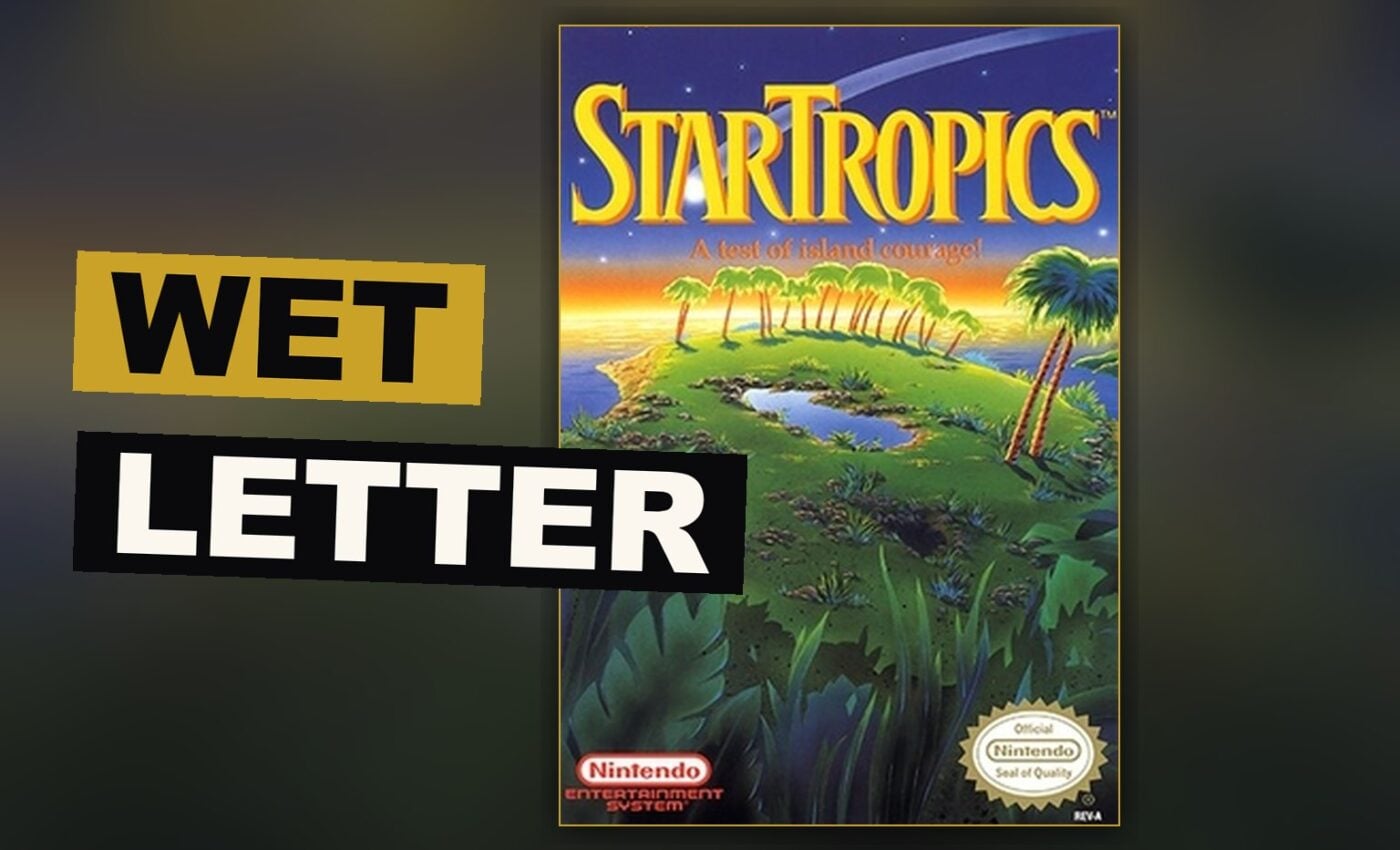
Nintendo shipped StarTropics in 1990 for the Nintendo Entertainment System and never gave Japan a copy. The game reached North America and Europe only, a rare omission for a first-party NES title, and it arrived under a title that promises sun and delivers something stranger: a teenage pitcher from Seattle hunting his kidnapped uncle across the South Seas.
That premise is the whole hook, and it still works. Mike Jones is 15, captain of his high school baseball team, and the star of the show.
Mike Jones Swings a Yo-Yo
StarTropics is an action-adventure game with role-playing bones, played from a 2D top-down view like the RPGs of its era. The structure is chapter-based. Each chapter drops Mike into a settlement or an area of interest, where he talks to non-player characters for information, then usually gets handed a local calamity to sort out. Dungeons switch to a closer camera and fill up with obstacles and enemies. You navigate them or destroy them. Progress depends on it.
Mike’s default weapon is a yo-yo. The Virtual Console release renamed it “star,” which is a small act of vandalism against one of the game’s better jokes. As you move through the chapters, more weapons and tools unlock, and a run of them are drawn from American baseball. That detail matters more than it sounds. A Seattle kid who throws for his high school team, fighting aliens with equipment that echoes his own sport, is a coherent piece of design rather than a gimmick bolted on.
The plot runs on the disappearance of Dr. Steven Jones, Mike’s uncle and an archaeologist working from a laboratory on C-Island in the South Seas. Mike lands in the tropical village of Coralcola and finds his uncle gone. The chief of Coralcola hands him the yo-yo so he can defend himself. Jones’s robot, Nav-Com, lets him take the submarine.
A Bottle, a Parrot, a Whale
On a nearby island, Mike finds a bottle holding a message from Jones. Aliens have abducted him. That is the turn the game hangs on, and it arrives early, before the map has fully opened.
From there Mike crosses the isles of the South Seas fighting monsters and meeting characters, among them a parrot and a mother dolphin searching for her son. A whale swallows Mike and the submarine. Inside its belly he runs into Jones’s assistant, who confirms the alien abduction and admits that fear kept him from giving Mike all the help he could have when they met earlier. The confession is the best beat in the script. It gives a minor character an actual failing and pays it off.
The assistant hands over a special code. Nav-Com tracks Jones’s location. Mike follows the signal to ruins holding the wreckage of an alien escape pod, then finds his uncle, who explains he discovered the pod some time ago. It came from the planet Argonia. Inside were three magic cubes, now held by the aliens’ leader, Zoda. Mike infiltrates the spaceship, recovers the three cubes, confronts Zoda, defeats him, and escapes as the ship self-destructs.
Back on C-Island, the cubes are placed together and a group of children appear. Their leader, Mica, says they are the last Argonians. Argonia was destroyed. Her father, King Hirocon, sent them to Earth to live.
The Letter That Needed Water
Here is the thing people actually remember about StarTropics, and it has nothing to do with yo-yos.
The original NES release shipped with a physical letter in the box. The letter sets up the story, and the game uses it as a plot device. At one point, StarTropics instructs the player to dip the letter in water to reveal a hidden code. The code is 747, and you cannot finish the game without it.
That is a bold piece of design. It drags the cardboard in your hands into the fiction and makes a physical object load-bearing. It also created a real problem for anyone who lost the letter, threw it out, or bought the cartridge secondhand. Nintendo fielded questions from fans and published the code in Nintendo Power.
Later re-releases handled it differently. The Wii Virtual Console version put the letter in the electronic manual and played an animation of it being dipped in water before the code appeared. The Nintendo Switch release, added to the Nintendo Classics library for Nintendo Switch Online, simply posted the code on Nintendo’s official customer support website.
The mystery survives. The ritual does not.
Release Timeline
| Date | Release |
|---|---|
| 1990 | Original NES release, North America and Europe |
| January 7, 2008 | Wii Virtual Console, North America |
| January 11, 2008 | Wii Virtual Console, PAL regions |
| September 3, 2015 | Wii U Virtual Console, Europe |
| September 4, 2015 | Wii U Virtual Console, Australia |
| May 26, 2016 | Wii U Virtual Console, North America |
| November 11, 2016 | NES Classic Edition |
| March 13, 2019 | Nintendo Classics library, Nintendo Switch Online |
Genyo Takeda produced, wrote and directed StarTropics. He came out of Nintendo Integrated Research & Development, the same group behind the Punch-Out!! series, and you can feel a little of that lineage in the timing demands and the readable enemy patterns. A sequel followed in 1994: Zoda’s Revenge: StarTropics II.
The game has never been treated as a major Nintendo property, and the Japan-only omission tells you where it sat in the company’s own estimation. It is not a Mario game. It is not a Zelda game, though the top-down exploration and the dungeon switching invite the comparison, and the comparison does it no favors.
Where StarTropics Actually Stands
Strip out the letter and StarTropics is a solid, slightly odd adventure that does several things well and one thing brilliantly.
The chapter structure keeps the pace up. Settlements give you information, dungeons test you, and the game rarely lets either section overstay. The top-down view is legible, the closer dungeon camera makes the combat feel more immediate, and the baseball-derived arsenal gives the whole thing a personality that a generic sword-and-shield setup would not have had. Mike is a specific kid from a specific city with a specific skill, and the game remembers that.
The plot is thinner than its best ideas. Aliens abducted the uncle, aliens have the cubes, defeat the alien leader. Zoda is a destination, not a character. The Argonian reveal lands as exposition rather than as a gut punch, and Mica’s arrival in the final minutes introduces a whole civilization’s worth of tragedy with almost no room to feel it. The whale sequence is the one stretch where the game slows down and lets a scene breathe, and the assistant’s confession gives it weight.
The letter is the part that will outlive everything else. It is the rare mechanic that could only exist in 1990, on a cartridge, in a box, with a piece of paper inside. Every re-release since has had to solve it, and every solution has been a workaround: an animation, a manual page, a support article. The code 747 is now a piece of trivia instead of a secret you had to ruin a letter to find. That is a real loss, and it is not Nintendo’s fault. It is just what happens when a game outlives its own packaging.
What holds up is the swing. A 15-year-old pitcher from Seattle, a yo-yo, a submarine, a robot named Nav-Com, and a whale that eats both of you. StarTropics is uneven and it never became a franchise, but it is more inventive than most of what surrounded it on the NES, and the letter stunt is the kind of thing almost no publisher would attempt now.
Get the Notebook.
The day's best stories and every fresh verdict, in plain English, in your inbox by seven. One email a day, no more.