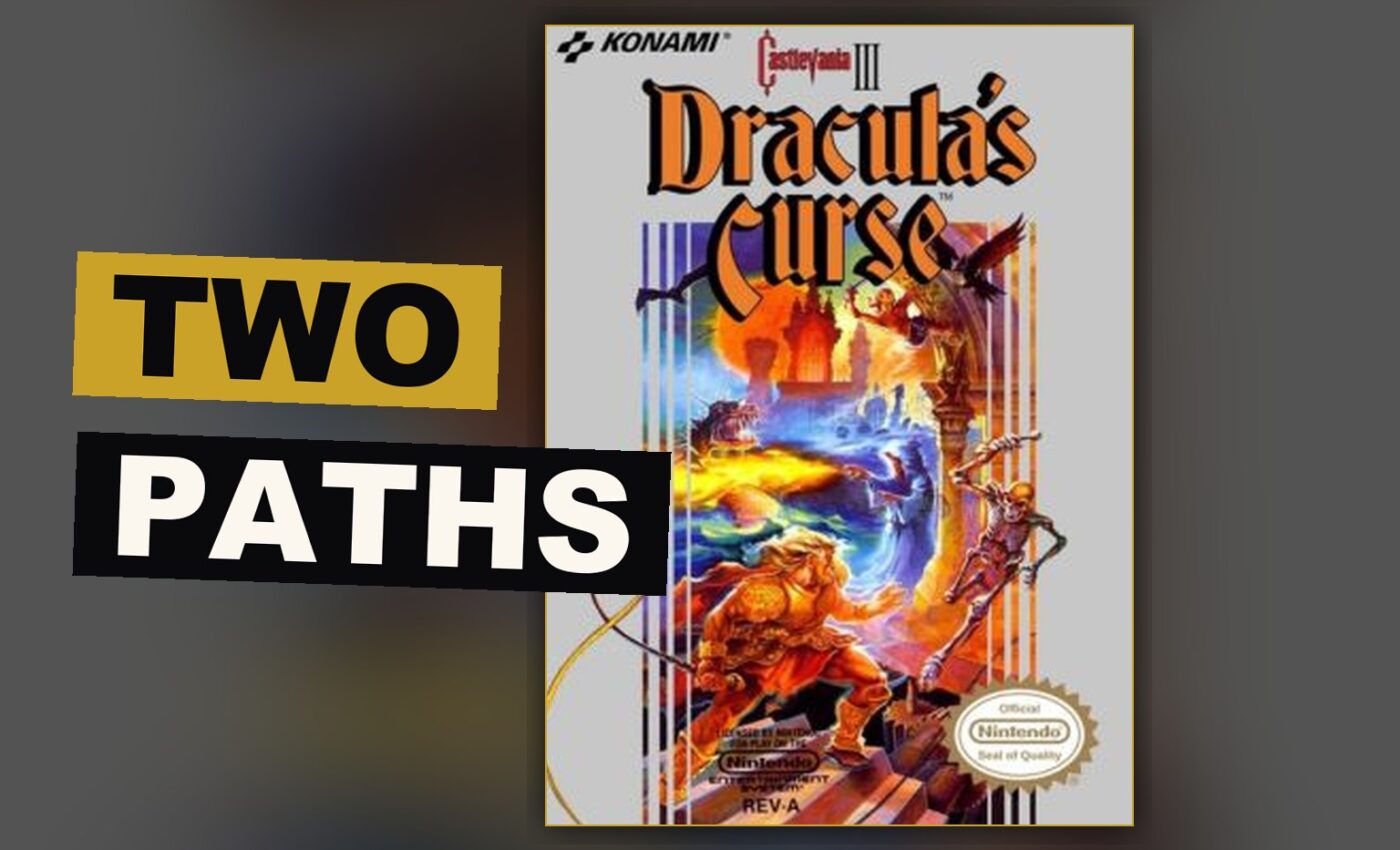
Castlevania III: Dracula’s Curse is the rare sequel that admits the previous one went too far. Konami’s 1989 platform game drops the role-playing and action-adventure detours of Castlevania II: Simon’s Quest and returns to the straight action-platforming of the 1986 original — then builds a second game on top of it with branching paths and three companions.
It is the third numbered Castlevania and also a prequel, set a few centuries before the first game. The hero is Trevor Belmont, ancestor of Simon Belmont. Dracula is ravaging Europe in 1476, the exiled Belmont family of vampire hunters is called back into action, and Trevor has to reach the castle and kill him.
The game drew positive reviews, and multiple critics called it a great return to roots for the series. Score: 7.8 of 10.
Trevor Belmont and the Three Companions
Castlevania III hands Trevor a choice the series had never offered before. After the first level, and at several points afterward, the player picks between two branching paths. The second stage is an optional excursion where Trevor can pick up one of three partner characters, and the main branch arrives partway through the third stage.
Each companion changes how the game plays, not just how it looks.
Sypha Belnades is a young sorceress. Her physical attack power is poor, and she makes up for it with powerful elemental magic spells. Grant Danasty is a pirate who can climb on walls and change direction in mid-jump, which turns vertical sections into a different kind of test. Alucard is Dracula’s son, a dhampir who shoots fireballs and transforms into a bat.
Trevor can only travel with one companion at a time. Take on another and the current one is gone.
That single rule does more work than any other mechanic in the game. It forces a commitment before the player knows what the next stretch demands, and it means a route choice is never only about geography.
Two Routes Through Sixteen Stages
The structure is where Castlevania III separates itself from the original. The game is non-linear. There are two main routes through the game’s sixteen stages, which are referred to as blocks and are broken down into several sections. Each route contains nine stages, or ten if the player takes the optional second stage.
The upper route takes Trevor across the lake to the main bridge, entering Dracula’s castle through the front gate. The lower route runs through tunnels and caverns and ends with a climb up the cliff face below the castle. The lower route has one short branch of its own at stage 6. Both paths meet in the main hall.
Here is how the two routes compare.
| Element | Upper route | Lower route |
|---|---|---|
| Approach | Across the lake to the main bridge | Tunnels and caverns, then a cliff climb |
| Castle entry | Front gate | Cliff face below the castle |
| Own branch | None | One short branch at stage 6 |
| Stages | Nine (ten with the optional second stage) | Nine (ten with the optional second stage) |
| Meets | Main hall of the castle | Main hall of the castle |
The table undersells it. The routes ask different things of the player, and the companion in tow decides whether a given stretch is manageable or miserable.
A Prequel That Earns Its Place
Calling Castlevania III a prequel is not a marketing label. The game is set a few centuries before the events of the original Castlevania, and its protagonist is an ancestor of that game’s hero. The series had already jumped forward in time once; this entry goes backward and fills in the family line.
The companions carry the same weight. Alucard is Dracula’s son, which puts a family argument inside the castle siege. Grant Danasty is a pirate with wall-climbing and mid-jump redirection. Sypha Belnades is a sorceress whose magic is strong and whose body is weak.
The endings change depending on which companion Trevor has with him when the game ends, or whether he takes no companion at all. That is a small thing on paper and a large thing in practice: it makes the roster a decision the player lives with rather than a menu they sample.
The Soundtrack Is the Best Thing Here
Multiple critics called Castlevania III a great return to roots for the series, and many of them singled out the soundtrack. That praise is deserved and it is not a consolation prize for the rest of the design.
The music is the most consistent element in the game. It holds up through the branching structure, which is more than can be said for every mechanic Konami added here. The soundtrack is also the part of Dracula’s Curse that outlived the cartridge, which tells you something about where the craft actually went.
The game has been re-released on the Virtual Console for the Wii, Nintendo 3DS and Wii U. It was later included in the Castlevania Anniversary Collection for Nintendo Switch, PlayStation 4, Windows and Xbox One. The game was later adapted into the first two seasons of the animated 2017 Castlevania television series.
So the audience for this review is not only people who still own the original hardware. The Anniversary Collection is the practical way to play it now, and the animated series is the reason a lot of people arrive at it in the first place.
Where the Branching Hurts
The branching paths are the headline feature and they are also the source of the game’s worst problem. A player who picks wrong does not get a harder version of the same level. They get a different level, with a different companion, and a long stretch before the next junction.
That is exciting once. It is tedious on a replay where the goal is a specific ending.
The companion rule compounds it. Trevor can only take one partner, and swapping means abandoning the current one. By the time a player understands what a given companion can do, the route that suits them may already be behind them.
None of this is a bug. It is the design, and it is the reason the game has defenders who will argue about routes for hours. But it is also the reason Castlevania III is harder to recommend casually than the original.
How to Rank the Three Companions
If the branching is the game’s identity, the companions are its difficulty settings. Ranked by how much they change a run:
- Alucard — Dracula’s son, a dhampir who shoots fireballs and transforms into a bat. The most mobile and the most useful in the stretches where the castle stops pretending to be fair.
- Grant Danasty — the pirate who climbs walls and redirects mid-jump. He turns vertical sections into something closer to a playground, and he is the pick for players who want to move rather than fight.
- Sypha Belnades — the sorceress. Powerful elemental magic, poor physical attack power. She is the highest-variance choice: devastating when the magic lines up with the room, punishing when it does not.
The order is not a tier list of power. It is a ranking of how much each companion changes what the game feels like, which is the only ranking that matters in a game built on route choice.
What Dracula’s Curse Gets Right
The return to action-platforming was the correct call. Castlevania II tried something and the result was a game people remember for its ideas rather than its execution. Castlevania III takes the original’s foundation and adds structure instead of systems.
The sixteen stages, the two routes, the optional second stage, the three companions, the multiple endings — this is a lot of game for a 1989 cartridge, and most of it works. The two paths converging in the main hall is a satisfying piece of design, and on this paper’s read it makes both routes feel like real roads to the same destination rather than one true path and one detour.
The game is also, for its era, generous. It trusts the player to make a choice and live with it.
The Verdict on Castlevania III
Castlevania III: Dracula’s Curse is this paper’s pick for the best of the three numbered Castlevania games. It corrects the previous entry’s drift, it keeps the original’s discipline, and it adds branching paths and companions that give the whole thing a second and third life. That is a judgement, not a consensus — the source material does not rank the three games.
It loses points for the opacity of those choices. The route structure asks the player to commit to a path and a partner with no preview of either, and the cost of a mismatch is a long stretch of the wrong game. That is a real cost, and it is why this is a great game rather than a flawless one.
The soundtrack carries it. The re-releases and the animated series have kept it in front of people who never owned the cartridge, and the Anniversary Collection is likely the version most players will meet. What they will find is a game that understood something the series would spend years relearning: a castle is more interesting when there is more than one way in.
Get the Notebook.
The day's best stories and every fresh verdict, in plain English, in your inbox by seven. One email a day, no more.