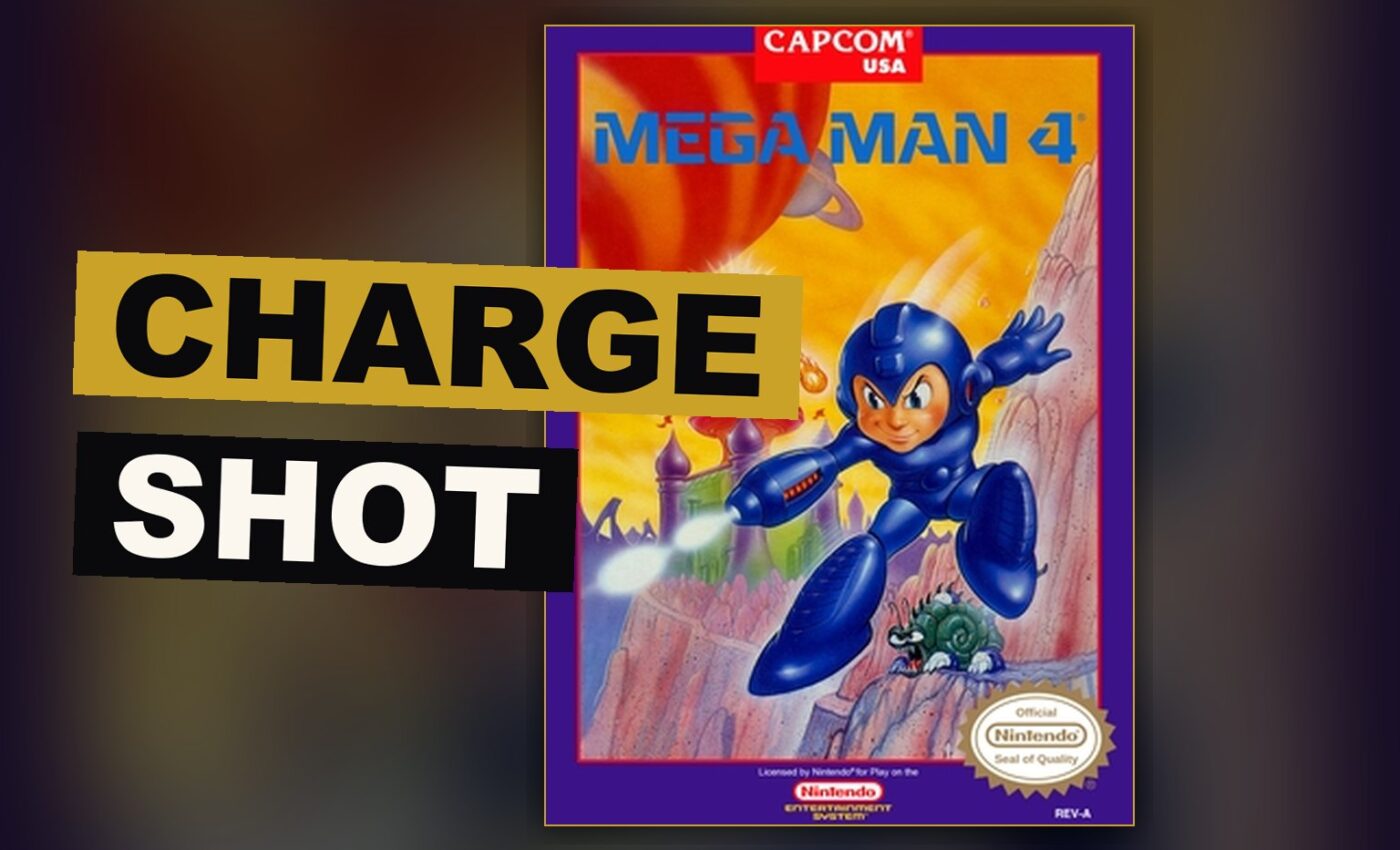
Mega Man 4 arrived on the Nintendo Entertainment System in December 1991 in Japan, the fourth run for Capcom’s blue robot and the one that handed him a charge shot. It is a competent, familiar game. It earns a 4.5 out of 10.
Dr. Cossack Takes Eight Cities
The premise is a swap. The story takes place after the third defeat and supposed death of Dr. Wily in Mega Man 3, and a Russian scientist named Dr. Cossack steps in with eight Robot Masters and a plan for world domination. Dr. Light sends Mega Man after them. The eight bosses have seized control of eight cities: Toad Man, Bright Man, Pharaoh Man, Ring Man, Dust Man, Skull Man, Dive Man, and Drill Man.
That is the whole hook. A new villain, same structure, same eight-stage loop.
The midgame turn is the one piece of storytelling that lands. Mega Man fights his way to Cossack’s icy fortress, and in the middle of the battle Proto Man teleports in with Cossack’s daughter, Kalinka. She begs Mega Man to stop. Dr. Wily kidnapped her, she explains, and forced her father to build the robot army and antagonize Mega Man as ransom.
Wily then steps out of the shadows, furious at the betrayal, and Mega Man chases him through Wily Castle. Wily escapes anyway. Mega Man rides home on top of a passing train, greeted by Roll and Rush.
The New Mega Buster
The headline addition is the New Mega Buster, an upgraded arm cannon that lets the player hold the firing button to charge a regular shot into a much more powerful blast. The source notes the development team was mindful that this innovation would change the overall feel of the game. That feature was later used in subsequent incarnations of the franchise.
Everything else is inherited. Mega Man runs, jumps, shoots, climbs, and keeps the slide that debuted in Mega Man 3. Stages can be completed in any order. Defeating a Robot Master grants its signature weapon for later stages. After all eight fall, two sets of linear stages close the game out.
Rush, Eddie, and the Hidden Adaptors
Rush returns from Mega Man 3 with three transformations: Coil, Jet, and Marine, each built for a different environment. Two more support items, the Wire Adaptor and the Balloon Adaptor, help reach areas that are otherwise inaccessible. Neither is awarded for beating a boss. Both must be found inside stages.
Flip Top Eddie is the new face. Eddie appears at designated points in some levels and hands over a random item: health, ammunition, or an E-Tank. The player cannot plan around him. He went on to appear in later Mega Man games.
| Feature | Mega Man 3 | Mega Man 4 |
|---|---|---|
| Slide | Debuts | Retained |
| Charge shot | Absent | New Mega Buster |
| Rush modes | Coil, Jet, Marine | Coil, Jet, Marine |
| Support robot | None | Eddie, random item drops |
| Hidden adaptors | None | Wire Adaptor, Balloon Adaptor |
| Stage structure | Eight stages, any order | Eight stages, any order |
Mega Man 4 adds a charge shot, a random-item robot, and two hidden tools. It removes nothing.
The Boss Roster
The eight Robot Masters are Toad Man, Bright Man, Pharaoh Man, Ring Man, Dust Man, Skull Man, Dive Man, and Drill Man. Each sits at the end of a stage and yields its signature weapon once beaten. The set is a roster of themes. The source does not rank them, and neither will this paper beyond noting that the names carry the whole character load.
The Wily Castle stages at the end are two separate sets of linear stages, the same closing structure the series had used before. The fortress self-destructs and Mega Man escapes.
Kalinka and the Hostage Reveal
The Kalinka turn is the one narrative move in Mega Man 4 that changes the shape of the story. A villain’s daughter stops the fight and explains that her father was never acting on his own. Dr. Wily kidnapped her, forcing Cossack to build the robot army and antagonize Mega Man as ransom.
The reveal reframes the middle of the game. It does not change the stages the player already cleared, and it does not change the fights. It arrives between Mega Man and Cossack, and then Wily steps out of the shadows.
The story takes place in an unspecified year in the 21st century, described as “20XX,” one year after Mega Man 3. Mega Man 4 was remade for PlayStation in Japan, and later appeared on mobile phones and in compilations including Mega Man Anniversary Collection. Emulated versions came to PlayStation Network and Virtual Console.
The Score
Mega Man 4 is a 4.5 out of 10. The source lists that figure as the published Metacritic user score for Mega Man Legacy Collection. It is the only score the source gives, and it is the one this review carries.
The game runs, controls, and delivers eight stages, two fortress runs, and a final boss. The charge shot is the biggest change to the formula, and it is the change the series kept.
That is the verdict. The New Mega Buster is the reason to play this one over its predecessors, and the reason the later games feel the way they do. Eddie is a random-item robot who hands the player something they did not ask for. The Kalinka reveal is the one story beat that does any work. Capcom shipped a fourth game with a new arm cannon, a new support robot, and a new villain who turned out to be the old one. The 4.5 is the number the source gives, and it is the number this review stands behind.
Get the Notebook.
The day's best stories and every fresh verdict, in plain English, in your inbox by seven. One email a day, no more.