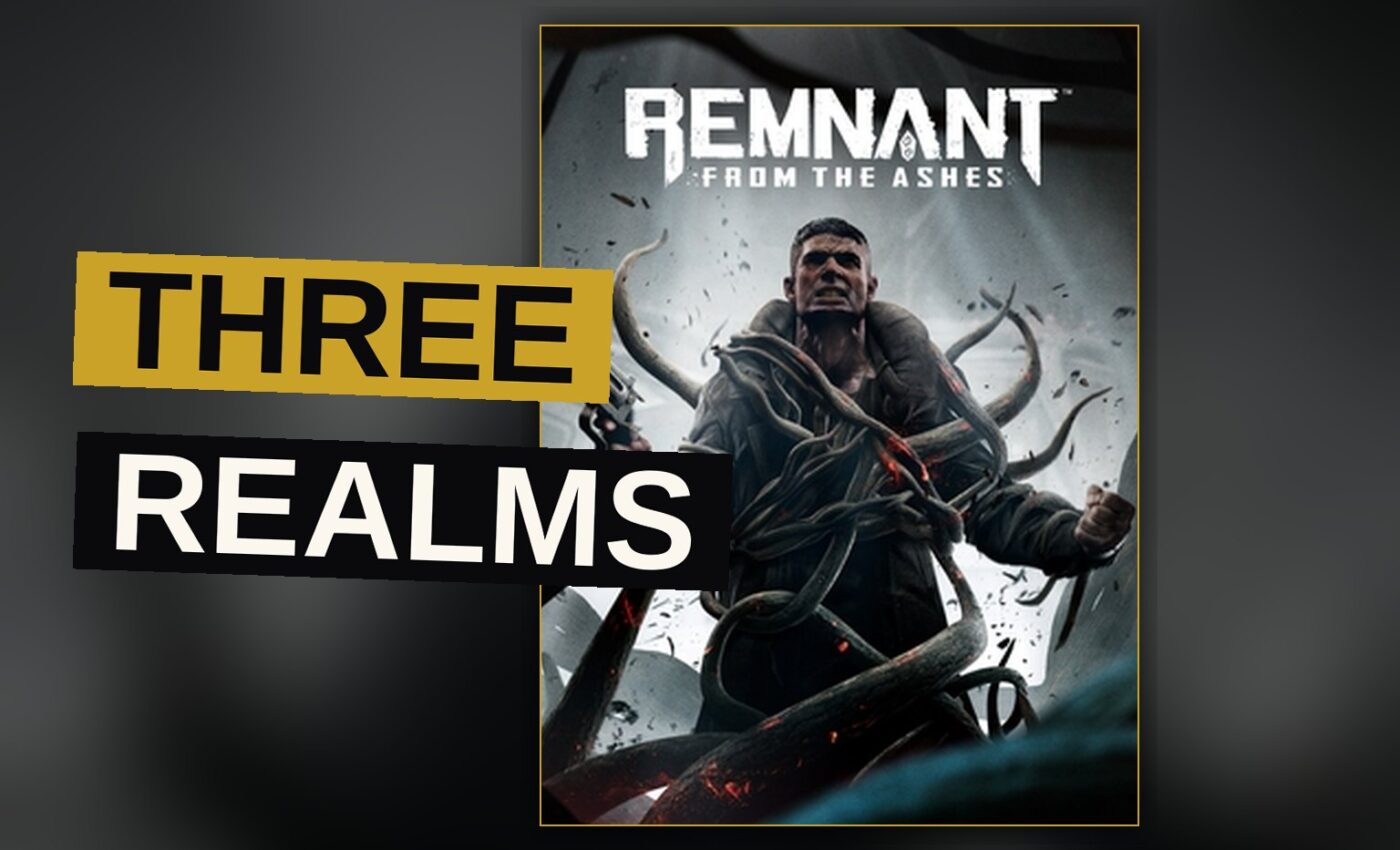
Remnant: From the Ashes asks players to hold three worlds together at once, and mostly succeeds. It is a looter-slasher that borrows from Dark Souls, Destiny and The Witcher 3, and it wants to be all of those things at once. That ambition shows in nearly every part of the game, for better and for worse.
Trailer, via PC Gamer.
The World of Three Realms
Remnant: From the Ashes splits its world into three realms, each tied to a different element: fire, water and earth. Players move between them through portals, solving puzzles and fighting bosses across a sprawling map. The design is clever, letting the game pack three distinct settings into one adventure without repeating itself.
The realms themselves are detailed and varied. Fire realms are hot and dry, water realms are wet and green, and earth realms sit somewhere in between. Each realm hides secrets behind locked doors, hidden chests and side quests that reward exploration. The variety keeps the world from feeling like a single repeated space.
Combat That Rewards Patience
Combat in Remnant: From the Ashes is fast and heavy, built around timing attacks and dodging. Enemies hit hard, and players need to manage health, stamina and resources to survive. The difficulty curve rises quickly, especially in later areas, forcing players to learn enemy patterns and build effective loadouts.
The dodge system is the star here. Players can dodge in any direction, and chaining dodges with attacks creates a rhythm that feels satisfying when mastered. Boss fights demand patience, asking players to wait for openings before striking. This approach mirrors the best games in the genre, even if Remnant: From the Ashes sometimes asks for more patience than it delivers.
Loot and Build Variety
Loot drives the loop in Remnant: From the Ashes, and the game offers a wide range of weapons, armor and abilities. Players can build characters around strength, agility or intelligence, mixing melee attacks with ranged spells and traps. The loot system rewards grinding, though some players may find the repetition tiresome.
Crafting plays a big role too. Players can upgrade gear at workbenches scattered throughout the world, combining materials found in chests and dropped by enemies. This system gives players a sense of progression beyond leveling up, though it can feel slow at times. The sheer amount of loot available keeps players engaged, even when the grind grows frustrating.
Story and Character
The story follows a small group of survivors trying to stop a godlike entity from consuming the world. It is a familiar setup, but the writing leans heavily on dialogue and lore entries rather than cinematic set pieces. Characters have moments of depth, but the plot often feels thin compared to other games in the genre.
The lore is dense, with text files and audio logs scattered throughout the world. These entries flesh out the history of the realms and the entities that threaten them, giving the setting a lived-in feel. The story’s pacing suffers from this density, as players spend long stretches reading about past events rather than seeing them unfold on screen.
Technical Issues and Performance
Technical issues mar an otherwise polished package. Load times can be long, and frame rate dips occur during boss fights and large enemy encounters. On PC, performance scales well, but console versions struggle with lag during busy scenes. These problems do not ruin the experience, but they undercut the smoothness the game otherwise achieves.
The game also suffers from a few visual glitches, including disappearing objects and flickering textures. These are minor compared to the bigger issues, but they add to the sense that Remnant: From the Ashes is still finding its footing. The game’s ambition is clear, but execution is uneven.
A Worthwhile, Flawed Adventure
Remnant: From the Ashes is a game that tries to do a lot. It succeeds at building a memorable world, crafting a combat system worth mastering and offering a deep loot loop. It falls short in storytelling and technical polish, leaving players with a game that is good but not great.
The game’s strengths are easy to see. The realm design is inventive, the combat is engaging, and the loot system offers endless variety. Its weaknesses are harder to ignore, especially for players who want a tighter narrative and smoother performance. The game’s flaws keep it from greatness, but they do not cancel out the pleasures it delivers.
Remnant: From the Ashes is a game worth playing for anyone who enjoys the genre, but it is not a must-play for everyone. It rewards patience and curiosity, and it offers a unique setting worth exploring. The flaws are real, but they are outweighed by the strengths.
Remnant: From the Ashes is currently available on Series X|S, PS4, PC and PS5, with performance varying across platforms. Players should expect a solid experience on PC and mixed results on consoles, depending on hardware. The game’s difficulty curve is steep, so players new to the genre may want to start with easier settings.
For fans of the genre, Remnant: From the Ashes is a worthwhile addition to their library. For players looking for a perfect game, it falls short. The game is a solid, flawed adventure that rewards dedication.
| Platform | Performance |
|---|---|
| Series X | S |
| PS4 | Mixed |
| PC | Solid |
| PS5 | Solid |
The score reflects a game that is ambitious, enjoyable and flawed. Remnant: From the Ashes is a worthy entry in the genre, with strengths that justify its existence and weaknesses that keep it from greatness.