
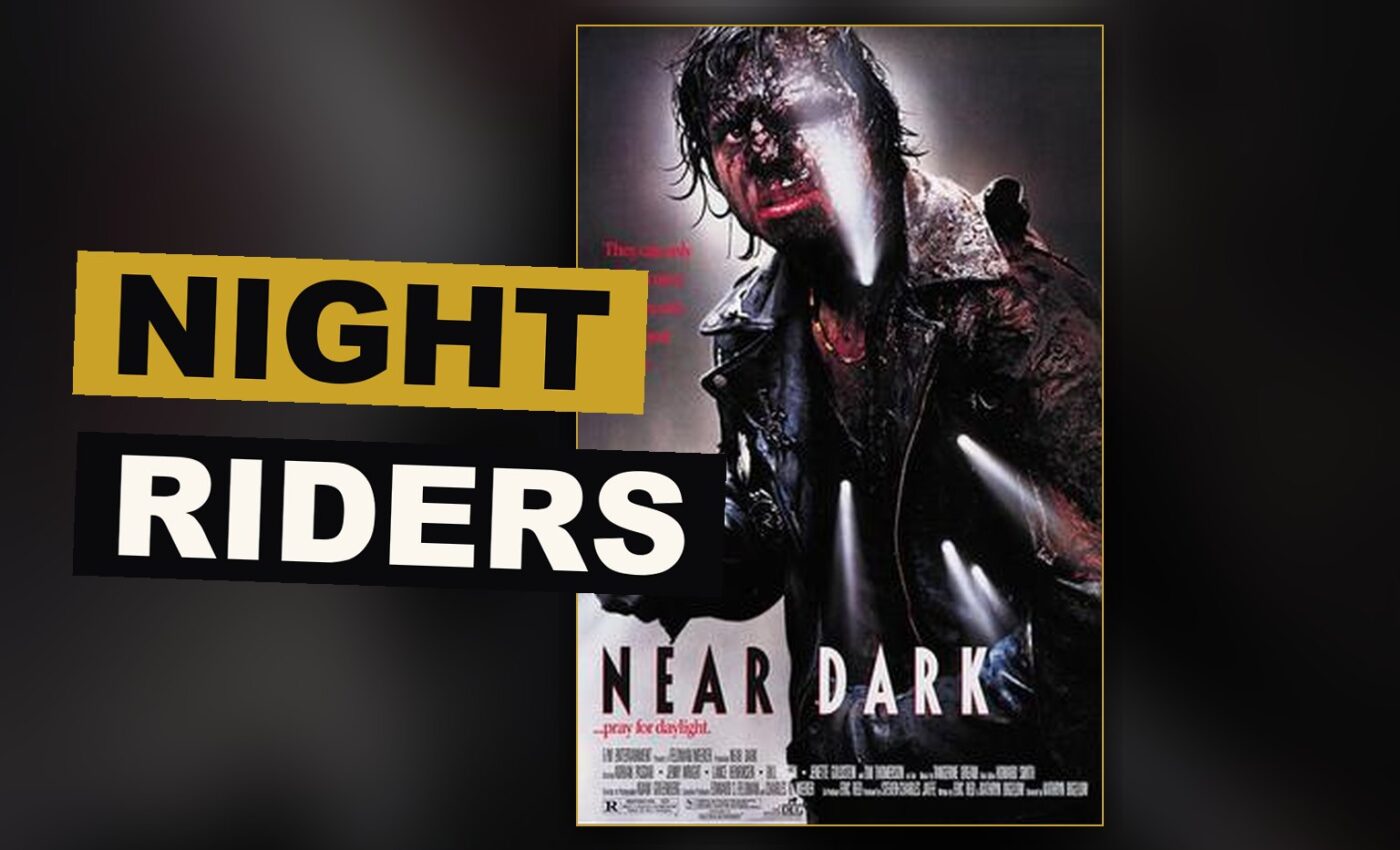
Kathryn Bigelow’s solo directorial debut opens on a boy in a small Oklahoma town and ends with a door left open and the sun pouring in. Near Dark runs 94 minutes, and in that time it turns a farm boy named Caleb Colton into something that smokes and burns when daylight touches him. The film is a horror picture with a Western’s bones — stolen cars instead of horses, an RV instead of a covered wagon, a band of killers working the highway instead of the plains.
It is also, by the numbers, a box office failure. That did not stop it from gathering a cult following in the years since. Both things are true, and the distance between them is the story of Near Dark.
Caleb Colton Meets Mae
The plot starts simple. Caleb meets a drifter named Mae. She is attractive, she is young, and she bites him on the neck just before sunrise. Then she runs off. The sun comes up, Caleb’s flesh begins to smoke and burn, and whatever he was before is over.
Mae comes back with a group of roaming vampires in an RV and takes him away. That is the whole turn. No ceremony, no explanation, no choice. Caleb is pulled into a family he did not ask for, and the film never lets him — or us — get comfortable with it.
Adrian Pasdar plays Caleb. Jenny Wright plays Mae. The bite is the hinge the entire movie swings on, and it happens in the first act without warning. Near Dark does not build to its monster. It hands you the monster and then asks what happens next.
Severen Wants Him Dead
The most psychotic of the vampires is Severen, played by Bill Paxton. Severen wants to kill Caleb outright. Mae stops him by revealing that she has already turned Caleb, which makes killing him pointless in the group’s logic.
Their leader is Jesse Hooker, played by Lance Henriksen. Jesse is charismatic, and he reluctantly agrees to let Caleb stay with them for a week. The terms are clear: learn to hunt, earn the group’s trust, or the arrangement ends.
Jenette Goldstein plays Diamondback. Joshua John Miller plays Homer, a child vampire in the group. The RV is a rolling household, and Caleb is the new member nobody voted for.
Caleb will not kill to feed. That refusal alienates him from the others, and it is the film’s central friction. He is a vampire who will not do the one thing vampires do.
A Bar, a Fire, and a Week to Prove Himself
Mae kills for him to keep him alive, then has him drink from her wrist. It is protection and it is also a kind of leash.
Jesse’s group enters a bar and kills the occupants. They set the bar on fire and flee. The scene is the film at its most blunt — the family working together, the violence collective, the exit fast.
Caleb endangers them by letting the only living occupant escape. All of them except Mae want him dead after that. The week Jesse granted him nearly ends on the spot.
Then a daylight police raid hits their motel room. Caleb endangers himself to help the others escape, and the group’s gratitude buys him time. Jesse and the others are temporarily mollified. A camaraderie commences.
That is the shape of the film. Caleb fails the group, then saves the group, then sits inside it a little longer. Near Dark is less interested in whether he survives than in what he becomes while he waits.
Jesse Hooker Fought for the South
The best scene in the film is a conversation. Caleb asks Jesse how old he is. Jesse answers that he “fought for the South” during the American Civil War. That makes him about 150 years old.
Severen had earlier suggested that he and Jesse started the Great Chicago Fire of 1871. The film does not confirm it. It does not need to. The line does the work of a century of backstory in a single boast.
This is where Near Dark separates itself from most vampire pictures. The mythology is not explained. It is accumulated, in jokes and asides, by people who were there. Jesse is not a monster with a tragic past. He is a man with a long resume and no interest in justifying it.
The Western tag is not decoration. These are outlaws on the move, and the South line places Jesse inside American history rather than outside it. He fought for the losing side and he is still here.
Homer, Sarah, and the Father at the Door
Caleb’s father, Loy Colton, played by Tim Thomerson, has been searching for Jesse’s group. That search drives the last act.
Homer meets Caleb’s sister, Sarah, played by Marcie Leeds. Homer wants to turn her into his companion. Caleb objects. The group argues about it.
While they argue, Caleb’s father arrives and holds them at gunpoint. He demands that Sarah be released. Jesse taunts him into shooting. Jesse regurgitates the bullet, then wrestles the gun away.
In the confusion, Sarah opens a door, letting in the sun. That is where the source material stops, and it is the right place to stop. The film ends on the one thing these vampires cannot survive and the one thing a child can do without thinking.
| Character | Actor | Role in the group |
|---|---|---|
| Caleb Colton | Adrian Pasdar | Turned by Mae, refuses to kill |
| Mae | Jenny Wright | Turns Caleb, kills to protect him |
| Jesse Hooker | Lance Henriksen | Leader, roughly 150 years old |
| Severen | Bill Paxton | Most psychotic, wants Caleb dead |
| Diamondback | Jenette Goldstein | Member of the RV family |
| Homer | Joshua John Miller | Child vampire, wants Sarah |
| Loy Colton | Tim Thomerson | Caleb’s father, searching for the group |
The table is also the film’s structure. Every name is a pressure on Caleb, and every one of them is introduced before the film needs them.
What Near Dark Gets Right
The mechanics are lean. Ninety-four minutes, one bite, one week, one fire, one raid, one door. Bigelow and co-writer Eric Red do not waste a scene on lore. The tagline — “…pray for daylight” — is the whole thesis, and the film earns it because daylight is the only thing that reliably wins.
The performances carry the load. Henriksen gives Jesse a calm that reads as age rather than menace, which is harder. Paxton plays Severen as pure appetite, and the film is better for letting him be funny about it. Pasdar has the hardest job, because Caleb spends most of the runtime refusing to participate, and the film keeps him sympathetic anyway.
The weaknesses are real. The middle stretch leans on the group’s cruelty without much variation, and Caleb’s week is a countdown the film does not always feel like a countdown. The bar scene is effective but it is also the moment the movie stops being about a boy and starts being about a gang.
The cult following makes sense. Near Dark does not look like the vampire films around it, and it does not behave like them either. It is a Western with fangs, and the RV is a better image than any castle.
The box office result makes sense too. This is a film with no heroes to root for, and the reviews were generally positive even then. The audience took longer.
What matters most is the daylight rule. Near Dark builds its entire climax on a mechanic it established in the first ten minutes, and it does not cheat it. Sarah opens a door. That is the payoff. A lesser film would have found a way to let Caleb win. This one just lets the sun in and cuts.
Near Dark is not Bigelow’s best film. It is the one that treats the mythology like a road map instead of a religion, and that is worth more than its box office suggests. The RV, the bar, the bullet, the door — four images, one rule, no wasted motion.
Get the Notebook.
The day's best stories and every fresh verdict, in plain English, in your inbox by seven. One email a day, no more.


