
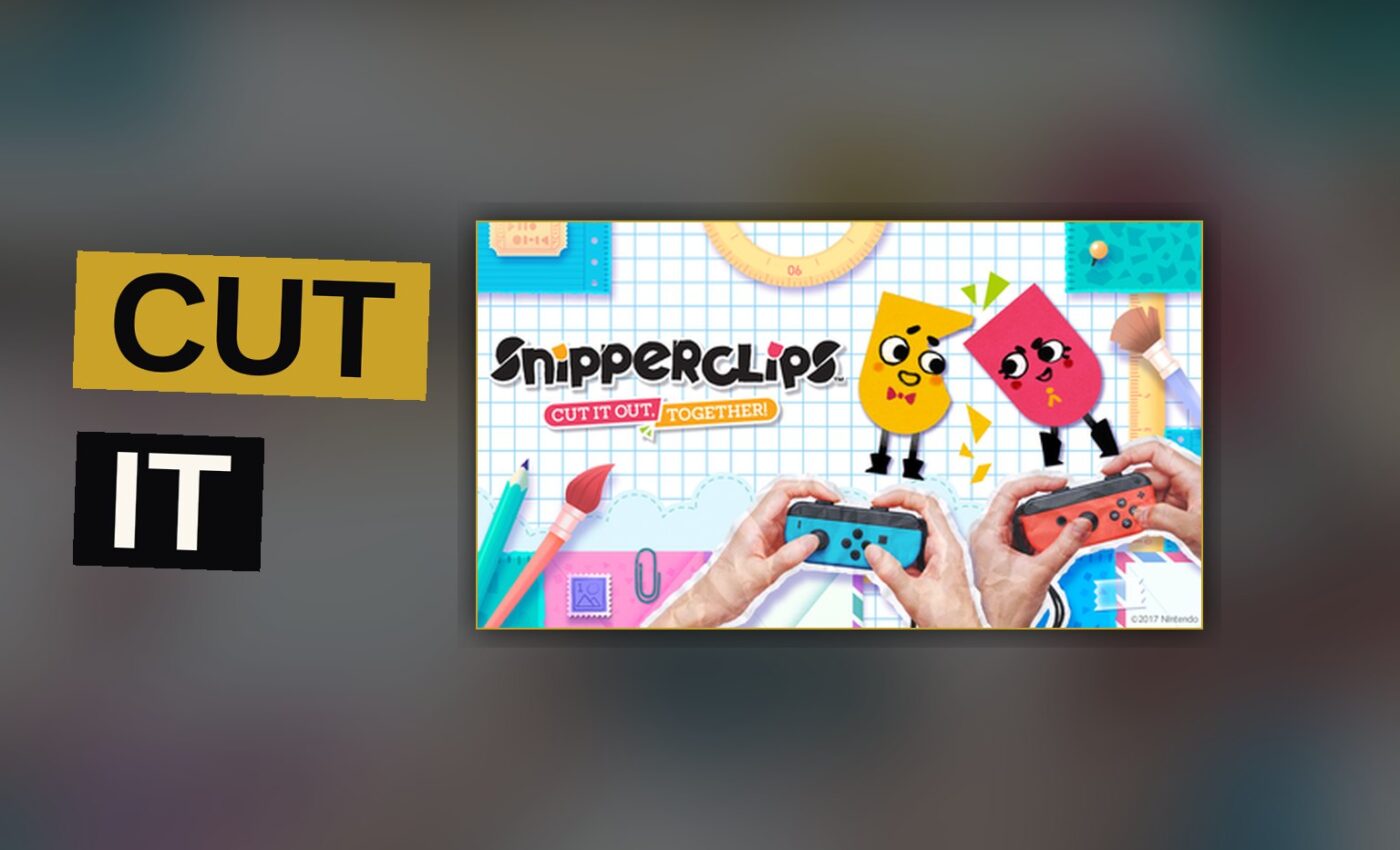
Snipperclips: Cut It Out, Together! arrived with the Nintendo Switch in 2017 as a launch-window curiosity: two paper characters, a pair of scissors, and a simple idea about cutting each other into new shapes. SFB Games built it, Nintendo published it, and it has held up better than most of the console’s early lineup.
The game scores 8 of 10, matching the published critical aggregate across 15 outlets.
Trailer, via Nintendo of America.
Two Paper Characters and a Pair of Scissors
The premise is exactly what the title says. You control paper characters who can snip each other into new silhouettes to solve puzzles. Cut a notch into your partner and they become a hook. Trim them into a wedge and they fit a gap. The shapes are the mechanic, and the mechanic is the whole game.
SFB Games keeps the controls to a minimum. You move, you jump, you cut. Everything else is a question of what shape you need and who has to become it. That restraint is the point. Snipperclips never buries its idea under systems.
It is a puzzle game first and a platform game second, though the side view and the jumping put it in both genres. The action is light, the comedy comes from the characters themselves, and the tone stays firmly in kids’ territory without talking down to anyone.
Single Player Works, Co-operative Works Better
Snipperclips supports single player, multiplayer and co-operative play, and the modes are not equal. Solo, you switch between the two characters and solve the puzzle by yourself. It functions. It is also the least interesting way to play.
Co-operative is where the design lands. Two players, two characters, one shape between them. You have to agree on who gets cut and where. That negotiation is the game. It turns a puzzle about geometry into a puzzle about communication, and it does so without a single line of dialogue.
Multiplayer extends the same idea into activities beyond the main puzzles. The modes are listed plainly — single player, multiplayer, co-operative — and the co-operative mode is the one that justifies the title’s second half.
Cutting Is the Only Verb That Matters
Most puzzle games give you a toolkit. Snipperclips gives you one verb. You cut. Every solution runs through that verb, and the game’s best moments come from realizing how much a single verb can cover.
A shape cut at an angle becomes a ramp. A shape cut down the middle becomes two tools. A shape cut badly becomes a problem you have to fix by cutting again. The game never adds a second mechanic to rescue you, and it never needs to.
That is a real design achievement, and it is the reason Snipperclips reads as more than a launch gimmick. The scope is small. The idea is not.
A World Built From Paper
The art matches the mechanic. Everything is paper, everything is flat, and everything can be trimmed. The side view keeps the action legible, which matters when two players are both moving and both cutting at once.
The themes are listed as action, comedy and kids, and the game earns all three. The comedy is physical and quiet — the characters themselves are the joke, and the cutting is the punchline. Nothing here is loud. Nothing here is mean.
For a 2017 Switch release, the look was never going to compete with the console’s bigger productions. It did not need to. The visual language is consistent with the mechanic, and consistency is worth more here than fidelity.
The Puzzles That Define the Game
The puzzles are dynamic rather than static. Shapes change as you cut them, so a solution you find early can be undone by a cut you make late. That makes the game forgiving in a specific way: mistakes are usually recoverable, and recovery is often part of the answer.
The activities outside the main puzzles follow the same logic. They take the cutting verb and point it at a new goal. None of them overstay. The game is comfortable being short and comfortable being replayed, which is a rare combination in a genre that usually pads.
Where Snipperclips is weakest is in the solo mode. Switching between characters breaks the flow that makes the co-operative mode sing. It is not broken. It is just clearly the second-best version of the same game.
How the Modes Rank
If you are deciding how to play Snipperclips, the order matters more than the mode list suggests. Ranked by what actually works:
- Co-operative play — two players, two characters, one shape. The negotiation is the game, and the game is at its best here.
- Multiplayer activities — the same cutting verb pointed at new goals, built for a group and comfortable being short.
- Single player — functional, but switching between characters breaks the flow that makes the co-operative mode work.
That ranking is the whole review in miniature. The game is built for two people, and every other mode is a concession to the fact that sometimes you are alone.
Why 15 Outlets Landed at 8.0
An 8.0 across 15 outlets is a strong, consistent result, and it matches what the game actually is. Snipperclips does one thing, does it well, and does not pretend to be larger than that.
The score reflects a game with no filler and no fat. It also reflects a game with a ceiling. There is no campaign to speak of, no progression system, no reason to keep playing once the puzzles are solved beyond the pleasure of solving them again with someone new.
That ceiling is real, and it is why the score is an 8 and not higher. The game is not trying to be a landmark. It is trying to be a very good puzzle game for two people, and it succeeds at exactly that.
The consistency of the aggregate matters here. When 15 outlets cluster at 8.0, they are agreeing on the shape of the thing: excellent at its core idea, limited in its reach. That is the correct read.
The Verdict on Snipperclips
Snipperclips: Cut It Out, Together! is one of the sharpest small games on the Switch. It takes a single idea — cut paper characters into new shapes — and builds an entire game around it without ever cheating the premise.
The co-operative mode is the reason to play. The single-player mode is functional but lesser. The art is simple and correct. The puzzles are dynamic and forgiving. The comedy is gentle and the tone stays in kids’ territory without becoming childish.
The published aggregate of 8.0 across 15 outlets is the right number. This is a game that knows exactly what it is and refuses to be anything else. That refusal is a strength, and it is why Snipperclips remains worth a slot on the console it launched with.
Get the Notebook.
The day's best stories and every fresh verdict, in plain English, in your inbox by seven. One email a day, no more.


