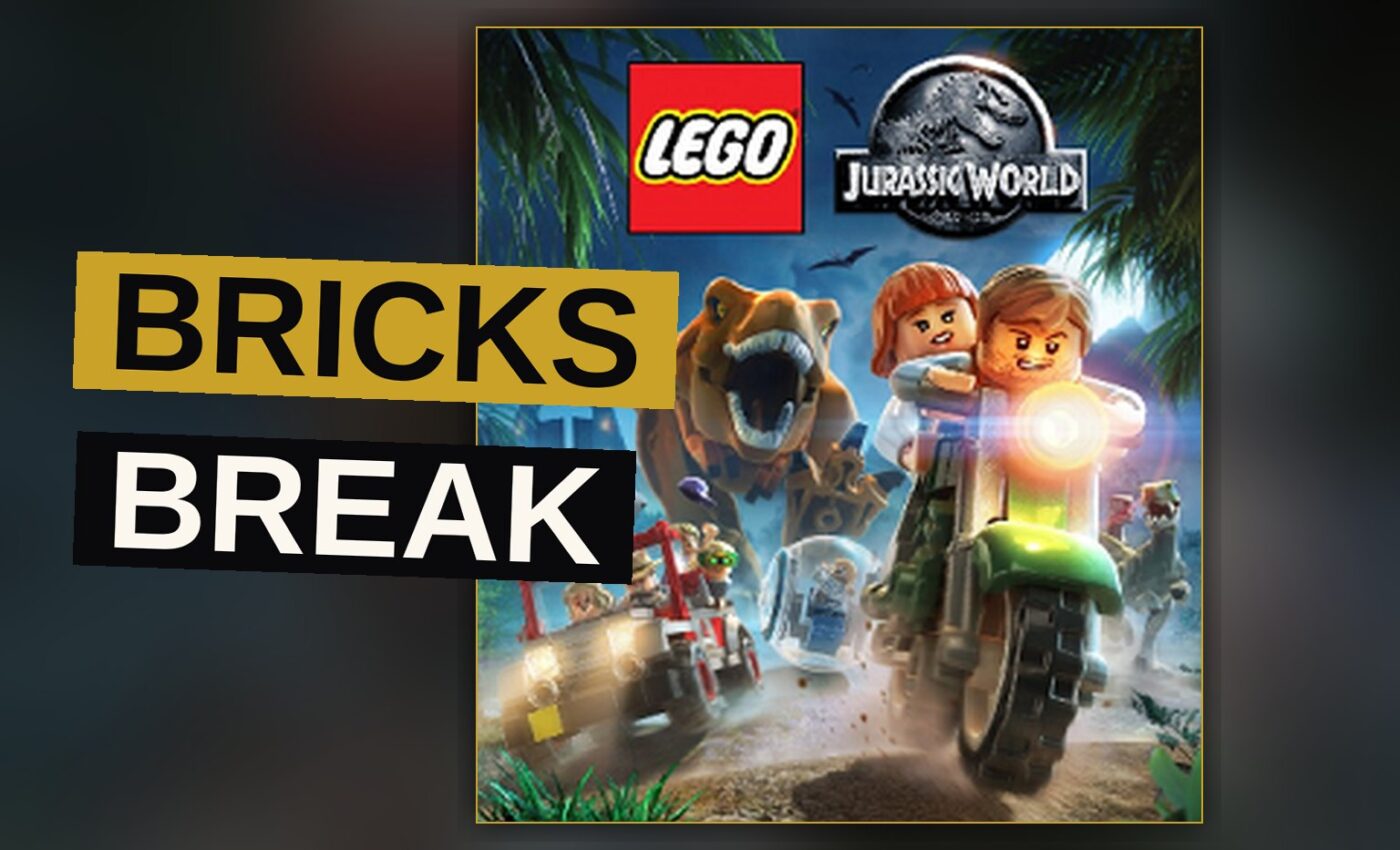
LEGO Jurassic World turns four films into one game, and it does it without spilling a drop of blood. The 2015 release from TT Fusion and Warner Bros. Interactive Entertainment adapts Jurassic Park, The Lost World: Jurassic Park, Jurassic Park III and Jurassic World into 20 levels, five based on each film. It released on 12 June 2015 for Nintendo 3DS, PlayStation 3, PlayStation 4, PlayStation Vita, Wii U, Windows, Xbox 360 and Xbox One, timed to the theatrical release of Jurassic World. It is a faithful, funny, occasionally thin tour through a franchise that spent two decades eating people. This one hands you a bucket of bricks instead.
Trailer, via IGDBcom.
The Indominus rex and five levels per film
The structure is clean. Each film gets five levels, and the levels are reached through a free-roaming overworld area. The 3DS version cuts the overworld for a central hub, but is otherwise nearly identical to the home console releases. An OS X port from Feral Interactive followed on 23 July 2015. Android and iOS versions landed on 31 March 2016. A Nintendo Switch version arrived on 17 September 2019.
That is a long tail for a game built on a summer movie. It also tells you what LEGO Jurassic World is: a dependable piece of licensed software that kept getting ported because people kept buying it. Nothing in the design suggests a team swinging for something new. The design suggests a team that knew exactly what it was making.
Mr. DNA hands out the hints
The best decision in LEGO Jurassic World is Mr. DNA. The cartoon character from the 1993 Jurassic Park film is an unlockable character, and throughout the game he gives the player hints and dinosaur trivia, just as he did in the Jurassic Park video game for the Super NES. It is a small thing. It is also the only part of the game that treats the source material as a body of knowledge rather than a set of action beats.
The roster is enormous. More than 100 characters are unlockable, including more than 20 dinosaur species. The dinosaurs include Velociraptor, Brachiosaurus, Spinosaurus, Ankylosaurus, Parasaurolophus, Stegosaurus, Triceratops and Tyrannosaurus. Human characters include Dr. Alan Grant, Ian Malcolm and Owen Grady. Every character has a special ability, and using those abilities is required to move forward. That is the spine of the puzzle design, and it works.
Then there are the oddities. Jurassic World producers Pat Crowley and Frank Marshall are playable, as is the film’s director, Colin Trevorrow. Steven Spielberg, a director and executive producer across the series, is playable too. You can create new human characters at the Jurassic Park Visitor Center or the Jurassic World Innovation Center, and you can build hybrid dinosaurs from unlocked parts. Enemies include Compsognathus, Dilophosaurus, Troodon and the Indominus rex.
Where the deaths went
Here is the trade the game makes. The developers modified the film storylines to fit five levels each, and they recreated notable scenes in a more humorous manner because the game was aimed at a younger audience. All death scenes from the films were removed. Characters are shown as injured, escaping harm, or miraculously surviving.
That is not a small edit. It is the whole personality of the thing. Jurassic Park works because the park fails and the failure is lethal. Take the lethality out and you are left with the park. LEGO Jurassic World knows this and leans into the joke, which is the correct call for the audience it wants. It is still worth naming what gets lost.
Two players, one screen
The game supports single player and multiplayer, including two-player co-operative play and split screen. The perspective is third person, with some bird view / isometric views. The genre labels are puzzle and adventure, with action and science fiction themes. That is an accurate description of what you do for the runtime: solve a room, unlock a character, solve the next room.
The two-player mode is where the design gets its legs. Puzzles built around two characters with different abilities are more interesting than puzzles built around one, and the split screen lets a second player matter. Solo play turns the same rooms into a checklist. Co-op turns them into an argument about who gets to be the raptor.
The ports, in order
The release history is its own document. It shows a game that kept finding new hardware rather than a game that kept finding new ideas. The Switch version arrived on 17 September 2019.
| Date | Platform |
|---|---|
| 12 June 2015 | Nintendo 3DS, PlayStation 3, PlayStation 4, PlayStation Vita, Wii U, Windows, Xbox 360, Xbox One |
| 23 July 2015 | OS X |
| 31 March 2016 | Android, iOS |
| 17 September 2019 | Nintendo Switch |
The Switch version arriving in 2019, four years after the film it was timed to, says something about how the game was valued: not as an event, but as a catalog item that could be reissued whenever a platform needed software.
What the 7.3 actually measures
LEGO Jurassic World holds a 7.3 out of 10 across 15 outlets in the IGDB critic aggregate. That number is fair, and it is fair for a specific reason.
Ranking what matters here, from most to least:
- Mr. DNA as the hint system and trivia source. It is the one idea in the game that could not have come from a generic licensed platformer.
- The two-player co-operative mode, which is what makes the ability-based puzzles worth solving twice.
- The dinosaur roster, more than 20 species, which is the actual fantasy the game is selling.
- The removal of every death scene, which is a coherent choice for the audience and a real loss for the material.
- The playable producers, director and Steven Spielberg, which is a fun bit of trivia and nothing more.
- The free-roaming overworld, which is fine and would not be missed.
The order matters because it tells you what the game is good at. It is good at being a dinosaur toy box. It is less good at being a Jurassic Park game, because Jurassic Park is not a toy box. It is a story about a toy box that opens.
The version to pick
If you are choosing a platform now, the Nintendo Switch release from 17 September 2019 is the practical answer, and the home console versions are the ones with the free-roaming overworld. The 3DS version swaps that overworld for a central hub and is otherwise nearly identical, which makes it a reasonable choice only if the handheld is what you have. The Mac port from Feral Interactive covers OS X.
The 3DS and mobile trade-offs are small. The bigger question is whether you want to play this alone or with someone. Play it with someone.
A toy box that stays shut
LEGO Jurassic World is the first video game where players can relive all four Jurassic films, and that is its whole pitch. It delivers on the pitch. It does not deliver on much else, and the 7.3 reflects a game that was made carefully and safely by people who understood the assignment and declined to exceed it.
The removal of the death scenes is the detail that should sit with you longest. It is the clearest evidence of what this game is: a version of Jurassic Park where the dinosaurs are a feature rather than a warning. That is a legitimate thing to build for a younger audience.
Mr. DNA is the exception. A cartoon host who explains the science and cracks jokes is the exact right guide for a game that wants you to look at dinosaurs without fearing them. Everything good here traces back to that one choice.
Get the Notebook.
The day's best stories and every fresh verdict, in plain English, in your inbox by seven. One email a day, no more.