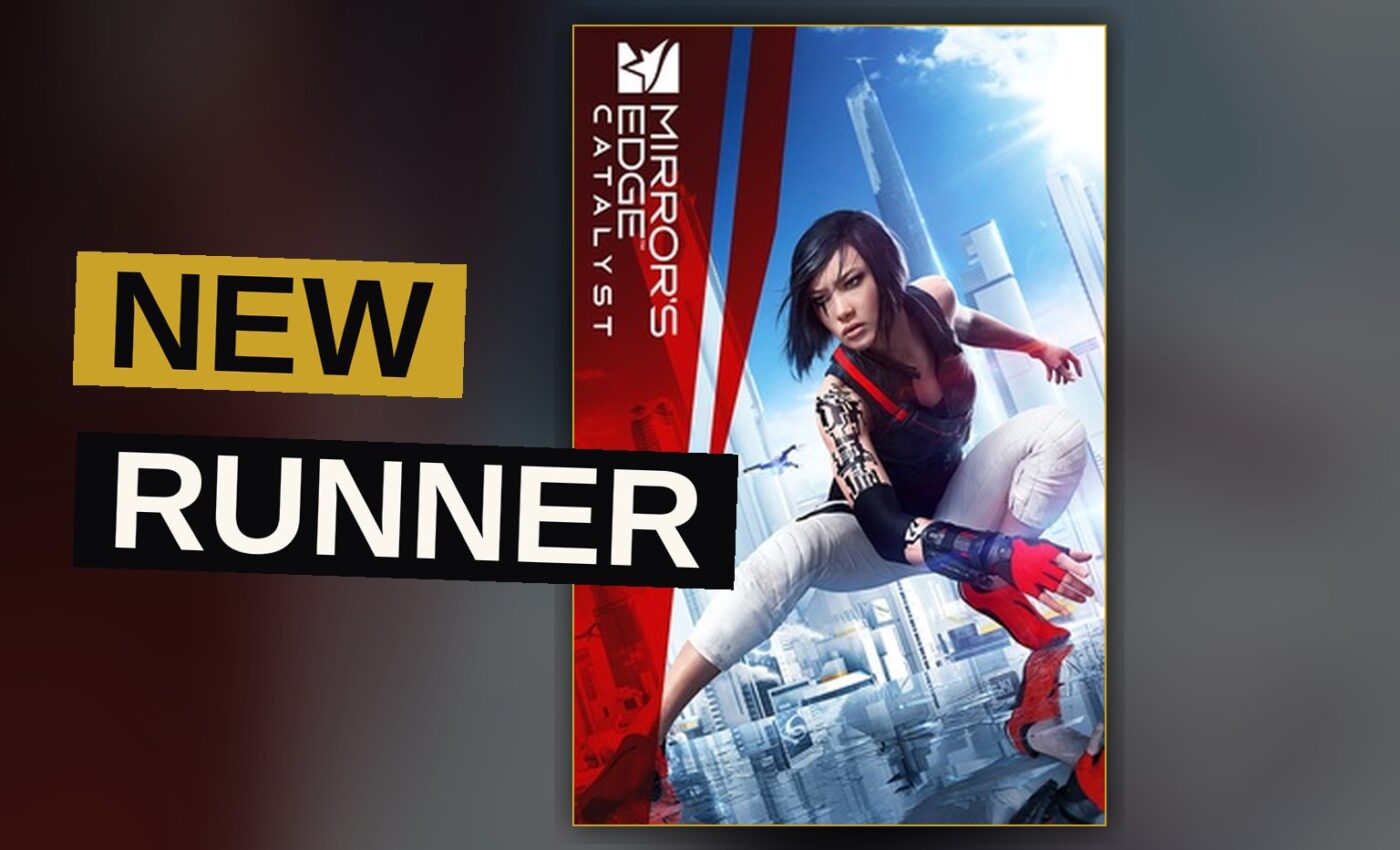
Mirror’s Edge Catalyst arrives on PS4, PC and Xbox One as a sequel to the original Mirror’s Edge, released back in 2008. It carries the same central idea: a runner who moves through a city by leaping between buildings, sliding along ledges and sprinting across rooftops. The new game adds a larger world, a narrative about corporate control and rebellion, and a protagonist who is not Faith, the character players knew from the first game. That change is the biggest gamble the developers made, and it shapes almost everything else about how this sequel plays out.
Trailer, via Mirror’s Edge.
Running Through the City
The setting is a city built around corporate towers, each owned by a different company. Players move between these districts, climbing walls, jumping gaps and sliding down railings to reach new heights. The traversal feels lighter and faster than in the original game, with a fluid motion that rewards momentum and punishes hesitation. Climbing a wall now takes a single button press, and moving along a narrow ledge becomes a matter of timing rather than patience.
Combat is present, though it is not the focus. Players can disarm enemies, dodge attacks and throw objects back at them, but the game pushes players toward evasion over confrontation whenever possible. The combat system works, but it is thin compared to the movement itself, which remains the star of the show.
The New Protagonist
The shift away from Faith changes the tone of the whole experience. Faith was a defined character with a history, a runner who had fought against the system and survived. Her absence leaves a void in the story, and the new protagonist, Faith’s sister, does not carry the same weight. She is competent and capable, but she lacks the presence that made Faith memorable.
The story follows her as she discovers that the city is not as free as she believed, and that her family’s past is tied to the very corporations she is fighting. The narrative is solid, with moments of tension and a few surprises, but it never quite reaches the emotional heights of the original game’s central conflict. The pacing drags in the middle stretch, with extended sequences of running that feel like filler rather than progress.
Exploring the Map
The city itself is the real achievement. Players can return to earlier districts after unlocking new abilities, which opens up new routes and shortcuts. This encourages exploration beyond the main objectives, and the game rewards curiosity with hidden collectibles and alternate paths. The map is dense with verticality, and the sense of scale is impressive for a game that asks players to move entirely on foot.
The districts vary in theme and design. Some are corporate headquarters with glass towers, while others are residential areas with narrow streets and balconies. Each district has its own visual identity, and the art direction is strong throughout. The lighting is particularly effective, with rain-soaked streets and neon-lit interiors giving the city a distinct mood.
The Technical Hurdles
Mirror’s Edge Catalyst is not without problems. The frame rate dips during busy sequences, especially on PS4, where the game struggles to keep pace with the action. Load times are also longer than they should be, which disrupts the flow of play. These issues are frustrating, but they do not break the game.
The game also suffers from occasional technical glitches, such as characters getting stuck in walls or objects failing to load properly. None of these issues are catastrophic, but they do chip away at the polish that the game otherwise strives for. On PC and Xbox One, the performance holds up better, though the console versions still show their limitations in busier scenes.
Music and Sound
The score is sparse and atmospheric, with a mix of electronic textures and percussion that matches the urban setting. It never overpowers the action, but it sets the tone effectively. The sound design is also strong, with footsteps, wind and distant machinery adding depth to the environment. The audio complements the visuals without competing with them, which is a smart choice for a game that relies so heavily on atmosphere.
What Is Missing
The game’s biggest weakness is its length. The campaign runs shorter than expected, and some of the late-game content feels rushed. The difficulty curve is uneven, with sections that are brutally hard followed by stretches that are almost too easy. The lack of multiplayer support is also notable, as the original Mirror’s Edge featured a competitive mode that fans enjoyed. Its absence here leaves a hole in the package.
Here is how the elements stack up:
- Movement: 8.5/10 — the best part of the game, with a fluid, satisfying feel.
- Combat: 6.5/10 — serviceable but shallow, and rarely the point of a sequence.
- Story: 6.8/10 — solid but missing the emotional punch of the original.
- Presentation: 7.8/10 — the city looks great, but the protagonist lacks charisma.
- Technical Performance: 6.2/10 — good on PC and Xbox One, rough on PS4.
Final Word
Mirror’s Edge Catalyst is a mixed bag. It improves on the original’s movement and expands the world significantly, but it fails to capture the same emotional stakes. The new protagonist is competent, but she is not Faith, and that loss is felt throughout the story. The technical issues, while fixable, are frequent enough to disrupt the experience.
Players who loved the original will find plenty to enjoy here, but newcomers may wonder why the protagonist’s story is less compelling. The game is at its best when players are moving, and at its worst when they are reading dialogue. It is a game of highs and lows, with the highs being far higher than the lows are low.
Mirror’s Edge Catalyst is a worthy successor to the original, but it falls short of matching its predecessor’s greatness. It is a game worth playing for its movement alone, but one that leaves players wanting more.
Get the Notebook.
The day's best stories and every fresh verdict, in plain English, in your inbox by seven. One email a day, no more.