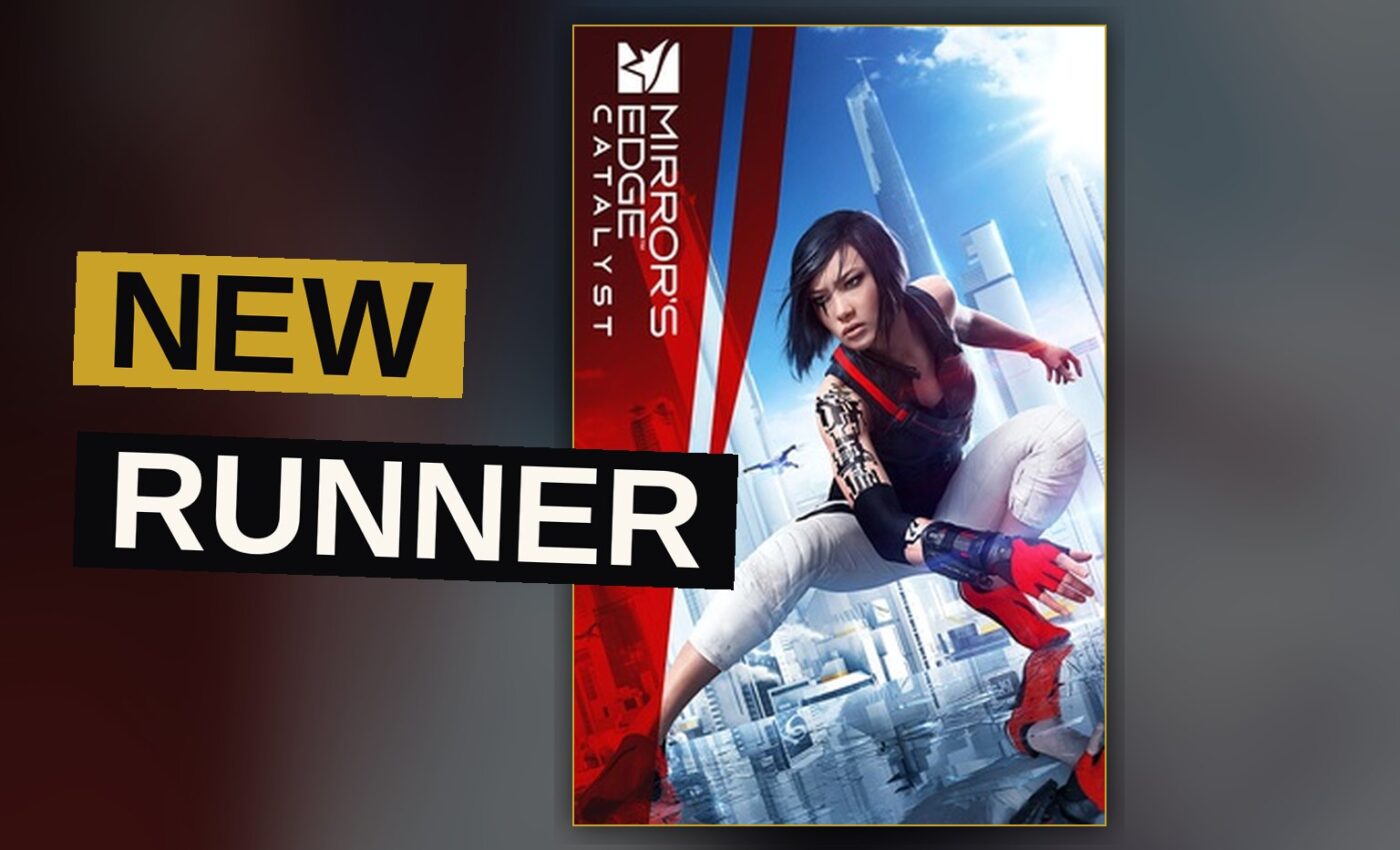
Mirror’s Edge Catalyst is a game about momentum, and its biggest problem is that it keeps stopping. DICE built a free-running sandbox in the city of Glass and then filled it with things that want you to stand still. The result is a reboot that understands exactly what made the 2008 original memorable and only partly delivers it.
Trailer, via Mirror’s Edge.
Faith Connors Returns to Glass
Faith Connors is fresh out of prison when Mirror’s Edge Catalyst opens. She reconnects with Icarus, a fellow Runner, and with Noah, the cabal leader who raised her after her parents died. Runners are freelance couriers who refuse connection to the Grid, the surveillance network that links nearly every citizen in the dystopian city of Glass. They live on rooftops and move by parkour.
The setup is strong. Glass is the showcase city of Cascadia, governed by a totalitarian corporatocracy, and the corporations are quietly preparing a project called Reflection. Faith stumbles into it during a data grab, when she disobeys orders and takes a hard drive. Gabriel Kruger, CEO of Kruger Security, sees her do it. She escapes.
That drive is the engine of the plot. Faith takes it to Plastic, a hacker who finds blueprints for Reflection inside. K-Sec then raids the Runners’ lair while Faith and Icarus are away, capturing or killing everyone there, including Noah. The two survivors turn to Rebecca Thane, who leads the militant resistance movement Black November.
Isabel Kruger and the Sister Reveal
Black November captures Isabel Kruger, a high-ranking K-Sec commander and Gabriel Kruger’s daughter. Faith asks Plastic to dig into K-Sec servers. What comes back is the game’s best story beat: Isabel is Caitlyn “Cat” Connors, Faith’s sister, presumed dead. Gabriel Kruger took her in as his adoptive daughter and told her Faith died with the rest of the family.
Faith races back to Black November headquarters, where Thane is preparing to execute Isabel to send her father a message. Isabel does not seem to remember Faith. Faith talks Thane out of the killing anyway. This is the one stretch where Mirror’s Edge Catalyst slows down and earns it, and it lands because the relationship is specific rather than abstract.
Isabel then hints that Noah may still be alive, held in a compound. Faith rescues detained Reflection scientists, including lead researcher Aline Maera, who explains what the project actually is: nanites injected into the population, remote-controlled to regulate thoughts and emotions. Faith finds Noah being experimented on with prototypes.
Running, and the GridLeaks Around It
The traversal is the reason to play Mirror’s Edge Catalyst. Players cross Glass in first person using parkour, zip-lines and ledges, plus a MAG Rope and a Disruptor that can disable fans and security cameras. Mark an objective on the map and runner vision highlights scenery in red as a guide.
The open world is the structural change from 2008. Instead of linear levels, Glass offers a free-roaming environment with multiple routes to any objective. Side activities include time trials, races and environmental puzzles, and GridLeaks are collectibles scattered across the map.
Combat got an overhaul, and not a good one. DICE removed player guns entirely and pushed melee attacks and evasion. Faith enters focus mode while running and, with enough focus, can dodge bullets. It sounds elegant. In practice it fights the momentum the rest of the game depends on.
| Feature | Mirror’s Edge (2008) | Mirror’s Edge Catalyst |
|---|---|---|
| Level structure | Linear levels | Open-world, free-roaming |
| Player firearms | Available | Removed entirely |
| Combat focus | Shooting and melee | Melee and evasion |
| Traversal tools | Parkour, zip-lines, ledges | Adds MAG Rope and Disruptor |
| Collectibles | Not described in source | GridLeaks |
A City That Watches Everything
Glass is the strongest thing DICE built here. Cascadian society is highly stratified. Most citizens work for the corporations and are connected to the Grid, a social surveillance system that digitally links everything and everyone. The Runners exist as a direct refusal of that, living on rooftops and making a living from covert deliveries while dodging corporate security.
That premise gives every rooftop a political charge. The game knows it, too, which is why the campaign keeps returning to Reflection and the nanite plan. A city where thoughts can be regulated is a real escalation from a city where movement is tracked.
The problem is that Mirror’s Edge Catalyst rarely lets the setting breathe. Missions push you from marker to marker, and the side content is mostly time trials and races, which treat Glass as a track rather than a place. The GridLeaks reward exploration, but they are collectibles, not storytelling.
What the Multiplayer Left Behind
Mirror’s Edge Catalyst shipped with single-player and multiplayer modes. In December 2023, EA shut down all servers for the game. Every multiplayer feature is now inoperable, and some achievements can no longer be obtained.
That matters more than it might sound. A game built around movement-based competition loses a whole layer when its servers go dark, and the shutdown turned part of the package into a permanent dead end. Anyone buying Mirror’s Edge Catalyst today is buying the campaign and the offline side activities, nothing else. The source does not say how many players used those modes or why EA closed them, and it does not need to. The features are simply gone.
A Reboot That Half Remembers
Mirror’s Edge Catalyst received mixed reviews on release, with praise for the free-running and the visuals and criticism for the storyline and combat system. That split is the honest read. The traversal is genuinely good, and the shift to an open world gives it room the 2008 game never had. The sister reveal and the Reflection conspiracy give the campaign a spine.
But the combat overhaul is a misstep. Removing guns was the right instinct. Replacing them with melee that interrupts your speed was not. Faith is at her best in motion, and the game keeps asking her to stop and trade punches. The open world also spreads the campaign thin, and the side activities rarely justify the distance between them.
The server shutdown is the part worth watching, because it shows what happens to a game when its online half is switched off and the offline half has to carry everything. Mirror’s Edge Catalyst can still do that. It just does not do it as well as it should.
Get the Notebook.
The day's best stories and every fresh verdict, in plain English, in your inbox by seven. One email a day, no more.