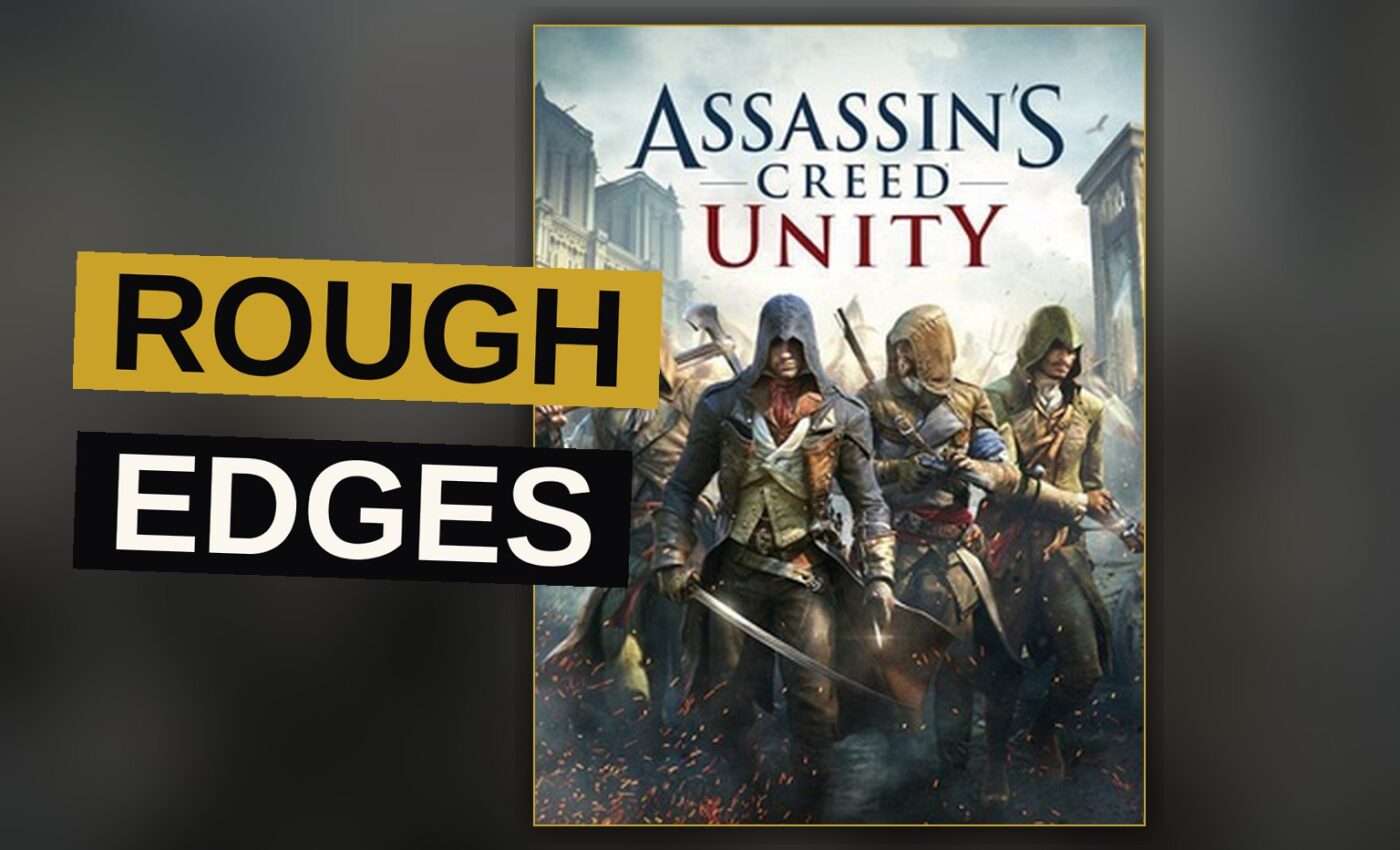
Assassin’s Creed Unity arrived in November 2014 for PlayStation 4, Windows and Xbox One, and it carried a heavier load than any game in the series before it. Ubisoft Montreal built Paris at roughly 1:1 scale, added four-player cooperative missions, and rebuilt combat around fencing. The ambition was enormous. The execution is uneven, and the game’s best ideas sit next to its most frustrating ones.
Trailer, via IGDBcom.
Arno Dorian and the Murder That Starts Everything
Arno Dorian is a native Frenchman born in Versailles to an Assassin father. When his father is killed by Shay Patrick Cormac at the end of Assassin’s Creed Rogue, Arno is adopted by a family with a senior position in the Templar Order — his new father figure is the Templar Grandmaster. Arno blames himself when his adoptive father is murdered, and that guilt drives him into the Brotherhood of Assassins, where he rises through the ranks much like Altaïr Ibn-La’Ahad and Ezio Auditore da Firenze before him.
Dan Jeannotte plays Arno, and Catherine Bérubé plays Élise de la Serre, the Grandmaster’s daughter and Arno’s love interest. Élise investigates her father’s death and the ideological shift inside the Templar Order that threatens its core values. The historical cast is deep: the Marquis de Sade (Alex Ivanovici), Maximilien Robespierre (Bruce Dinsmore), and a young Napoleon Bonaparte (Brent Skagford) all appear.
A Paris Built at Full Scale
The setting is the strongest thing Unity has. The game recreates late 18th-century Paris across seven major districts — Le Louvre, Île de la Cité, Le Marais, La Bièvre, Les Invalides, Quartier Latin, and Ventre de Paris — plus the town of Versailles on the outskirts. The commune of Saint-Denis, renamed Franciade during the Revolution, arrives in the free Dead Kings expansion.
Arno’s story opens in Versailles when he is a child, then moves to Paris on the eve of the French Revolution in 1789 and runs to the Thermidorian Reaction in 1794. The open world holds side missions that give the city its texture. “Paris Stories” asks the player to help a non-playable character, usually a historical figure, with a minor problem. “Murder Mysteries” has the player investigate murder scenes, collect clues and interrogate witnesses to identify the culprit. “Nostradamus Enigmas” strings cryptic riddles across the map toward artifacts that unlock a special reward. Treasure chests, cockades and artifacts sit scattered around Paris, paying out new gear or cosmetic options.
The Phantom Blade and a Revised Fight System
Combat in Unity was greatly refined over previous entries, with fencing as the inspiration for the new system. The stealth system gained manual crouching and the Phantom Blade, a variation of the series’ signature Hidden Blade that doubles as a silent crossbow. The linear assassination missions of earlier Assassin’s Creed games were abandoned in favor of a new “Black Box” structure that lets the player choose an approach.
Cooperative multiplayer is the series first, letting up to four players take on narrative-driven missions and explore the open world map together. Those missions follow the development of the Brotherhood of Assassins during the French Revolution. The modern-day frame is set in the 21st century and features an unidentified, unseen protagonist who joins the Assassins as an initiate to help locate the corpse of an 18th-century Templar Grand Master. “Time anomalies” appear during the story, sending Arno to other points in Parisian history, including the Belle Époque and the city’s occupation by Nazi Germany during World War II.
The Best Idea in the Game Is the One It Buried
The co-op missions are where Unity justifies itself. Four players moving through Revolutionary Paris, running narrative-driven jobs rather than deathmatch filler, is a structure the series had never tried and rarely matched afterward. The Black Box assassination missions belong to the same instinct: hand the player a space, a target and a set of tools, then get out of the way. When Unity trusts its own design, it is the most interesting Assassin’s Creed of its era.
Then there is the combat. Fencing is a fine inspiration on paper. In practice the revised system is slower and heavier than the swashbuckling of the Ezio trilogy, and the stealth additions — manual crouching, the Phantom Blade — are correct fixes to problems the series had carried for years rather than revelations. They make Unity playable in a way its predecessors were not. They do not make it thrilling.
The stealth system also saw several improvements with the addition of new features like manual crouching and the Phantom Blade, a variation of the series’ signature Hidden Blade which doubles as a silent crossbow.
Seven Districts and One Long Corridor
The scale of Paris is the game’s signature achievement and its quiet trap. Seven districts at roughly 1:1 scale, plus Versailles, is a staggering amount of city. It is also a staggering amount of walking. The side content — Paris Stories, Murder Mysteries, Nostradamus Enigmas, the chests and cockades — fills the map with things to do, and the Murder Mysteries in particular give the open world a reason to exist beyond scenery. But the density is uneven, and the collectibles are collectibles.
The historical reach is the part that holds up. Arno’s story runs from 1789 to 1794, and the game stages the period as a lived-in place rather than a backdrop. Robespierre, de Sade and a young Napoleon are not cameos so much as furniture of the era, and Élise de la Serre gives the Templar side of the story a face and a motive rather than a slogan.
The Verdict on Assassin’s Creed Unity
Assassin’s Creed Unity is a game with a great city, a good co-op mode, and a combat system that never quite earns its fencing inspiration. It is the eighth major installment in the series and the successor to 2013’s Assassin’s Creed IV: Black Flag, with ties to Assassin’s Creed Rogue, which released for the previous generation consoles the same day. That pairing matters: Unity was the future, Rogue was the past, and Unity’s ambition pointed forward even when its execution stumbled.
What matters most, in hindsight, is the co-op. Ubisoft Montreal built four-player narrative missions into an Assassin’s Creed game and then largely walked away from the idea. Paris at 1:1 scale remains the franchise’s most impressive single environment. The Phantom Blade and manual crouching are quality-of-life fixes that should have arrived years earlier. None of it is enough to make Unity a great game. All of it is enough to make it a more interesting one than its reputation suggests.
Get the Notebook.
The day's best stories and every fresh verdict, in plain English, in your inbox by seven. One email a day, no more.