
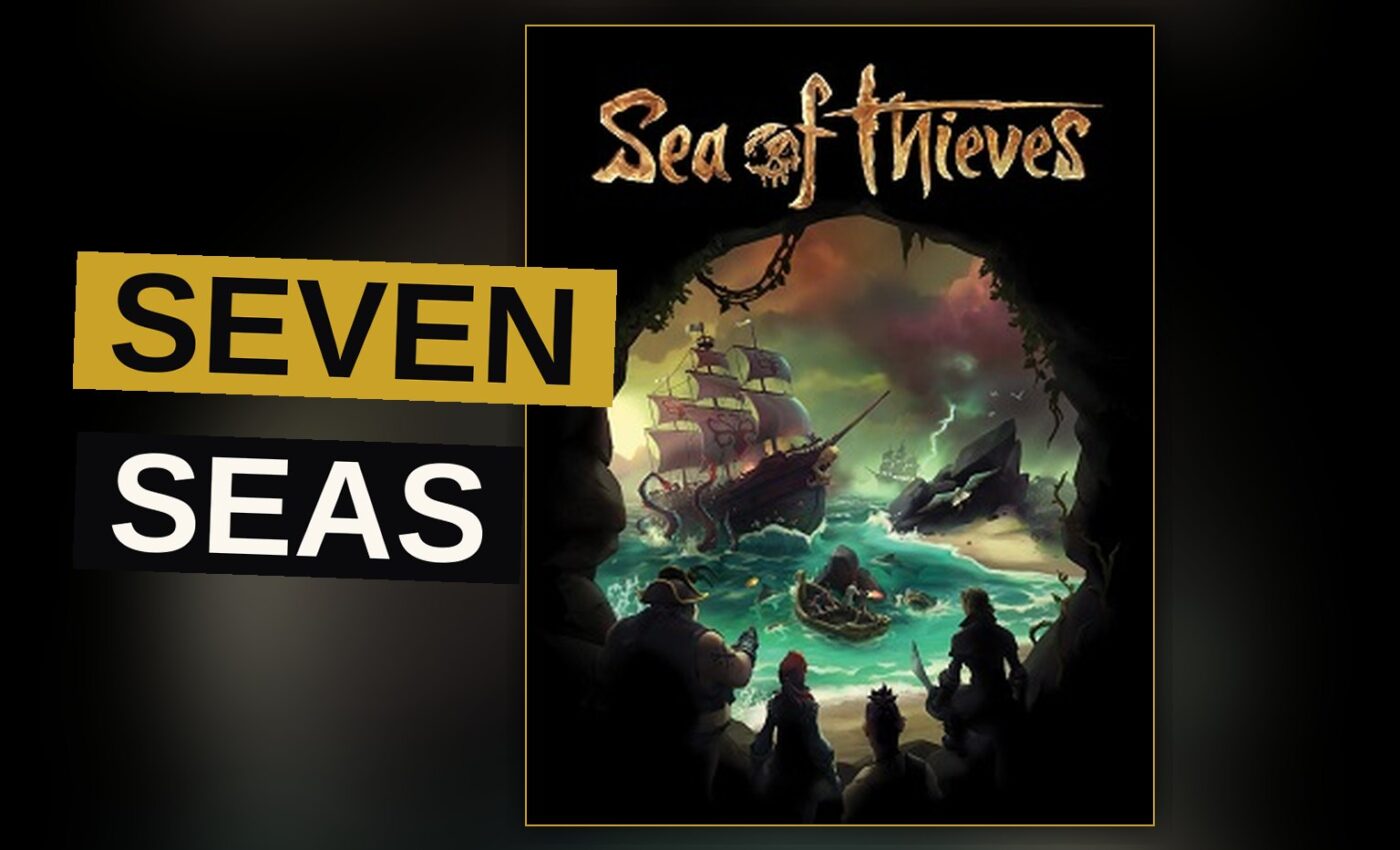
Sea of Thieves asks players to trust each other. That is the whole design, and it is also the whole problem. Rare’s 2018 pirate game drops crews of one to four onto a shared ocean, hands them a ship, and refuses to explain much of anything. There is no tutorial. There are no gameplay bonuses for veterans. Everyone sails with the same tools, the same cannons, the same odds. It is a bold premise, and it produces moments no other game of its era could manufacture. It also produces long stretches where nothing happens at all.
Trailer, via Sea of Thieves.
A Sloop, a Brigantine, and a Galleon
Sea of Thieves is a first-person action-adventure game developed by Rare and published by Xbox Game Studios. It launched in March 2018 for Windows and Xbox One, and it now runs on Xbox Series X|S, PC, PlayStation 5 and Xbox One. The setup is simple. Players pick a procedurally generated avatar, choose a ship, and sail into an open world to complete voyages for trading companies.
Crews run one to four players. A sloop takes one or two. A brigantine takes three. A galleon takes four. Every crew picks a vessel that matches its size, and every vessel handles differently on the water.
Voyages pay out in treasure. Players sell that treasure to trading company representatives at outposts, and the sale builds reputation. Reputation unlocks cosmetics. Nothing else. No stat boosts, no better cannons, no faster hulls.
The Progression System Rare Built on Purpose
This is the most interesting decision in the game. Rare noticed that experienced players in other multiplayer games tended to grind for endgame content instead of playing alongside newcomers. Novices, meanwhile, worried about falling behind. So the team built a system where rank buys appearance and nothing more.
Gold, doubloons and ancient coins all feed the same cosmetic economy. Every item carries identical attributes. A player with hundreds of hours and a player on their first voyage have the same combat power.
Rare’s stated hope was that veterans would help novices finish voyages, closing the gap between the two groups. The logic holds up on paper. In practice, the system removes the incentive that keeps a lot of players logging in. Cosmetics motivate some people enormously. They do not motivate everyone.
Fifteen Minutes to Half an Hour
Sea of Thieves runs on a shared world. Multiple crews occupy the same server, and they run into each other. Sometimes they form alliances. Sometimes they go head-to-head, fighting naval battles and trying to steal each other’s treasure.
Rare tuned the spacing deliberately. Rather than capping how many players a server holds, the studio kept player groups spread apart so encounters happen regularly but not constantly. Rare’s Chapman estimated a player will see another player-controlled ship every 15 minutes to half an hour.
That number is the game’s pulse. It means long quiet stretches broken by sudden, unscripted contact with strangers who may help or may sink you.
No Tutorial, No Rules, No Map Reading
Rare designed Sea of Thieves to test soft skills. Players need common sense to solve its challenges. They need to learn to read maps. To push those skills, the game ships without a beginner’s tutorial, on the theory that players should discover mechanics themselves.
The team also avoided hard gameplay rules, hoping crews would use their own creativity. Rare did add structured points of interest — shipwrecks and forts players can find — and Chapman called these locations the “catalyst for stories.”
That phrase is doing a lot of work. A catalyst only matters if something reacts.
What the Ocean Actually Delivers
The ship combat works. The multiplayer works. The visuals and the physics of a galleon cutting through a storm work. Critics at the time praised all four, and that praise was earned.
The criticism landed elsewhere: on progression, on the core gameplay loop, and on a plain lack of content. Those complaints were also earned. A game that hands players an ocean and asks them to make their own fun has to survive the sessions where nobody makes any.
Sea of Thieves launched as one of the earliest first-party games available to Xbox Game Pass subscribers. Rare envisioned it as a “game as a service” and has shipped numerous content updates since. That model fits the design. A shared world with thin progression needs a steady drip of new things to find.
A Timeline of the Water
| Period | What Rare Did |
|---|---|
| 2014 | Conceived the concept for Sea of Thieves |
| Development | Explored vampire and dinosaur settings before settling on pirates |
| Development | Drew inspiration from Pirates of the Caribbean and The Goonies (1985) |
| Development | Watched Eve Online, DayZ and Rust players build their own stories with game tools |
| Development | Invited players to test early builds, breaking from Rare’s reputation for secrecy |
| March 2018 | Released for Windows and Xbox One |
| After launch | Shipped numerous content updates under a “game as a service” plan |
The inspirations are worth naming. Rare looked at Eve Online (2003), DayZ (2018) and Rust (2018) and saw players using those games’ tools to write their own narratives. It explored vampires and dinosaurs before landing on pirates, pushed there by the Pirates of the Caribbean films and The Goonies (1985).
The studio also broke with its own habits. Rare has a reputation for secrecy, and it set that aside during development, inviting players in to test early builds.
Where the Design Holds and Where It Slips
The cosmetic-only system is the right call, and it is the part of Sea of Thieves most worth defending. It puts a fresh crew and a seasoned crew on equal footing, which is exactly what a shared-world game needs if strangers are going to cooperate. Rare solved a real problem that other multiplayer games mostly ignore.
The no-tutorial choice is a different matter. Learning to read a map by failing to read a map is charming once. It is tedious the fourth time.
The spacing of encounters is the design’s weakest lever. Fifteen to thirty minutes between sightings is a long wait when the ocean between them holds nothing but water. Rare’s bet is that the quiet makes the contact mean more. Sometimes it does. Often it just means the player sails alone.
The “catalyst for stories” framing is honest about what Sea of Thieves is. It is a stage, not a script. Shipwrecks and forts give crews something to find, but the game’s best moments come from other people, not from Rare’s content. That makes the experience wildly uneven. It also makes it genuinely unpredictable in a way few games of its scale manage.
Eight years of updates have added plenty. The foundation has not changed. Sea of Thieves still asks players to bring their own reasons to sail, and it still rewards the ones who do.
Get the Notebook.
The day's best stories and every fresh verdict, in plain English, in your inbox by seven. One email a day, no more.


