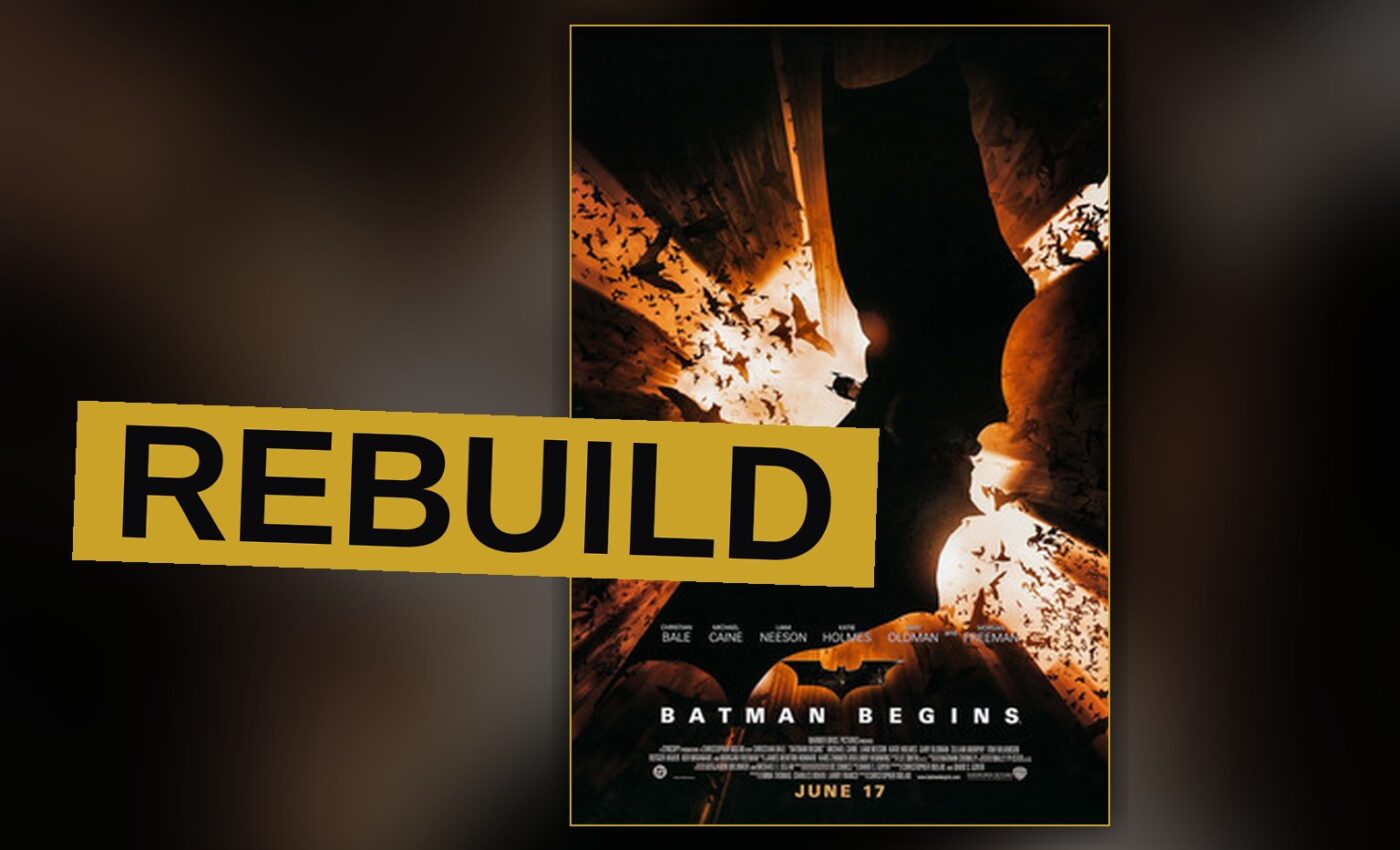
Batman Begins arrived in 2005 carrying a burden heavier than any cape. After the franchise had been driven into the ground by Joel Schumacher’s neon excess, the character needed a reset. Director Christopher Nolan delivered one, and in doing so, he changed what a superhero movie could be. The film does not wink at the audience. It does not apologize for its source material. It takes Bruce Wayne seriously, and that seriousness became the template for the next two decades of the genre.
The story traces Bruce Wayne from the pit of his childhood trauma to the rooftops of Gotham City. Christian Bale plays Wayne as a man who has been broken and is trying to reassemble himself into something useful. The film opens not with a costume, but with a prison. Bruce has abandoned his wealth and his name, wandering the world to understand criminality. He lands in a Bhutanese prison, where he meets Henri Ducard, played by Liam Neeson. Ducard recruits him into the League of Shadows, a secret order that has spent millennia destroying corrupt civilizations. Their method is absolute: burn the rot to the ground.
Trailer, via Warner Bros. Entertainment.
A Bhutanese Prison and a Frozen Lake
The early sequences in the prison and the training montage on the mountain establish the film’s physicality. Nolan shoots these scenes with a documentary grit that was unheard of for the genre at the time. The fight choreography is not balletic. It is brutal, close-quartered, and practical. When Bruce fights Ducard on a frozen lake, the ice cracks under their weight. The threat is not a laser or a monster. It is the cold, the fall, and the man across from you.
Bale’s physical transformation is the engine of these scenes. He bulked up from his gaunt frame in The Machinist to a fighter’s build, and the film lets that work show. He moves like someone who has learned violence, not been born to it. The script, credited to Nolan and David S. Goyer, gives Bruce a clear arc: he seeks the means to fight injustice, but he must first decide what he will not become. When the League of Shadows demands he execute a criminal to prove his commitment, he refuses. He burns their temple instead. That choice defines him.
Building the Suit and the Tumbler
When Bruce returns to Gotham, the film delivers its origin in careful stages. He does not simply put on a costume. He builds one. The suit is a piece of military hardware, sourced from Lucius Fox, played by Morgan Freeman. Freeman’s Fox is a dry counterweight to the film’s gloom, a man who knows exactly what his company’s prototypes can do. The suit is not armor for its own sake. It is a tool designed to terrify. Bruce explains that he wants to be a symbol, something that can be projected into the minds of criminals. The bat is chosen because it is what he fears most.
The Batcave is rendered as a practical, industrial space. The tumbler, the vehicle that would later be called the Batmobile, is a tank with a jet engine. Nolan filmed it on real streets in Chicago, and the chase sequence in the third act has a weight that CGI never quite matches. The film treats the gadgetry as engineering, not magic. Every piece of equipment has a function, and every function has a cost.
Dr. Crane and the Fear Toxin
The villain of the piece is Dr. Jonathan Crane, played by Cillian Murphy. Crane is a corrupt psychiatrist who has weaponized a fear toxin. He operates out of Arkham Asylum, and his public face is a scarecrow mask. Murphy plays him with a quiet, reptilian menace. He is not a brawler. He is a man who has found a chemical way to break the human mind. The toxin is the film’s central metaphor. It forces people to confront their worst fears, and it works on Bruce in a crucial sequence where he is dosed and forced to relive his parents’ murder.
The connection between Crane and the League of Shadows is the film’s structural hinge. Ducard, it turns out, is actually Ra’s al Ghul, the leader of the League. He has manipulated Bruce into returning to Gotham so that the League can destroy it. The plot involves a microwave emitter that vaporizes water supplies, allowing the fear toxin to be delivered through the city’s water system. It is a plan of grand, impersonal destruction, and it gives the film a second-act antagonist who is not a man but a system.
The Narrows and the Monorail Chase
The third act takes place across the Narrows, a slum district of Gotham, and a monorail that runs through it. The League of Shadows has released the toxin, and the city is descending into chaos. Bruce must stop the emitter from vaporizing the central water supply, and he must do it while fighting Ducard on a moving train. The sequence is a masterclass in practical filmmaking. The train is real. The fight is real. The stakes are clear.
The film’s Gotham is a character in itself. Nolan shot in Chicago, and the city’s brutalist architecture gives the story a grounded reality. Gotham is not a cartoon city of gargoyles and smoke. It is a place of steel, glass, and rain. The corruption is not supernatural. It is institutional. The police are bought. The courts are compromised. The city’s salvation does not come from a single act of heroism. It comes from Bruce Wayne’s willingness to be a symbol that the people can rally around.
Gordon, Alfred, and Rachel
The supporting cast is uniformly strong. Gary Oldman plays Jim Gordon as a tired, honest cop who has been waiting for someone to change the game. Michael Caine plays Alfred, and he gives the butler a warmth that anchors the film’s emotional core. Katie Holmes plays Rachel Dawes, Bruce’s childhood friend and a district attorney. Her role is somewhat underwritten, but Holmes sells the idea that Rachel is the moral compass Bruce has lost. Ken Watanabe appears as the decoy Ra’s al Ghul, a misdirection that the film plays fairly.
The dialogue is spare. Nolan does not write quips. He writes convictions. When Bruce tells Alfred that he wants to be a symbol, he says, “As a symbol, I can be incorruptible. I can be everlasting.” That line is the film’s thesis. The costume is not a disguise. It is a declaration.
Zimmer’s Two-Note Theme
Hans Zimmer and James Newton Howard composed the score, and it is a landmark. The main theme is a two-note motif that builds into a percussive swell. It does not announce heroism. It announces determination. The music is tied to the film’s editing, which favors quick cuts and close-ups. The action is not always easy to follow, but it is always felt. The sound design is equally careful. The tumbler’s engine roar is a physical presence. The bat’s wings are a rush of air. Nothing feels synthesized.
What the Film Changed
Batman Begins was not the highest-grossing film of its year. It did not win major awards. But its influence is undeniable. It proved that a superhero film could be a serious drama. It proved that a studio could trust a director’s vision. It opened the door for The Dark Knight and The Dark Knight Rises. One could argue it reshaped the genre’s vocabulary — that without it, there would be no Iron Man, no The Avengers, no Joker. The film’s shadow is long.
But the film has limits. The third act is crowded. The microwave emitter plot is convoluted. Rachel is a thin character. The fight choreography, while gritty, is sometimes too dark and too quick to read. The film’s earnestness can tip into self-importance. It is a movie that takes itself very seriously, and that seriousness is both its strength and its occasional weakness.
The film also struggles with its own logic. Bruce Wayne returns to Gotham after seven years away, and he is immediately trusted by Lucius Fox. The technology he requisitions is never questioned. The police never seriously investigate the bat. These are genre conventions, but Nolan’s realism makes them stand out more than they would in a lighter film.
The Rooftop Vow
What Batman Begins gets right is the origin. It understands that Bruce Wayne is not born a hero. He is made one. The film shows the process: the fear, the training, the failure, the choice. It earns its moments. When Bruce confronts Carmine Falcone at the docks and declares, “I’m Batman,” the line is not a punchline. It is a vow.
The film also understands that Gotham is not a city that can be saved by one man. It needs a system. It needs allies. Gordon is the first of those allies, and the film ends with the bat signal glowing over the city. The final shot is a promise. The story is not over. It is just beginning.
Batman Begins is a film of conviction. It is a blockbuster that refuses to be dumb. It is a spectacle that insists on character. It is not perfect. It is too dense, too grim, too eager to prove itself. But it is honest. It believes in its own myth, and that belief is contagious.
The film’s strengths can be ranked by their impact on the genre:
- The grounded origin story, which rebuilt the character from scratch.
- The practical action sequences, which set a new standard for physical filmmaking.
- The score by Hans Zimmer and James Newton Howard, which redefined superhero music.
- The supporting cast, which gave the world depth beyond the lead.
- The thematic seriousness, which proved the genre could carry weight.
The film’s score of 7.7 out of 10 reflects its strengths and its flaws. It is a very good movie, not a great one. It is a foundation, not a peak. It is the work of a director who was about to become one of the most important filmmakers of his generation, and it shows. The ambition is visible in every frame. The execution is not always equal to that ambition, but the attempt is worthy.