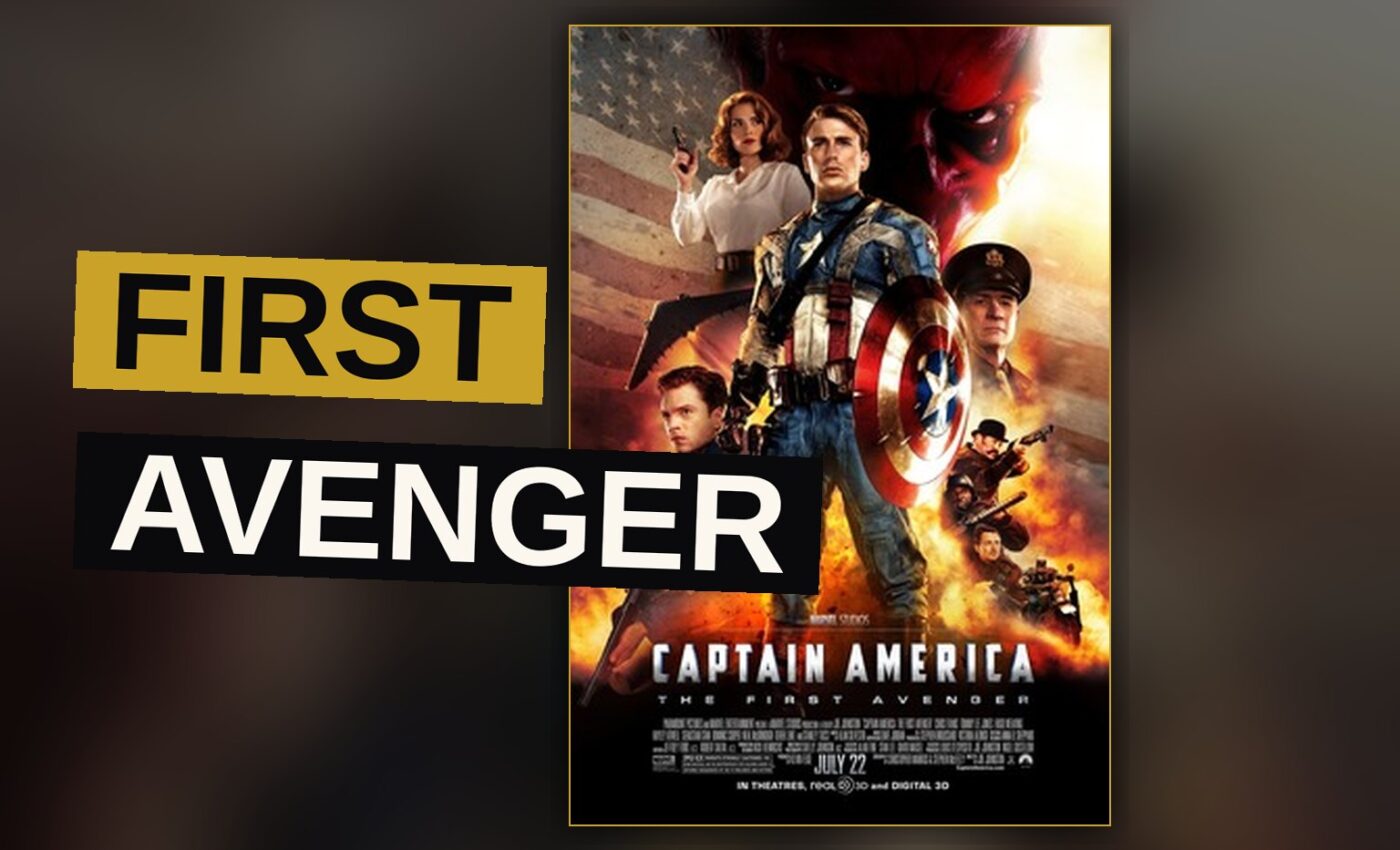
Captain America: The First Avenger opens with a weak kid from Brooklyn who keeps getting beaten up in alleyways. He has a list of diseases, a stubborn streak, and a desperate desire to enlist. The army rejects him, but a scientist named Dr. Abraham Erskine sees something in him and picks Steve Rogers for a secret experiment. The transformation turns the weakling into a super-soldier.
The year is 1942. The experiment works, but not in the way Rogers hoped. Instead of being sent to the front lines, he is dressed in a colorful costume and sent on a tour to sell war bonds. The movie spends a good chunk of its runtime on this humiliation. Rogers punches a dummy of Hitler on a stage, and the crowd laughs at him. It is a clever way to delay the action, and it gives Chris Evans a chance to play frustration rather than triumph.
Evans is the right choice for the role. He has the jawline of a recruiting poster and the earnestness of a kid who actually believes in the words he is saying. He is neither ironic nor cool. He is simply decent, and that decency carries the film through its sillier moments.
Trailer, via Marvel Entertainment.
Schmidt and His Hydra
The villain is Johann Schmidt, a Nazi scientist who experiments on himself with the same serum that made Rogers strong. The serum burns his face off, leaving him with a red skull for a head. Hugo Weaving plays him with a theatrical sneer that fits the comic book tone. Schmidt calls himself the Red Skull and leads a secret organization called Hydra.
“I have seen the future, Captain. There are no flags.”
That line is the core of the movie. Schmidt believes in power without borders, a vision that is pure fascism. Rogers believes in the opposite: loyalty, duty, and the flag. The film does not pretend these ideas are equal. It makes Schmidt monstrous and Rogers heroic, without apology.
The Howling Commandos
Once Rogers proves himself by rescuing 400 prisoners from a Hydra fortress, he gets his own team, the Howling Commandos, which he leads himself. Bucky Barnes, Rogers’ childhood friend, is among them. The team is stock types: a British guy, a French guy, a black guy, and a guy with a big gun. They are not given much to do, but they serve their purpose.
The action sequences are solid — not the shaky-cam chaos of later superhero films, but clean, clear, and a little old-fashioned. Rogers throws his shield, and it bounces off walls and hits bad guys in the head. The choreography is simple, but it works. The movie feels like a Saturday matinee serial, and that is a compliment.
Peggy Carter and the Kiss
The romance is between Rogers and Peggy Carter, a British officer played by Hayley Atwell. She is no damsel but a sharpshooter who tells Rogers to stop being a showman and start being a soldier. Their relationship is built on a single kiss, but earns it through the film’s careful pacing.
The ending is the movie’s strongest card. Rogers sacrifices himself to save New York. He crashes a plane into the ice and wakes up 70 years later in a fake 1940s hospital room. He runs out into the street and realizes the war is over, his friends are dead, and the woman he loved has grown old without him. It is a melancholy ending for a superhero movie, and it lands.
Retro-Futurist Style
The production design has a retro-futurist look, with Hydra’s weapons glowing blue and the Allied gear looking like polished brass. The color palette is saturated, almost painterly. It looks like a comic book, not a gritty war film. That choice keeps the movie light on its feet.
Alan Silvestri’s score is big and brassy, like a John Williams score from the 1980s, and it fits the tone perfectly. A recurring motif swells during the final montage — the kind of music that makes you want to stand up and salute.
Flat Spots
The movie is not perfect. The Howling Commandos are underdeveloped. The Red Skull’s plan is vague. He wants to use a cube called the Tesseract to power his weapons, but the details are fuzzy. The film also rushes through the middle act, skipping from mission to mission without much breathing room.
The supporting cast is wasted. Tommy Lee Jones plays a gruff colonel, and Stanley Tucci plays Dr. Erskine. Both are good, but they are given little to do. The movie is 124 minutes long, and it could have used another 20 to give these characters more weight.
A Sincere Adventure
Captain America: The First Avenger is a solid superhero movie that knows exactly what it wants to be. It is neither dark nor cynical. It is a sincere adventure story about a good man in a bad war. It has a strong lead, a memorable villain, and an ending that actually means something.
The film was directed by Joe Johnston, who also made The Rocketeer. That is the right reference point. This is a movie that loves the past, and it shows that love in every frame. It is not the best Marvel movie, but it is one of the most charming.
Captain America: The First Avenger scores 7 of 10.