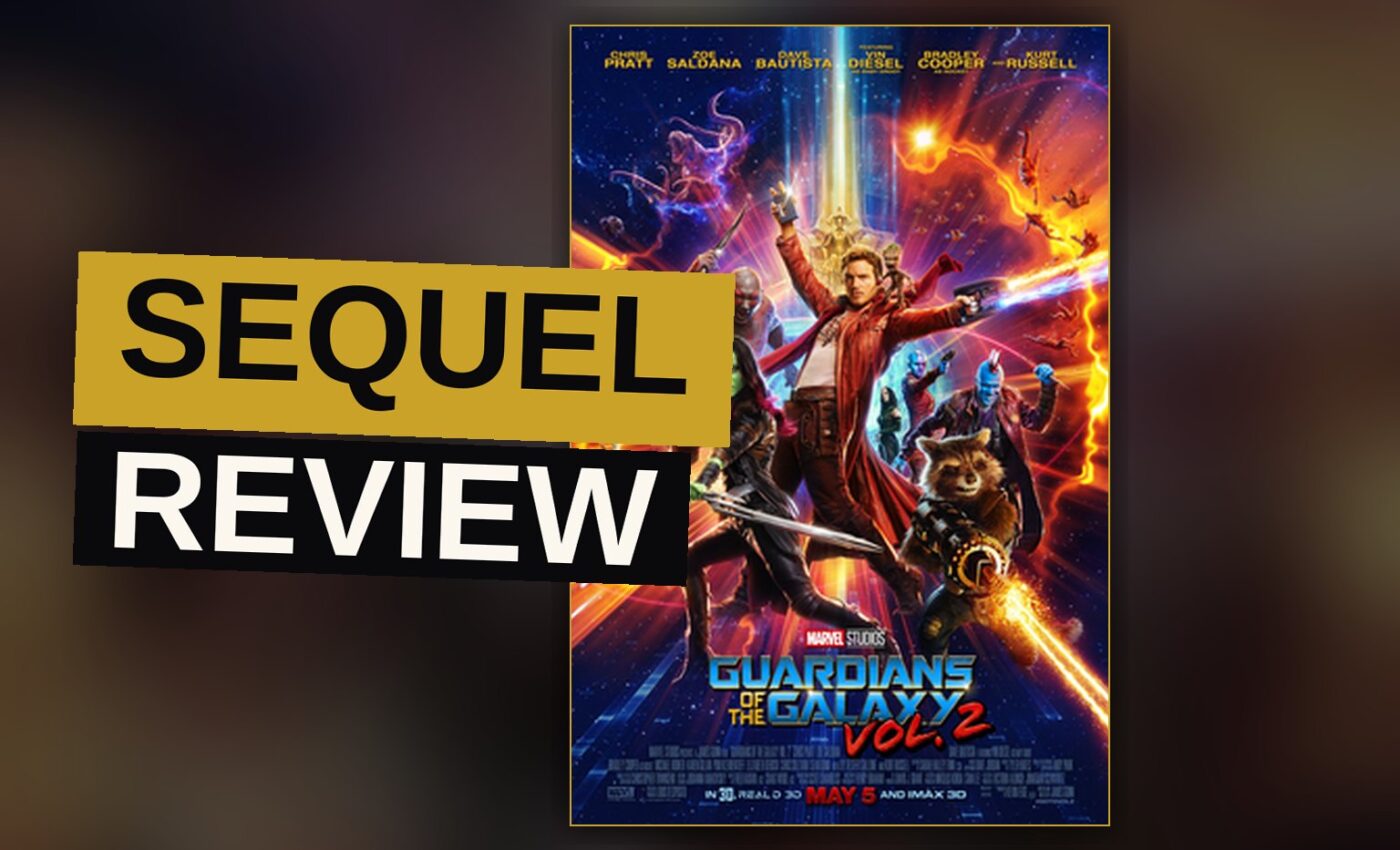
Guardians of the Galaxy Vol. 2 is louder, brighter and more crowded than its predecessor. It is also more sentimental. That combination should not work, yet it mostly does. The film trades the surprise of the 2014 original for something harder to pull off: a sequel that deepens its characters while doubling the spectacle.
James Gunn returns as writer and director, and he has made a film that feels like a family reunion where everyone talks over each other. The story follows Peter Quill, Gamora, Drax, Rocket and Baby Groot as they tangle with the Sovereign, a gold-skinned race that demands vengeance after Rocket steals their batteries. Quill also meets his father, Ego, a living planet played by Kurt Russell, who offers answers about Peter’s divine heritage.
The film opens with a bravura sequence. The Guardians fight a massive interdimensional monster while Baby Groot dances to Electric Light Orchestra’s “Mr. Blue Sky.” The fight and the dance happen at the same time, and the camera never loses either thread.
Trailer, via Marvel Entertainment.
Family Ties That Bind
The core of the film is the group’s fractious bond. Quill and Gamora’s romance remains a slow burn, mostly conducted through bickering. Drax, played by Dave Bautista, has become the film’s comic engine, taking every metaphor literally and delivering deadpan observations about the absurdity around him. Rocket, voiced by Bradley Cooper, is angrier and more vulnerable, nursing the wound of being a created thing that no one wanted. And Baby Groot, voiced by Vin Diesel, is the film’s unlikely heart, a mute sapling who communicates through three words and a lot of expressive eyes.
Gunn’s script gives each character a moment to hurt and a moment to shine. The film’s emotional climax involves Quill learning that his father is not the benevolent god he claims to be. Ego reveals that he planted the tumor that killed Quill’s mother, hoping to draw his son to him. It is a brutal twist, and Russell sells the shift from warm paternalism to cold cosmic arrogance with unsettling ease.
The film’s best scene, however, belongs to Yondu, the blue-skinned ravager played by Michael Rooker. Yondu has always been a surrogate father to Quill, and the film makes that explicit. When he sacrifices himself to save Quill from Ego’s collapsing planet, the moment lands with genuine weight. Rooker, who spent the first film as a comic menace, delivers a performance of quiet dignity in his final scenes. The funeral sequence, set to Cat Stevens’ “Father and Son,” is the kind of emotional manipulation that works because the film has earned it.
Music as a Narrative Device
The music remains the franchise’s secret weapon. The first film’s “Awesome Mix Vol. 1” was a nostalgia trip that grounded the cosmic nonsense in human feeling. Vol. 2 uses its soundtrack, “Awesome Mix Vol. 2,” more deliberately. Each song is chosen to comment on the action or the character’s state of mind.
“Brandy (You’re a Fine Girl)” by Looking Glass plays as Ego explains his love for Quill’s mother, and the lyrics about a sailor’s devotion to the sea mirror Ego’s obsession with his own plans. “The Chain” by Fleetwood Mac underscores the Guardians’ attempt to escape Ego’s planet, its driving rhythm matching the on-screen chaos.
The soundtrack also gives the film a distinct identity in a genre where scores often blur together. Tyler Bates’ original score is functional but forgettable; the needle drops are what you remember.
Visuals and Pacing
The film’s production design is a marvel. Ego’s planet is a kaleidoscope of crystalline structures and swirling colors, a place that looks beautiful and wrong at the same time. The Sovereign are rendered as sleek, golden automatons, their perfection hiding a deep vanity. The Ravagers’ fleet, led by Sylvester Stallone’s Stakar, has a grimy, lived-in texture that contrasts with the gleaming surfaces elsewhere.
The action sequences are inventive. Rocket’s escape from the Sovereign’s fleet, which involves flying through a field of asteroids while being chased by drone ships, is a highlight. The final battle, in which the Guardians fight Ego’s plant-like tendrils across the planet’s surface, is chaotic but legible. Gunn has a gift for staging fights that are both funny and thrilling, and he rarely lets the CGI overwhelm the characters.
The film’s biggest weakness is its length. At 136 minutes, it runs longer than the original, and the middle section sags. The detour to the Sovereign’s home world and the extended sequence on Ego’s planet both feel padded. The film could have lost twenty minutes without losing any of its emotional beats.
Jokes, Gags and Cameos
The humor is relentless, and not every joke works. Drax’s literal-mindedness is funny the first five times, but it wears thin by the tenth. The film also leans heavily on Rocket’s insults, which are sharp but repetitive. Yet the best gags are the ones that come from character. During the escape from the Ravager ship, Baby Groot keeps fetching the wrong items — a detonator, a disembodied paw, Yondu’s prototype fin — instead of the cage lock’s release button. It is a masterclass in physical comedy.
The film also handles its cameos well. Stallone’s Stakar appears briefly, setting up a potential Ravagers spin-off, and his scenes with Rooker hint at a shared history that feels lived-in. The post-credits scenes, of which there are five, are a mix of jokes and teases. The one featuring a teenage Groot, who is now obsessed with his phone, is the best of the bunch.
Fatherhood and Its Costs
The film’s central theme is fatherhood, and it explores the idea from multiple angles. Quill has two fathers: Ego, who is a monster, and Yondu, who is a flawed but loving man. The film argues that family is not about blood but about choice. Yondu’s final line, “He may have been your father, boy, but he wasn’t your daddy,” is the thesis statement, and it lands with the force of a hammer.
The film is not subtle about its themes. Gunn beats you over the head with them, but he does so with sincerity. The emotional beats are earned because the characters have been established with care. When Gamora and her sister Nebula reconcile, it feels like a natural progression. When Rocket admits he is afraid of being alone, it feels like a confession, not a plot point.
The film’s biggest achievement is making you care about a talking raccoon and a tree. The Guardians are a family of misfits, and the film celebrates their flaws rather than erasing them. It is a messy, overstuffed movie, but it is also a heartfelt one.
Running Order of the Mixtape
| Sequence | Scene | Song or Beat |
|---|---|---|
| 1 | The monster fight on Sovereign | “Mr. Blue Sky” |
| 2 | Crash landing on Berhert | “Come a Little Bit Closer” |
| 3 | Ego’s arrival | “Brandy (You’re a Fine Girl)” |
| 4 | Rocket’s escape from the Sovereign fleet | “The Chain” |
| 5 | Yondu’s mutiny and rescue | “Come a Little Bit Closer” (reprise) |
| 6 | Ego’s reveal | “Father and Son” |
| 7 | Yondu’s funeral | “Father and Son” (full) |
| 8 | Post-credits scenes | Various |
Each major beat is anchored by a song, and the songs themselves tell a story of longing and loss. The result is a film that feels less like a series of set pieces and more like a mixtape with a plot.
A Messy, Heartfelt Blockbuster
Guardians of the Galaxy Vol. 2 is a sequel that tries to do too much and mostly succeeds. It is funnier, sadder and more visually ambitious than the original. It also suffers from pacing issues and an overreliance on jokes that do not always land. But the film’s strengths outweigh its flaws. The performances are excellent, with Rooker and Russell standing out. The soundtrack is impeccable. And the emotional core is genuine.
The film is a rare blockbuster that has both spectacle and soul. It is not a masterpiece, but it is a very good time at the movies. It is a big, loud, colorful celebration of family, in all its dysfunctional glory. If you can forgive the bloat, you will find a movie that cares about its characters and asks you to care too.
On TMDB, the film holds an audience score of 7.6 out of 10, based on 23,409 votes.