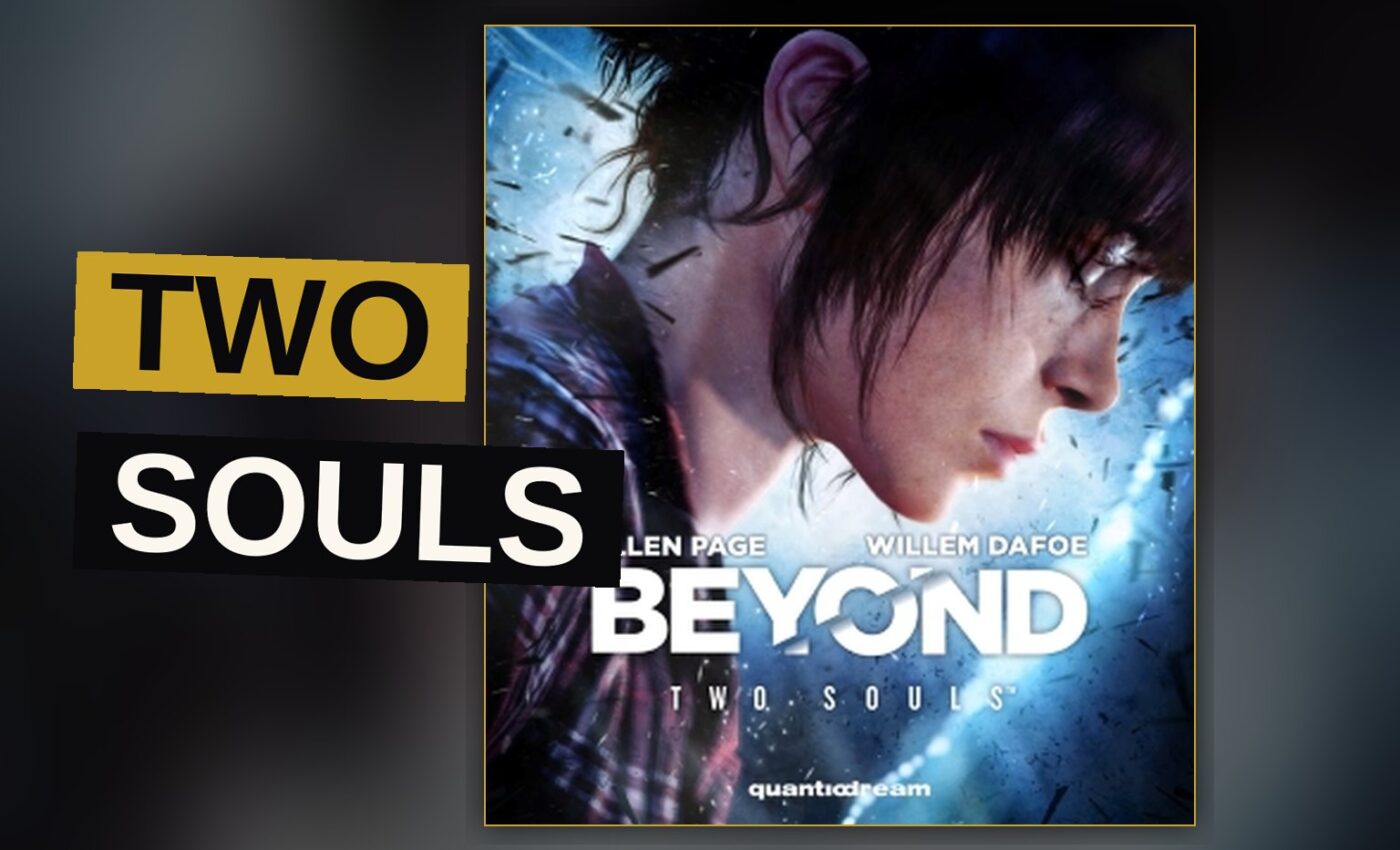
Beyond: Two Souls asks you to spend 15 years inside one woman’s life, then hands you a ghost on a leash. Quantic Dream’s action-adventure game stars Elliot Page as Jodie Holmes and Willem Dafoe as Nathan Dawkins, and it wants to be a film you can steer. The result is often striking and just as often maddening. It scores 6.6 of 10.
Trailer, via Quantic Dream.
Jodie Holmes and the Entity Called Aiden
Jodie is one of two player characters. The other is Aiden, an incorporeal entity described in the game’s own fiction as a separate soul linked to Jodie since birth. She has supernatural powers through a psychic link to him. The story runs from a confused child to a crack CIA agent as she learns to control Aiden and the powers they share.
That premise is the whole engine. Quantic Dream built a game where the second playable character exists permanently in noclip mode, able to move through walls and ceilings and other obstacles. Aiden is limited to a certain radius around Jodie because of their spiritual tethering. It is a clever piece of design on paper: one body, one ghost, two sets of rules.
A Paris Studio and a Year of Performance Capture
Page and Dafoe worked on set at Quantic Dream’s Paris studio for a year, doing voice acting and motion-capture acting. Dafoe plays Nathan Dawkins, a researcher in the Department of Paranormal Activity and Jodie’s surrogate father figure. Kadeem Hardison plays Cole Freeman, the second doctor. Eric Winter plays Ryan Clayton, the CIA agent who recruits Jodie. Caroline Wolfson plays young Jodie.
The A-list casting is not decoration. The game’s marketing leaned hard on Page and Dafoe, and the performances are the reason the material holds together at all. Quantic Dream was selling Hollywood in a box.
The Condenser and the Infraworld
Young Jodie lives with foster parents in a suburban home. After an incident with neighbourhood kids nearly ends with Aiden killing one of them, the foster parents hand her over permanently to Nathan and Cole. Under their care she learns control. Meanwhile the two doctors build the condenser, a portal connecting the living world to the dead — the Infraworld.
One night Nathan learns his wife and daughter were killed in a car accident. While comforting him, Jodie discovers she can channel spirits of the dead, helping them speak to the living through a psychic link made by her physical contact. Later the condenser breaks open. Jodie braves hostile entities from the Infraworld, shuts it down, and warns Nathan not to build another.
That warning gets the CIA’s attention. Ryan Clayton is sent to forcibly recruit her. After training, the adult Jodie runs field missions, often with Ryan.
Slow Motion, White Dots and Floating Prompts
The player mostly controls Jodie through environments, moving her into interactions with objects and non-player characters to advance the story. At almost any time, a second player can switch to Aiden. Interactive objects are marked with a white dot, tilted toward with the controller stick.
If Jodie must perform a specific action, icons pop up prompting the player to press or hold certain controller buttons. Conversation prompts float in the air and default to a certain choice if too much time passes before selection. During chases and hand-to-hand combat, the cinematography moves into slow motion while Jodie performs the manoeuvre; the player has to read the direction she is moving and push the stick that way.
Other sequences require real-time stealth, sneaking Jodie through environments while coordinating actions with Aiden. Failing certain action sequences alters the course of a chapter, and sometimes later chapters, and in some cases leads to the death of a non-player character. Playing as Aiden renders the game monochromatic, with interactive objects highlighted by an aura.
The game supports single player, multiplayer and co-operative modes, and it is played in third person.
2013, 2015, 2019: Three Platforms, One Argument
- PlayStation 3: released 8 October 2013
- PlayStation 4: released 24 November 2015
- Windows PC: released 22 July 2019, self-published by Quantic Dream
- Sales: 2.8 million units by July 2018
- Critic aggregate: 6.6 of 10 from 15 outlets
Sony Computer Entertainment published the original release. Quantic Dream self-published the PC port six years later.
Tribeca and David Cage’s Pitch
Beyond: Two Souls premiered at the 2013 Tribeca Film Festival. It was the second time the festival had recognised a video game. Writer and director David Cage said development studios should provide “interactive storytelling” that can be played by everyone, including non-gamers.
That quote is the design brief and the problem in one sentence. Cage wanted a game for people who do not play games. What he built is a game that keeps interrupting its own story to ask you to tilt a stick.
What Actually Works Here
The performance capture is the strongest asset. Page carries Jodie from adolescence to adulthood, and Dafoe gives Nathan a warmth that the script needs badly. The Paris studio year shows on screen. When the game slows down and lets a scene breathe, the Hollywood investment pays off.
Aiden is the best idea Quantic Dream has had. A second playable character who moves through walls, sees in monochrome, and can only stray so far from Jodie is a genuinely novel set of constraints. The tether is both a mechanic and a metaphor, and the game knows it.
Where the Design Fights the Story
The interaction layer is the weak point. White dots, floating conversation prompts, button icons, stick-tilt directions — this is a control scheme that asks the player to translate a film into inputs. The slow-motion combat sequences turn action into a reading test. The stealth sections sit awkwardly beside the drama.
Worse, the game cannot decide how much your choices matter. Failing an action can change a chapter, or later chapters, or kill a non-player character. That is real consequence. But the prompts default if you hesitate, which means the game will make your decision for you if you take too long to care. A story about a woman fighting for control of her own life keeps taking control away from the person holding the controller.
The 15-year structure is ambitious and uneven. Jumping across Jodie’s life means the emotional build is choppy. Some chapters land. Others feel like they exist to show off a mechanic.
What the 6.6 Says About the Bet
Beyond: Two Souls is a 6.6 of 10. It is worth playing for Page, for Dafoe, and for Aiden, who remains one of the more original playable characters in a big-budget game. It is worth arguing about for everything else.
The 2.8 million units sold by July 2018 suggest the pitch worked on enough people. The polarised reception suggests it also failed on enough of them. Both are true.
Quantic Dream’s bet was that interactive storytelling could be for everyone, including non-gamers. The bet half-landed. The story is often strong. The storytelling machinery is often in the way. A television adaptation is in development, with Page producing through his production company, and that makes sense precisely because the best parts of Beyond: Two Souls are the parts that do not require a controller.
Get the Notebook.
The day's best stories and every fresh verdict, in plain English, in your inbox by seven. One email a day, no more.