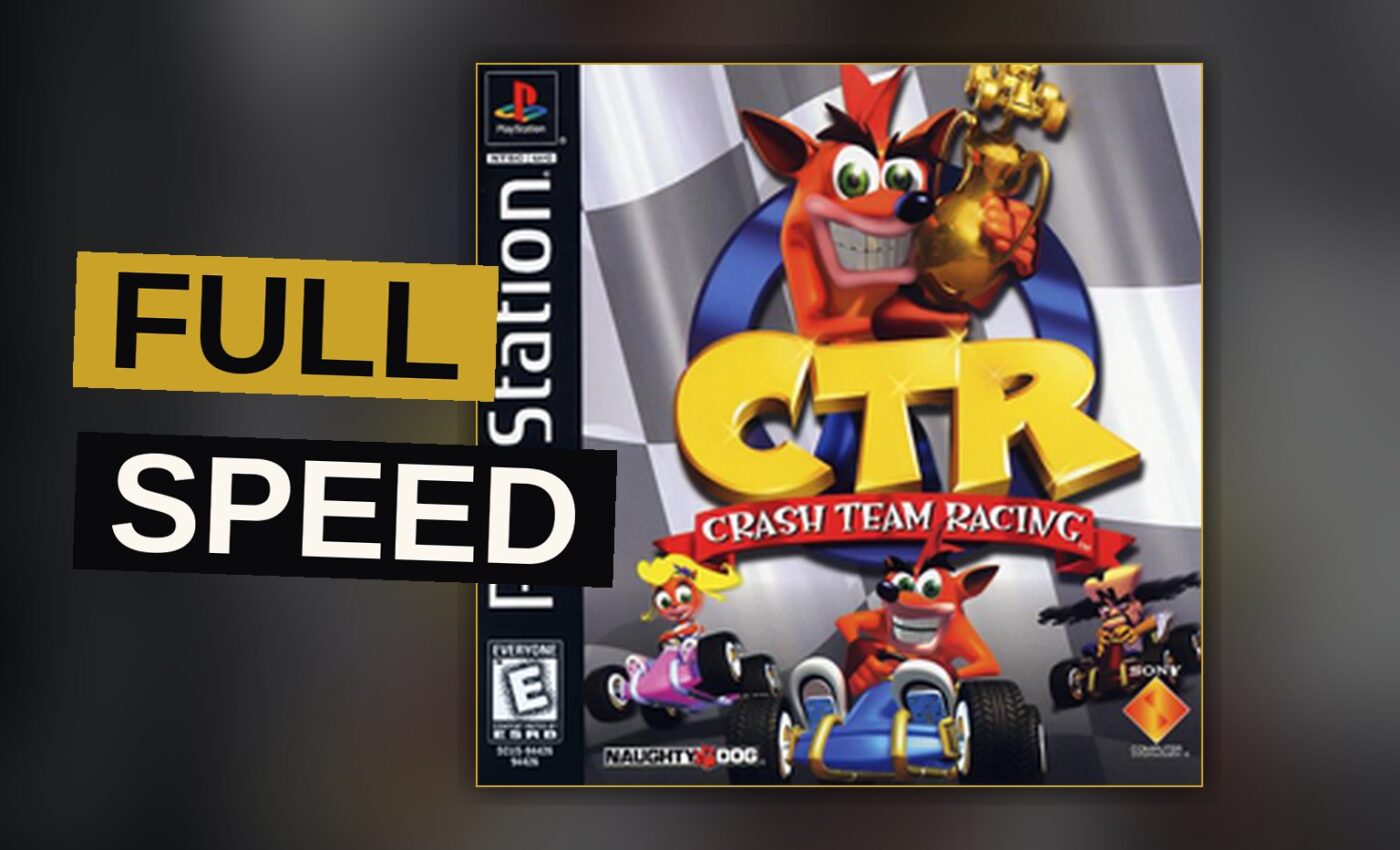
Crash Team Racing arrived on the original PlayStation in 1999 as the fourth game in the Crash Bandicoot series and the last one Naughty Dog would make. Sony Computer Entertainment published it. The pitch is simple: take the characters from a platforming series, put them in karts, and let them race. What could have been a quick cash-in instead became one of the most polished kart racers of its era, a game that understood exactly what it was and executed almost every part of it cleanly.
Nitros Oxide and the Wager
The story sets up a race for the planet. An egotistical space alien named Nitros Oxide comes to Earth and challenges Crash Bandicoot, his friends and his foes to a racing competition. The stakes are not subtle. If Oxide wins, he turns the world into a concrete parking lot. The only way to stop him is to beat him on the track.
That premise does two things well. It gives every character a reason to race together, including villains who would normally be trying to destroy Crash. Doctor Neo Cortex, his longtime adversary, ends up on the same ragtag team as Crash. The game does not waste time explaining the truce. It just puts everyone behind a wheel and lets the rivalry play out at speed.
Fifteen Characters, Eight to Start
Players can take control of one of fifteen Crash Bandicoot series characters, though only eight are available at first. The rest unlock as you progress, which gives the roster a sense of reward rather than dumping everything on the player at once.
Characters fall into three types. Large characters have slow acceleration, high top speed and poor handling. Medium characters are balanced. Small characters have fast acceleration, great handling and low top speed. That split matters more than it sounds. Picking a heavy character on a tight track is a genuine handicap, and the game makes you feel it.
The story mode lets you choose any one of the characters to complete all the main races and beat Nitrous Oxide. Each main race pits you against seven other AI competitors, and there are five boss races on top of that. Arcade modes support up to four players.
Power Slides and the Turbo Boost Meter
The core of Crash Team Racing is the power slide, and it is the reason the game still feels good to play. You hold a shoulder button to hop, then steer before the kart lands. While sliding, the Turbo Boost Meter in the lower-right corner of the screen fills and shifts from green to red. The exhaust from your kart turns black at the same time.
To get a speed boost, you quickly press the opposite shoulder button while the meter is red. You can chain three boosts in a single power slide, and the third is more powerful than the first two. The timing is tight. Wait too long and the kart back-fires, killing the boost. Slide too long and you spin out.
That risk-reward loop is the whole game in miniature. It rewards players who learn the rhythm and punishes those who get greedy. Nothing else in the racer demands as much attention, and nothing else pays off as much.
The player can execute three speed boosts in a row during a power slide, with the third speed boost being more powerful than the previous two.
Speed boosts also come from hang time. Leaping over gaps in the track and staying airborne longer produces a bigger boost when you land. Hitting the accelerator just before the race begins gives an initial boost off the line. Small details, but they add up to a game where every second of a lap has something to optimize.
Crates, Power-Ups and Track Chaos
Two distinct forms of crates are scattered throughout the tracks and arenas. Crates with question marks hold power-ups, which you get by driving through and breaking them apart. Offensive and speed-boosting power-ups can be used during races to gain an advantage.
The crate system does more than hand out weapons. It shapes how you drive. Weaving to collect crates costs you time and puts you in traffic, so every pickup is a small trade. That tension keeps the racing from becoming a straight sprint.
The tracks themselves support the mechanics rather than fighting them. Gaps exist to be jumped for hang time. Corners exist to be slid through. The design and the driving system are pointed at the same goal.
A Mario Kart Blueprint, Refined
Crash Team Racing drew heavy inspiration from Nintendo’s Mario Kart and Diddy Kong Racing. That is not a secret and the game does not pretend otherwise. The structure, the power-ups, the character types and the four-player split screen all come from a formula that was already established.
What separates Crash Team Racing is the execution. The power slide gives it a skill ceiling that Mario Kart of that era did not really have. The technical side holds up too. The game runs smoothly, the controls respond, and the whole thing feels like it was polished rather than pushed out.
The lack of originality is real. If you wanted a kart racer that invented something new, this was not it. But invention is not the only measure of a game, and Crash Team Racing beats its competitors in several areas despite borrowing their blueprint. The power slide alone is a stronger mechanical idea than anything in Diddy Kong Racing.
The Last Naughty Dog Crash Game
Crash Team Racing was the final Crash Bandicoot game developed by Naughty Dog. That fact gives it a certain weight in hindsight. The studio that built the series walked away after this one, and it walked away with a game that still holds up.
The series did not stop. A successor, Crash Nitro Kart, was released in 2003 for the Game Boy Advance, GameCube, PlayStation 2, Xbox and N-Gage. A remaster developed by Beenox, titled Crash Team Racing Nitro-Fueled, was announced at The Game Awards 2018 and released on the Nintendo Switch, PlayStation 4 and Xbox One on June 21, 2019, by Activision.
That a remaster exists at all says something about how the original was received. Games that were merely fine in 1999 do not usually get a second life two decades later. Crash Team Racing earned its return.
What the Boost Meter Decides
Crash Team Racing was met with critical acclaim upon release, widely regarded as a highly polished and entertaining kart racing game. Critics praised its execution, technical achievements and engaging gameplay, often arguing it surpassed its competitors in several areas despite its lack of originality.
That assessment holds up. The game is not original, but it is better than it needed to be. The power slide gives it depth that most kart racers never bother to build, and the three character types make roster choice matter. The story mode gives the single-player experience a real spine, and the boss races break up the routine of standard laps.
The weaknesses are the ones you would expect. The roster is thin at the start, and the fifteen-character count only matters once you have unlocked the rest. The AI can be uneven across the five boss races. And the game never tries to be anything more than a very good kart racer, which is fine but also a ceiling.
What matters is that Crash Team Racing does the core thing right. Racing against seven opponents on a track you have learned, chaining three boosts through a corner, and beating Nitros Oxide is still satisfying. The concrete parking lot threat is silly. The racing is not.
Get the Notebook.
The day's best stories and every fresh verdict, in plain English, in your inbox by seven. One email a day, no more.