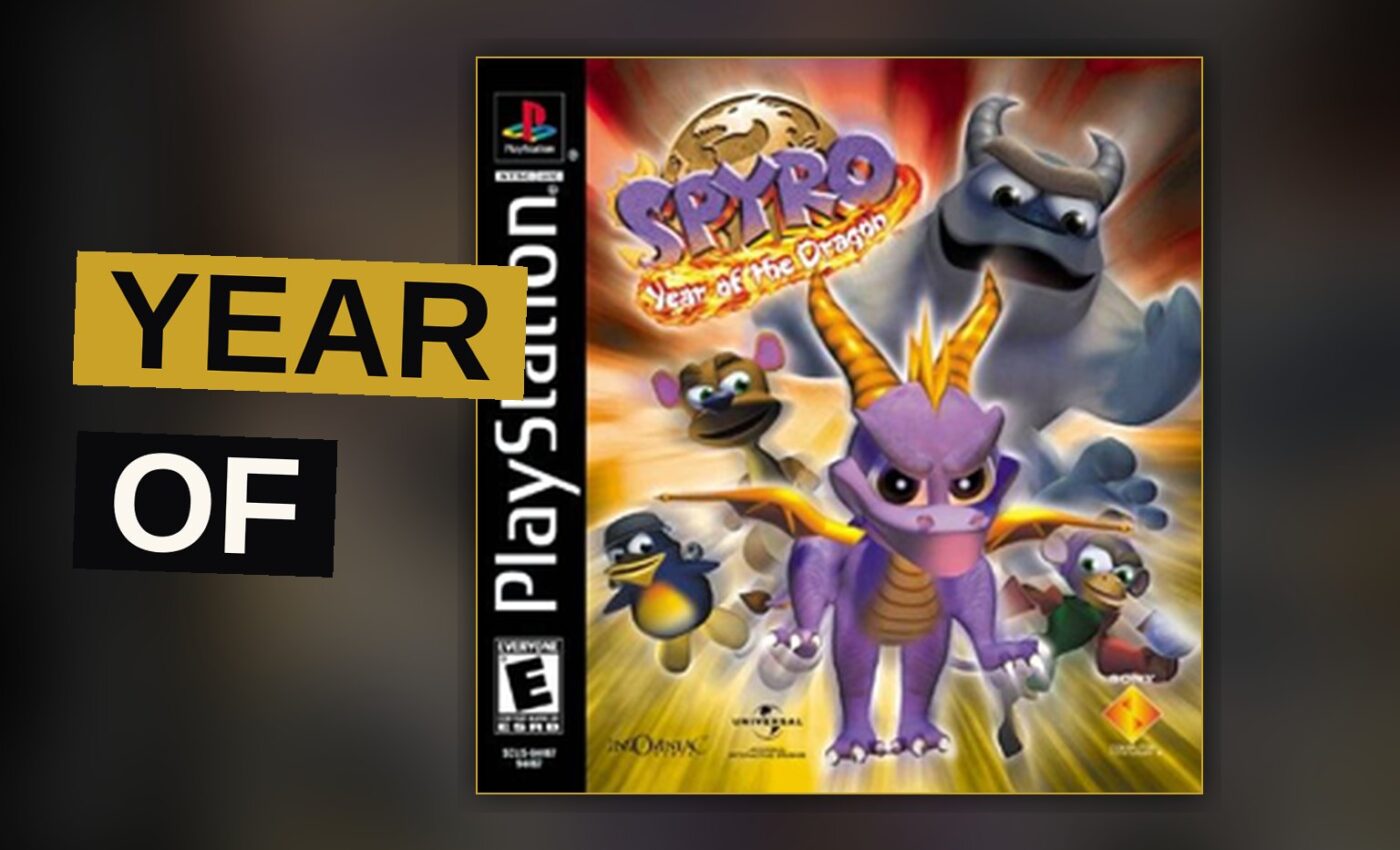
Spyro: Year of the Dragon asks players to save four dragon realms from a war between two rival kingdoms, and it does so with a level design so clever that the game feels less like a checklist of tasks and more like a puzzle box built to be opened. This sequel to the original Spyro drops the fixed camera and adds a small amount of movement freedom, a change that gives every stage a distinct rhythm. The result is a platformer that still holds up decades later, even if its scope is modest compared to what followed it.
From Fixed Camera to Free Movement
The biggest change in Year of the Dragon is also the simplest: Spyro can now move left and right freely through levels, rather than being locked into a set path. That single shift opens up the way each stage is laid out. Enemies and obstacles sit in tighter spots now, forcing players to plan their moves rather than walk past them. The camera follows closely behind, rarely getting in the way during a run.
It is a small addition, but it changes everything. Levels feel less like a series of rooms and more like open ground to be explored, even within the narrow limits of the PlayStation hardware.
Four Realms, One Story
The game splits its world into four realms, each ruled by a kingdom caught in a war with the other. Players move through each realm to gather gems, defeat bosses, and unlock new paths. The story is thin, mostly told through short scenes between stages, but the setup gives Year of the Dragon a shape the original lacked. There is a reason to care about each realm beyond simply collecting its gems.
The pacing keeps things moving. No single realm drags on too long, and the difficulty rises steadily across the game, giving players a clear sense of progress as they move from one kingdom to the next.
The Gem System Returns
Players return to the gem-collecting system that defined the original Spyro. Gems fill a counter on screen, and once full, players can summon a dragon statue that clears enemies and opens new paths. It is a simple system, but it rewards exploration. Finding every gem in a level often means searching off the beaten path, and the game hides enough extras that players will want to look twice before moving on.
The system is not without friction. Filling the gem counter takes time, and some levels ask for more gems than the player has collected. That forces a return trip, which can feel tedious in a few stages. Still, the system holds together better than it had any right to.
Boss Fights and Difficulty
Boss fights stand out as the high points of Year of the Dragon. Each boss is a distinct fight, tied to the realm it guards, and the game gives players enough room to learn their patterns without punishing mistakes too harshly. The final boss in particular is a demanding test that asks players to put everything they have learned to use.
Difficulty rises steadily across the game. Early levels are forgiving, but the middle stretch ramps up quickly, especially in the last two realms. Players who rush through early will find themselves slowed down later, a lesson the game teaches well.
Sound and Look
The graphics hold up well for their time. Character models are detailed for the hardware, and the animation work is expressive, giving Spyro a personality that carries the whole game. The color palette is bright and varied, with each realm offering its own distinct look. The music matches the tone of each level, shifting between playful and tense depending on where players are.
Sound effects are simple but effective. Enemy hits land with weight, and the sound of gems being collected is satisfying. Nothing here reaches for grandeur, but the game does not need it.
Where It Falls Short
Year of the Dragon is not without its rough edges. Some levels repeat ideas from earlier stages without adding much new. A few sections rely too heavily on repeated enemy types, which can make the middle portion feel dull compared to the opening realms. The game also does not offer much in the way of extra content beyond its main campaign, though the gem-counting system gives players a reason to look around.
None of these problems sink the game. They simply keep it from being perfect.
How It Compares
| Feature | Spyro: Year of the Dragon | Later Spyro Titles |
|---|---|---|
| Camera | Fixed path, free movement | Fully free movement |
| Story | Split into four realms | Single unified setting |
| Gem system | Present and central | Often present but secondary |
| Difficulty | Steady rise | More variable |
The table shows how Year of the Dragon sits between the original Spyro and the games that followed it. Its systems are simpler, its scope smaller, but its level design remains sharp. Later Spyro titles pushed the series further in terms of scale and polish, but Year of the Dragon holds its own as a tight, focused piece of work.
Final Word
Spyro: Year of the Dragon earns its reputation as one of the best platformers on the original PlayStation. Its level design is clever, its movement is satisfying, and its gem system rewards curiosity. The rough patches — repeated levels, thin story, lack of extra content — are real, but they do not cancel out the strengths. This is a game built with care, and it shows.