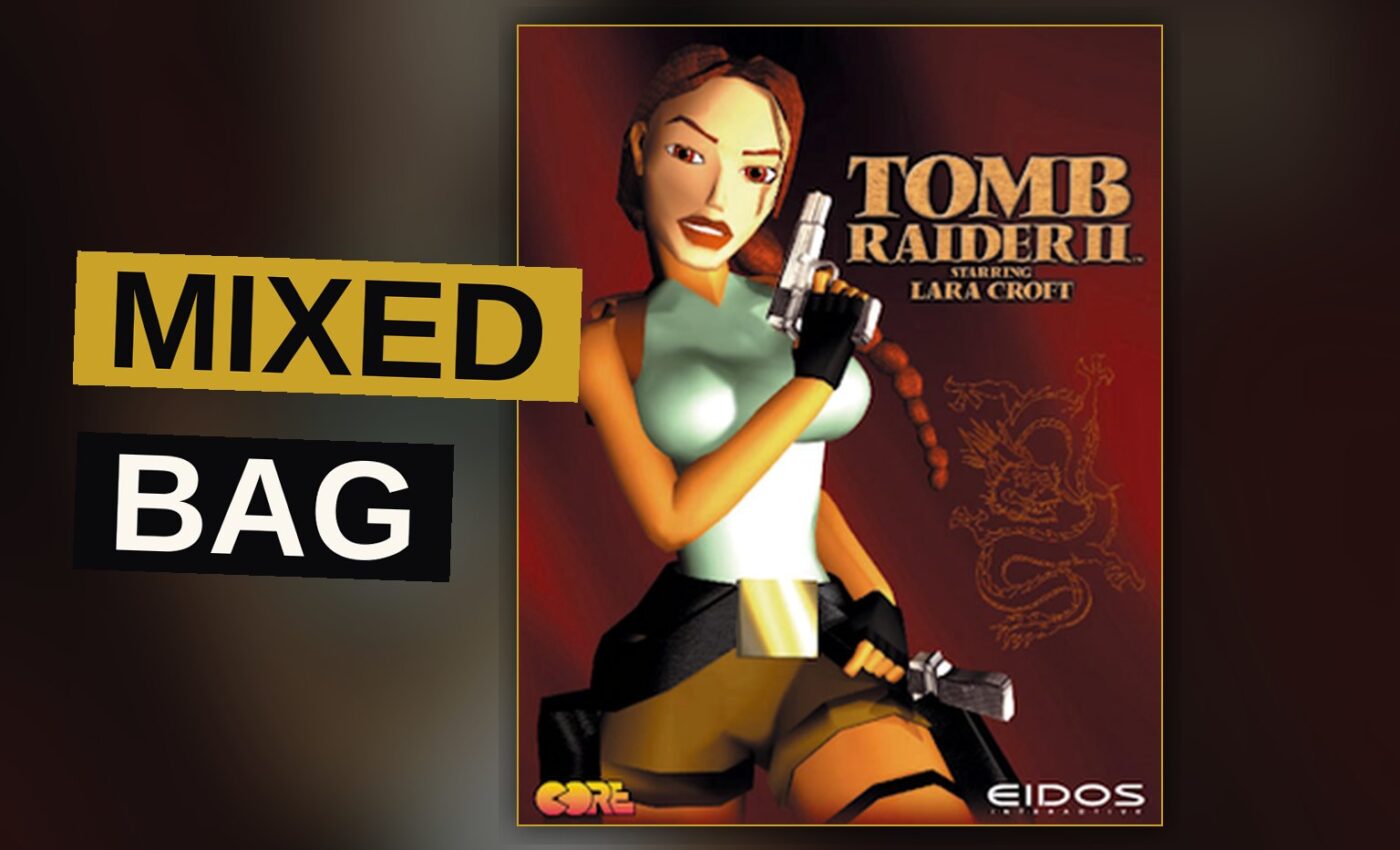
Tomb Raider II arrived in 1997 on the back of a genuine phenomenon, and it carries the marks of a game made too fast to think. Core Design built it in six to nine months, straight after the first Tomb Raider’s success, and Eidos first released it on Windows and PlayStation. You can feel the rush in every level. It sold nearly seven million copies. It is not a good game.
Lara Croft and the Dagger of Xian
The premise is sturdy enough. Lara Croft hunts the Dagger of Xian, a weapon Chinese emperors used to command their armies. Pierce your own heart with it and you become a dragon. A Venetian crime lord named Marco Bartoli wants it, and he leads the Fiamma Nera, an Italian cult obsessed with the dagger. Lara races him across the Great Wall, Venice, an oil rig, a shipwreck and the foothills of Tibet.
That itinerary is the best thing here. The game moves, and it moves through places worth seeing.
Tank Controls and Grid-Based Rooms
The problems start the moment you touch the controller. Tomb Raider II keeps the grid-based movement and tank controls of its predecessor, and it keeps the third-person camera fixed on Lara. Neither has aged into charm. Lara runs, walks along ledges, shimmies, crawls, swims, climbs ladders, moves blocks and turns 180 degrees mid-jump. She can drive a speedboat in Venice and a snowmobile in Tibet.
Every one of those actions is a negotiation with a camera that will not cooperate. A jump that looks simple becomes a small ordeal. The grid does not forgive.
The Weapons Cabinet
Combat got the sequel’s attention, and the arsenal tells the story. By default Lara carries two pistols with infinite ammo, and she cannot do anything but jump while they are drawn. Everything else is found and finite.
- Shotgun
- Dual automatic pistols
- Dual Uzis
- M16 rifle
- Grenade launcher
- Harpoon gun, for underwater fights
That is a lot of hardware. It does not make the fighting interesting. It makes it louder.
Fiamma Nera, Barkhang Monastery, Maria Doria
The plot is a chase, and it is told in fits. Lara overhears Bartoli on a seaplane discussing the Seraph, an object key to retrieving the key to the Dagger’s chamber, which sank with his father Gianni’s liner Maria Doria. She gets caught. She gets imprisoned on a repurposed oil rig above the wreck. She escapes, dives the Maria Doria, retrieves the Seraph, and heads for the Barkhang Monastery in Tibet, where monks once defeated the Emperor and sealed the dagger away.
A monk there tries to stop Bartoli and is killed for it. Lara uses the Seraph to open the way to retrieve the key to the Dagger’s chamber, and is plunged into the catacombs before she can reach it. She climbs back, and watches Bartoli stab himself with the dagger and get carried off.
It is a serviceable adventure. It is also a story that keeps happening to Lara rather than because of her.
Great Wall, Venice, Tibet
The level design is where the sequel’s reputation rests, and it is uneven. The Great Wall opens things well. Venice is the highlight, with its canals, its opera house and the speedboat, and it gives the game a texture the first one never had. The oil rig and the Maria Doria drag. Tibet is fine.
Croft Manor returns as a training area from the start menu and gets reused in the final level, which is a cost-saving trick that reads as one. Zip lines cross some gaps. Flares light dark rooms for a limited time. These are small, sensible additions.
What Nearly Seven Million Copies Bought
Tomb Raider II was well-received on release, with critics noting expanded gameplay and smoother graphics. That verdict has not held up. An expansion, The Further Adventures of Lara Croft, was in development in late 1997 but was cancelled, and a Sega Saturn version was scrapped over technical limits and an exclusivity deal between Eidos and Sony. Original staff Toby Gard and Paul Douglas left over creative differences with Eidos, though composer Nathan McCree stayed.
The departures are a real loss. The game’s problems sit in the parts that were never finished properly, and the record does not say the two are connected.
Tomb Raider II is a fast follow-up that mistook more for better. The M16 and the grenade launcher do not fix combat that was never the point. The speedboat and the snowmobile do not fix a camera that fights you. What the game actually adds is volume: more enemies, more weapons, more human foes to shoot, and a shorter fuse on every jump.
The Venice stretch is worth playing. Very little else is. Nearly seven million copies made this the version of Lara Croft a generation remembers, and that is a strange thing to be remembered for.
Get the Notebook.
The day's best stories and every fresh verdict, in plain English, in your inbox by seven. One email a day, no more.