
The White House says Chevron has confirmed it will increase its presence in Venezuela, following an announcement from President Donald Trump about a deal to develop the country’s oil reserves while giving the Pentagon a share of the profits.
Over the next five years, the company intends to spend more than $7 billion on investment. The goal is to raise its current production in the Orinoco Belt by more than double, reaching roughly 600,000 barrels a day.
Chevron’s Long History in Venezuela
The company has held operations in Venezuela since 1923, and Mike Wirth, its chief executive, positioned the growth there as a sign of belief in what the nation’s resources could produce.
“Chevron’s history in Venezuela spans more than a century, and our expanded position reflects our confidence in the country’s deep resource potential,” Wirth said in a prepared statement.
Venezuela holds the world’s largest proven reserves, totaling more than 303 billion barrels of crude oil, according to OPEC’s 2025 Annual Statistical Bulletin. Saudi Arabia trails far behind with 267 billion barrels.
The statistics paint a partial picture of Venezuela’s oil output. The country pumps roughly 1 million barrels a day, while Saudi Arabia’s daily production falls between 10 million and 11 million barrels. The United States, by contrast, extracts nearly 14 million barrels per day.
The White House Deal
The White House is moving ahead with a wider effort to engage with Venezuela’s oil industry. The administration confirmed Monday that it is partnering with North American Blue Energy Partners, NABEP, as part of Trump’s plan, and the expansion is part of that push.
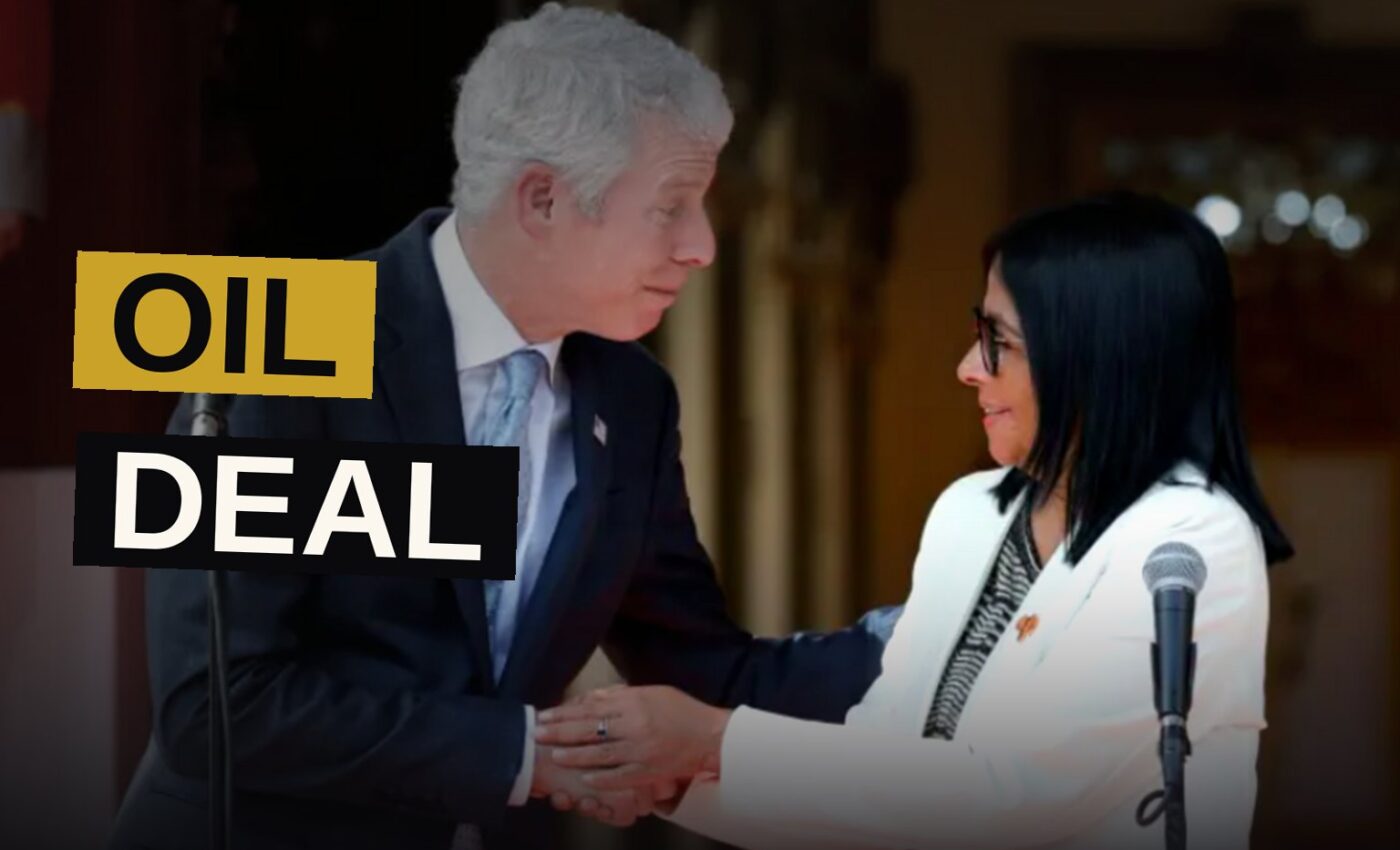
Wednesday saw U.S. Energy Secretary Chris Wright take part in a ceremony held by the government of Venezuela’s capital, where Chevron, Italian oil company Eni and other energy firms signed agreements with the South American country’.
Wright made his case without pulling any punches, arguing that the arrangement stood at the center of a larger undertaking.
“President Trump’s mission in Venezuela is straightforward. The mission is to bring peace, freedom, opportunity and prosperity to the people of Venezuela,” Wright said in Caracas. “I believe the deals that are signed today – tens of billions of dollars of investment, ultimately many thousands of jobs – are critical in starting this ball rolling of peace, opportunity and prosperity for everyone in Venezuela.”
Questions Over the Acting President’s Authority
The deal has raised skepticism from energy experts, who say reviving Venezuela’s oil industry will take years. There are also questions about whether Venezuela’s acting president, Delcy Rodríguez, has the authority to grant NABEP 100-year rights over 17 oil fields with reserves of 65 billion barrels.
The Cato Institute’s vice president for international studies, Ian Vásquez, wrote that the arrangement lacks legitimacy because it was negotiated with a regime that has held power through violence and fraud.
“The deal lacks legitimacy since it was agreed to with a dictatorship that has clung to power for decades through violence and by committing what was probably the largest electoral fraud in Latin American history in 2024,” Vásquez wrote. “The agreement was also reached under overwhelming pressure, military and otherwise, from the United States. As such, any future Venezuelan democracy will question the deal, thus undermining confidence in the current arrangement.”
The National Assembly is required to approve such arrangements under Venezuela’s constitution, and it has not done so. On Tuesday, the ruling party-controlled National Assembly voiced support for the deal during its session, yet lawmakers did not hold a debate or vote to approve it.
Wright Pushes Back on Criticism
Wright dismissed the criticism, telling reporters that the deal is “a massive win” for both countries.
“Because what it’s going to do is take resources that are underground, not helping anyone, and invest capital and technology and bring them to the surface to better the lives of Venezuelans, better supply energy to Americans,” Wright said during a joint press conference with Rodríguez.
The Road Ahead
Since the January capture of then-President Nicolás Maduro, Trump has had his eye on Venezuela’s oil. He has pushed for U.S. companies to return to the country, pointing out in January that “We have Exxon going in, we have Chevron going in. We have our big oil companies going in.”
The proof supports just one of those two statements. Chevron has stated its intention to expand; Exxon has offered no comparable demonstration of dedication.
Exxon Mobil CEO Darren Woods said in January that Venezuela was “uninvestable.” An Exxon spokesman said this week that “nothing has changed.”
The backstory behind U.S. oil giants’ reluctance in Venezuela dates back to two key moments. In 1976, the nation took over its own oil industry and created the state-run company Petróleos de Venezuela S.A. Then, in 2007, President Hugo Chávez moved to force foreign oil companies into joint ventures controlled by the state and seized the holdings of those that declined. Chevron accepted the arrangement. Exxon and ConocoPhillips rejected it, and Venezuela took their assets instead.
The Infrastructure Problem
Trump has said the agreement would “substantially lower” gasoline prices in the U.S. Analysts warn that Venezuela’s dilapidated oil infrastructure will require years of restoration work and tens of billions of dollars to resuscitate.
“It could take 2 to 4 years to get new greenfield facilities online in the Orinoco region,” Amy Jaffe, director of the Global Energy, Climate, and Sustainability Lab at New York University, said in an email. “Other places where there is no pipeline and other kinds of support infrastructure could take longer.”
For drivers, the timing is crucial. Overnight, the national average price for a gallon of regular gasoline rose to $4.12, according to the motor club AAA. That represents an increase of 93 cents over what it cost at this time last year.
What Comes Next
Chevron’s $7 billion bet rests on several assumptions. The first is that the deal holds together, despite the questions over Rodríguez’s authority and the National Assembly’s failure to approve it.
That the issues with infrastructure can be resolved inside the schedule Jaffe laid out is the second point.
The payoff hinges on two things:
- Whether the infrastructure can be rebuilt, and
- Whether the deal survives scrutiny.
The company is pressing ahead at present, with the White House working to see that the arrangement moves forward.