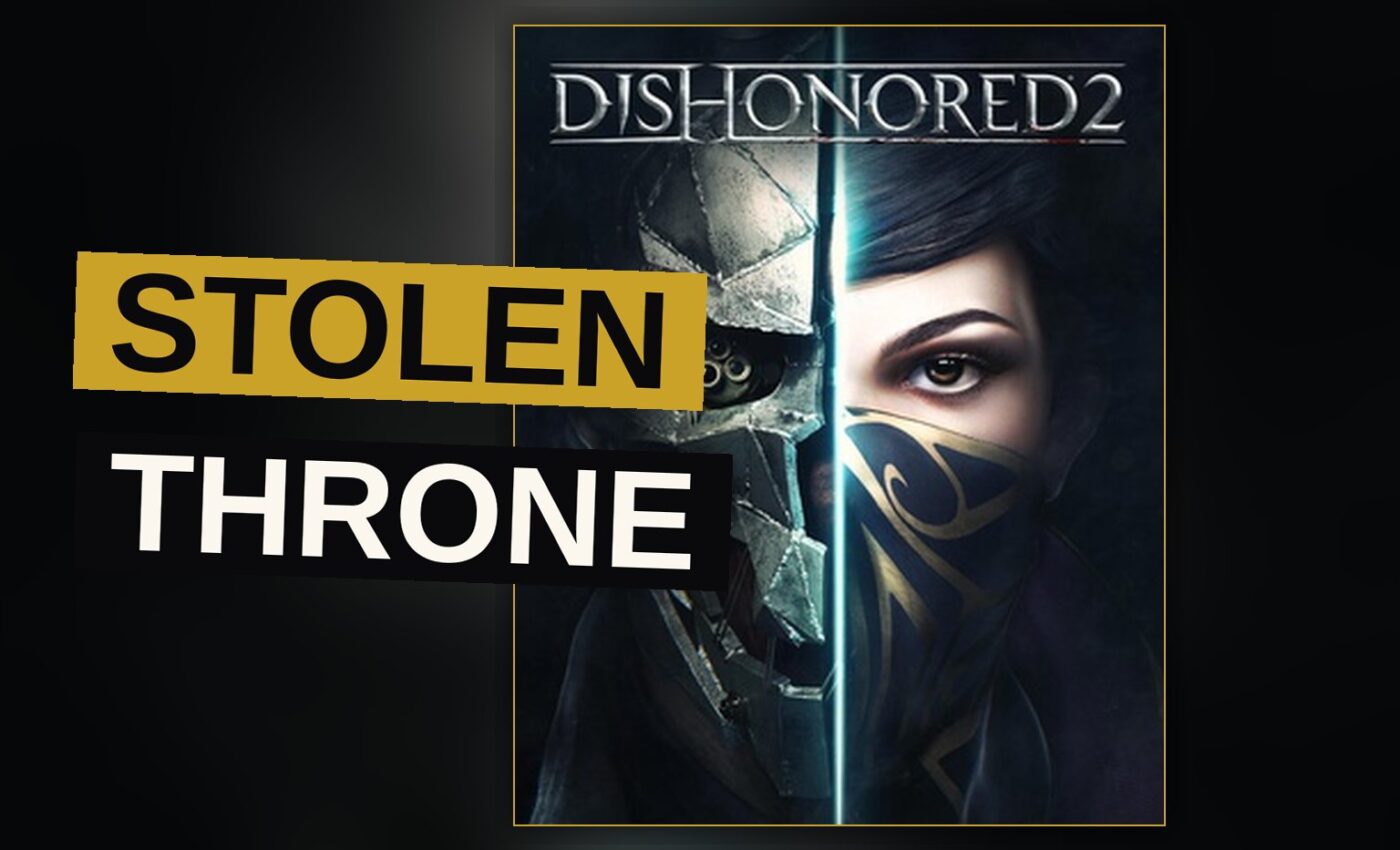
The city in Dishonored 2 runs on oil wealth and buried class rage, and the game trusts players to pick their own way through it. That trust pays off far more often than it fails. Arkane Studios built a sequel that does not simply repeat the first game’s tricks; it moves the action to a new place, gives the player two distinct heroes, and asks the same question from a different angle: how much violence are you willing to bring to get what you want?
Dishonored 2 came out on PC, PS4 and Xbox One on November 11, 2016. It was made by Arkane Studios, the developer behind the first Dishonored, and it builds on that game’s world rather than starting over. The core loop remains intact — pick a target, find a route, decide whether to kill or spare — but the setting and the cast give the familiar structure a fresh coat of paint.
Trailer, via Bethesda Softworks.
From Dunwall To Karnaca
The story leaves behind Dunwall, the plague-ridden capital of the first game, for Karnaca, a sunlit port city built on wealth and division. The shift in setting changes the whole mood. Where Dunwall was gray and sick, Karnaca is bright, rich, and just as corrupt underneath the surface. The city runs on whale oil and silver, and the gap between the wealthy families who hold power and the workers who keep the machines running is the engine that drives the plot.
Two rulers, one throne, and a stolen crown drive the story forward. The player picks one of two lead characters at the start of the game, and each has a different set of strange powers drawn from the same dark magic that shaped the series from the beginning. The choice is not cosmetic; it changes how missions play out, which abilities are available, and how the story frames the conflict between the two leads.
Emily And Corvo, Two Power Sets
Emily Kaldwin, the empress deposed at the start of the story, leans on tricks. Her powers include Domino, which links enemies so harm done to one spreads to the group, and Far Reach, which pulls a distant target close with a thought. These abilities reward a player who wants to manipulate the battlefield from a distance, setting up chains of cause and effect rather than wading into the middle of a fight.
Corvo Attano, her father and the hero of the first game, keeps a familiar set of abilities, including Blink, a short-range jump that let players slip past guards and over roofs with ease. His kit feels like a return to form for anyone who played the original, but it is not simply a copy of the old moves; the levels are built with both heroes in mind, so Corvo’s routes often differ from Emily’s even in the same mission.
Neither hero is pushed toward killing or sneaking. Every mission in Dishonored 2 can be finished with a blade drawn or without touching a single soul. That open design is the base the whole game rests on, and it holds up mission after mission. The game never tells the player they are playing wrong, and it never punishes a choice by locking content away entirely; it simply adjusts the world’s response to what the player does.
The Clockwork Mansion
The best level in Dishonored 2 belongs to Kirin Jindosh, an inventor whose home shifts shape at the pull of a lever. The Clockwork Mansion changes as the player moves through it. Walls slide. Rooms change places. Floors drop away while the player still stands on them, and the whole house becomes a puzzle box built into the level itself. Few games have designed a single space this cleverly, and it stands as the clearest proof of what Arkane does best.
The level works because it is not just a gimmick. The moving walls and sliding floors are tied to the mission’s goals, so the player has to learn how the house works in order to reach Jindosh and decide his fate. It is a space that rewards curiosity and punishes impatience, and it is the moment in the game where the level design and the story feel perfectly aligned.
A later level lets the player move between two versions of the same house, split apart by years. Deeds done in one version show up as marks left behind in the other. A locked door in the early version might stand open later on. It is a tight, exact bit of design work, and it rewards close attention. The two levels together form the high point of the campaign, and they are the reason many players remember Dishonored 2 fondly despite its flaws.
The Chaos System
The chaos system carried over from the first Dishonored tracks how much violence the player brings to each mission, and it shapes the story, the talk between characters, and the ending that follows. It is not a simple good-or-evil meter; it responds to specific actions, and it changes the world in ways that are not always obvious at first.
More killing brings a harsher, more hostile Karnaca by the end. Fewer deaths and a lighter touch bring a calmer, kinder close. The difference shows up in small ways — a line of dialogue here, a changed encounter there — and in larger ones, such as the fate of certain characters and the tone of the final scenes.
Here is a short list of what shapes the chaos measure the most across a playthrough:
- Whether targets are killed or left alive and unconscious
- How many guards and bystanders die during a mission
- Whether alarms are set off
- Which side goals are found and finished
- The final choices made in the closing missions
That system, paired with Emily and Corvo to choose between, gives Dishonored 2 real reason to play it more than once. A second run rarely feels like the first, and the game quietly encourages the player to try the other hero and the other approach.
Rough Edges At Launch
The PC version of Dishonored 2 did not launch in good shape. Frame rate drops and jerky motion showed up widely at release, even on strong machines. Patches followed in the weeks after launch and fixed much of the trouble, but the rough start left a mark on how some early players saw the game.
The console builds ran with fewer of these problems, though neither version was free of trouble at launch. The technical issues were not enough to sink the game, but they did cost it some goodwill at a time when the sequel needed to prove itself.
That early stumble should not be the last word on the game, but it is a fair one. For players who came in later, after the patches, the experience is much smoother, and the game’s strengths are easier to see without the distraction of stuttering frames.
Sneaking Or Swinging A Blade
Fighting in Dishonored 2 moves fast, and it punishes carelessness. Guards notice sound, light, and movement, and a fight gone wrong can turn into a losing one in seconds if the player leans too hard on force alone. Sneaking stays the more rewarding path for players willing to move slow, watch guard patterns closely, and plan a route rather than force one.
The level design backs both paths equally well. Tall buildings, hidden routes, and more than one way into each area mean there is rarely just one right path through a mission. The game rewards observation and patience, but it also gives the player room to improvise when a plan falls apart.
The best moments in Dishonored 2 come when the player is forced to adapt. A guard spots you, an alarm goes off, and suddenly the careful route is gone. The game does not punish this with a game over screen; it lets the player fight their way out and live with the consequences.
The Numbers
- Platforms: PC, PS4, Xbox One
- Release date: November 11, 2016
- Developer: Arkane Studios
- Two lead characters to choose between at the start
- Score: 8.6/10
The story trails behind the level design at times, and the rough PC launch cost the game some early goodwill. Even so, the Clockwork Mansion and the split-time mission that follows it rank among the finest design work Arkane has put out. Dishonored 2 earns an 8.6 out of 10.