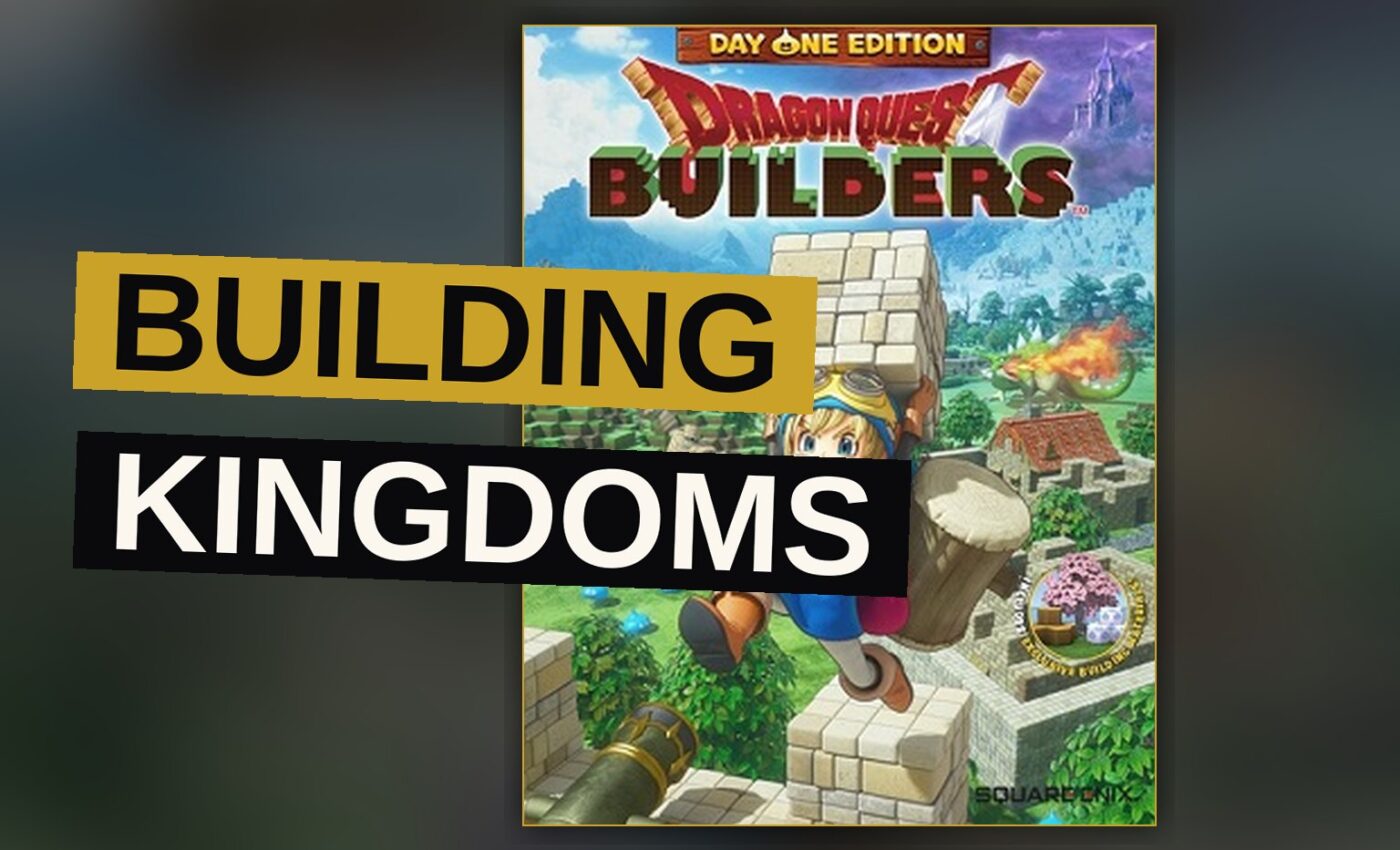
Dragon Quest Builders asks players to build a world out of blocks, and then defend it from monsters. That simple premise turns into one of the most inventive entries in the long-running Dragon Quest series. Released for PS3, PS4, Android and PC in 2016, the game trades its usual quest-driven structure for a sandbox where players gather materials, craft tools and furniture, and construct towns brick by brick. It is a bold shift, and mostly it works.
Trailer, via DRAGON QUEST.
Building a Town From Scratch
The core loop is straightforward. Players explore the game’s procedurally generated islands, hacking through enemies with a sword or a pickaxe to collect stone, wood and ore. They then use those resources to build walls, doors, beds and other items. There is no set plan. Players decide where to put a village, what shape it takes, and what features matter most.
That freedom is the heart of the experience. Unlike many block-building games, Dragon Quest Builders ties its crafting directly to its combat. A well-built wall can protect villagers from waves of monsters, while a poorly placed door lets enemies pour in. The game rewards planning, but it never punishes experimentation. A player can knock down a wall and rebuild it elsewhere without losing progress.
The construction interface is intuitive. Players select a material, choose a shape, and place it with a few clicks. More complex structures require careful arrangement of supports and foundations, which adds a layer of mechanical challenge on top of the creative fun. The result is a system that feels both accessible and deep.
Monsters and Combat
Combat in Dragon Quest Builders is simple but effective. Players strike enemies with swords, axes or magic, and each hit chips away at their health bars. Enemies drop resources after defeat, which feeds back into the building cycle. The game’s difficulty curve is gentle early on, then ramps up as later islands throw tougher foes at players.
Boss fights stand out as the highlights of the adventure. Each boss requires a specific approach, whether that means building a platform to reach them, creating a shield to block attacks, or arranging villagers in a formation that protects them from damage. These moments feel like small puzzles wrapped inside battles, and they give the combat a sense of variety that pure grinding lacks.
The enemy design is a mixed bag. Some foes are cleverly designed, with patterns that reward observation. Others feel repetitive, especially in the middle stretch of the game. The game’s writing helps carry the weaker encounters, giving even minor enemies a personality that makes them memorable.
Story and Setting
The plot follows a hero who is trapped on a cursed island and must rebuild a kingdom to escape. Along the way, they meet villagers, solve quests and uncover the mystery behind the curse. The story is light on dialogue but heavy on atmosphere. The islands themselves are rendered in a bright, cartoonish style that suits the tone, and the music, composed by Koichi Sugiyama, carries the emotional weight that the script sometimes lacks.
The narrative is not the strongest part of Dragon Quest Builders, but it serves the gameplay well. It provides a loose framework for the building and exploring, without ever getting in the way of the main activity. Players who dive into the sandbox rarely notice the plot anyway, since the game encourages wandering and experimenting over following a strict path.
Multiplayer and Modes
The multiplayer mode allows up to four players to build together on a shared island. It is a welcome addition, though it changes the dynamic somewhat. With multiple builders working at once, resource management becomes more complex, and the pace of construction speeds up dramatically. The game handles the extra load well, but the experience shifts from a solitary meditation to a chaotic collaboration.
There is also a mode that strips away the building entirely, turning Dragon Quest Builders into a traditional action-adventure game. This mode is shorter and simpler than the main campaign, but it offers a fresh way to play for those who want a different challenge. It is a clever inclusion, one that shows how versatile the underlying systems are.
What Works Best
Several elements distinguish Dragon Quest Builders from its peers. The construction system is tied directly to the game’s goals, so building a town is not just a cosmetic activity but a strategic one. The combat is engaging enough to keep players motivated, and the boss fights provide satisfying peaks in the otherwise steady progression. The procedural generation ensures that no two playthroughs look identical, which extends the game’s replay value.
Here is a quick rundown of the strengths:
- The construction system is tightly integrated with combat, giving every brick a purpose.
- The boss fights are creative, rewarding players who think strategically about placement and timing.
- The procedural generation keeps the islands varied and interesting across multiple playthroughs.
- The multiplayer mode adds a social layer without diluting the core experience.
Where It Falls Short
Not everything lands. The enemy design drags in the middle portion of the game, and some areas feel repetitive due to similar enemy types and resource drops. The story is thin, which means players who care about narrative depth might find themselves drifting off during quieter stretches. The difficulty spikes occasionally, catching players off guard after long periods of gentle progression.
| Element | Strength | Weakness |
|---|---|---|
| Construction System | Tied directly to combat | Can feel overwhelming in multiplayer |
| Combat | Engaging and varied | Difficulty spikes catch players off guard |
| Procedural Generation | Keeps islands varied | Some islands feel similar to each other |
| Story | Light and atmospheric | Thin on character development |
Final Verdict
Dragon Quest Builders succeeds because it commits fully to its central idea. It trusts players to enjoy the act of creation, and it rewards that trust with a satisfying loop of gathering, building and defending. The game stumbles in places, particularly with its enemy design and pacing, but the highs are high enough to carry the whole package.
This is a game that knows what it wants to be, and it executes that vision with confidence. It is not a perfect entry in the Dragon Quest series, but it is a bold one, and that boldness is what makes it memorable.