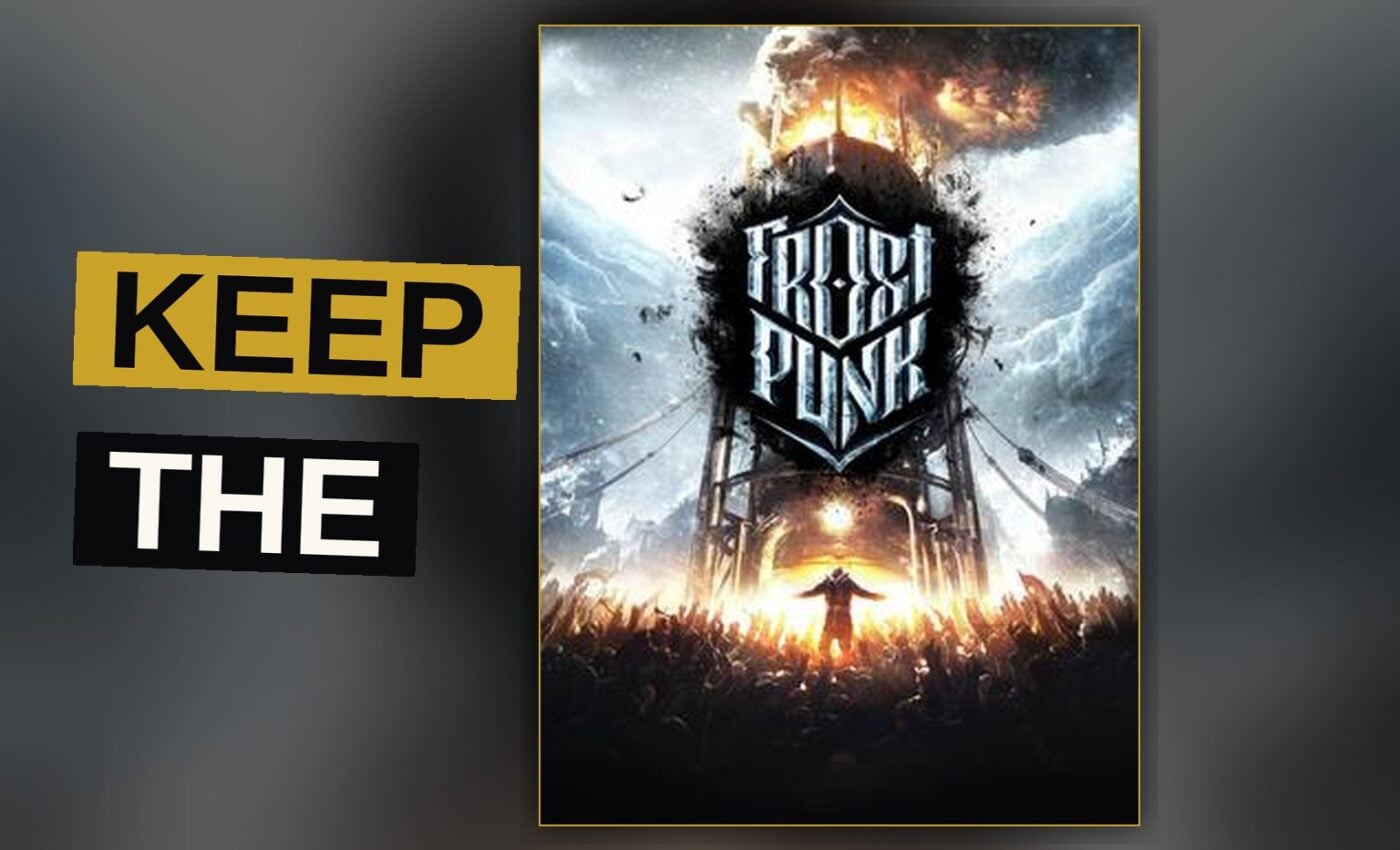
Frostpunk drops you into an alternate 1886, where the eruptions of Krakatoa and other unknown events have triggered a worldwide volcanic winter. Crops fail. Millions die. The British Empire and the United States build coal-fired “generators” across the frozen North, designed as city centres for the mass migration south. You are the leader of one such city. You keep it warm, or everyone in it dies.
Trailer, via 11 bit studios.
The Generator at the Centre of New London
In the main campaign, “A New Home,” refugees from London settle a city they call New London. Your job is resource management under a clock that never stops. Citizens need hope kept high and discontent kept low. Coal, wood, steel and food come from sawmills, hunting huts, mines and factories, and all of it feeds a massive coal-fired generator that throws heat in a circular radius. Buildings sit on a circular grid around it. Habitations, medical facilities and workplaces must be insulated, or occupants get frostbite and fall ill.
The generator can shut down if coal runs out. It can explode if you overload it to meet heat demand, and that ends the run. Workers and engineers take assignments; citizens work only during warm daylight hours unless you enforce emergency shifts. “Automatons,” giant autonomous machines built from “Steam Cores,” can run facilities without people.
A Great Storm, and More Scenarios
The campaign runs a three-act structure and asks you to survive a “Great Storm” while the nearby city of Winterhome falls. That collapse is not background noise. It shapes what New London becomes.
Frostpunk launched with three scenarios. “The Arks” follows Oxford and Cambridge scientists running a largely automated city to preserve plant samples taken before the cooling. “The Refugees” covers a group that seized a generator meant for wealthy nobles, and the social struggle that follows. Three more came later as downloadable content: “The Fall of Winterhome,” free to all players and set immediately before “A New Home”; “The Last Autumn,” a prequel about building a generator to evacuate Liverpool; and “On the Edge,” a sequel centred on an outpost established by New London.
11 Bit Studios came to this after This War of Mine in 2014. That game’s unexpected success pushed the studio toward what it called “meaningful entertainment,” and Frostpunk scales the question up from one person to a whole society. More than 60 team members worked on it. The team drew on Jacek Dukaj’s 2007 novel Ice and on accounts from early polar explorers and Andes survivors.
| Scenario | Type | Focus |
|---|---|---|
| A New Home | Base campaign | New London, the Great Storm |
| The Arks | Base | Oxford and Cambridge scientists, plant samples |
| The Refugees | Base | Seized generator, social struggle |
| The Fall of Winterhome | Free add-on | Evacuation before A New Home |
| The Last Autumn | Season Pass add-on | Generator construction, Liverpool |
| On the Edge | Season Pass add-on | New London outpost |
Where the Cold Does the Work
The temperature keeps dropping, and management gets harder with it. That is the whole design in one sentence, and it works because the game never lets optimization stay clean. Every efficiency you chase costs someone something. The moral pressure is not decoration on top of a city builder; it is the city builder.
This is the rare strategy game where the systems and the argument are the same thing. Frostpunk asks whether you will challenge your beliefs in adversity, and then it makes you answer with a coal budget. The scenarios give that question six different shapes, and the later prequels are smart additions rather than filler.
The cold is the antagonist. It does not negotiate.
Get the Notebook.
The day's best stories and every fresh verdict, in plain English, in your inbox by seven. One email a day, no more.