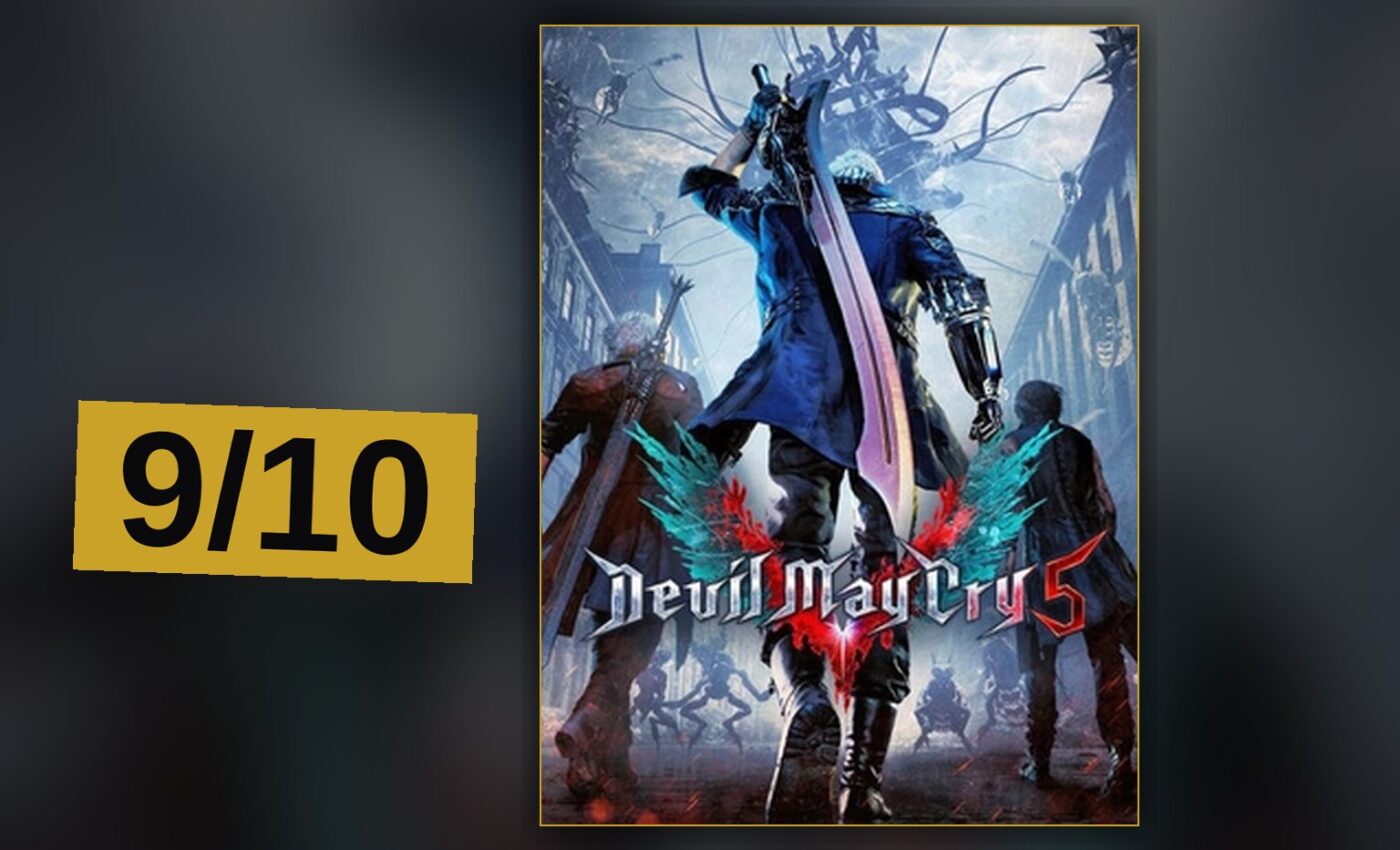
Devil May Cry 5 is the rare sequel that understands exactly what made its predecessors great, then pushes that formula to its breaking point without snapping it. Capcom’s action game, available for PS4, Xbox One, and PC, is a masterclass in stylish combat, absurd spectacle, and genuine character work. It is also, at times, a mess of uneven pacing and tonal whiplash. But when it clicks, and it clicks often, it feels like the purest expression of the hack-and-slash genre ever made.
The game picks up years after Devil May Cry 4. Nero, the hot-headed young demon hunter, is back, but he is not the same cocky kid. He has lost his demonic arm, the Devil Bringer, and in its place sits a prosthetic built by his friend Nico. That loss is the engine of the story, setting Nero on a collision course with a new threat: demon king Urizen, who has plunged the human world into chaos by growing a giant demonic tree in the middle of Red Grave City.
Trailer, via XBOX.
Nero’s New Arms and a Slow Start
The opening hours are a slow burn, and that is a problem. Nero’s new mechanics are excellent. His prosthetic arms, called Devil Breakers, are consumable tools that break after a few uses. One is a rocket punch that launches enemies. Another is a lightning rod that stuns groups. The variety is dazzling, and the risk-reward of burning through your arsenal mid-combo is a brilliant twist on the series’ depth.
But the campaign initially drags. The first few missions are linear, corridor-heavy affairs that funnel you through the same ruined streets and underground tunnels. The enemy variety is thin, and the boss fights, while visually stunning, feel like damage sponges rather than duels. You are waiting for the game to open up, and it takes its time.
Dante Returns With Four Styles
Then Dante arrives in Mission 10, and the legendary demon hunter is a revelation. Dante has four fighting styles — Swordmaster, Gunslinger, Trickster, and Royal Guard — and he can switch between them on the fly. His weapon list is insane: a motorcycle that splits into twin chainsaws, a pair of gauntlets that charge up for massive punches, and his iconic Rebellion sword.
Playing Dante is like conducting an orchestra of violence. You can juggle an enemy in the air, swap to a different style mid-combo, and finish with a cinematic finisher that leaves the screen covered in blood. He is the character the game has been building toward, and he does not disappoint.
The third playable character is V, and he is the game’s biggest gamble. V does not fight directly. Instead, he summons three familiars — a panther, a bird, and a golem — to do his bidding. You control V from a distance, directing his pets with the shoulder buttons while he strolls through the battlefield reading poetry.
It is a radically different pace, and it takes a while to click. But when it does, V offers a strategic layer the series has never had. You are managing cooldowns, positioning, and a finisher meter that only fills when your familiars land the killing blow. It is smart, and a welcome change of pace from the relentless aggression of Nero and Dante.
A Story That Actually Cares
The plot is surprisingly emotional. The series has always been campy, with Dante cracking jokes and flipping his coat. But this game digs into the family drama that has simmered since the first Devil May Cry. Dante’s twin brother Vergil is the key, and his relationship with Nero is the heart of the story. Without spoiling the twists, the game recontextualizes Nero’s entire existence. His anger, his loss, his drive — it all makes sense by the final act.
The writing is sharp. Nero is no longer a whiny teenager; he is a man trying to prove himself. Dante is older, wearier, and the game lets him show a vulnerability that is rare for the character. V is a strange, fragile presence, and his arc is the most surprising. The voice acting is excellent across the board, and the motion capture gives the characters a physicality that sells the drama.
But the story stumbles in its pacing. The game is structured in 20 missions, and the middle section, roughly Missions 8 through 12, grinds to a halt. You revisit the same areas, fight the same bosses with inflated health bars, and watch cutscenes that repeat information you already know. The game is at its best when it is moving forward, and it spends too much time treading water.
Combat Depth and the SSS Rank
The combat is the reason to play Devil May Cry 5, and the best the series has ever offered. The depth is staggering. Every character has a move list dozens of entries long, and the game rewards experimentation. The scoring system, which grades your performance from D to SSS, is ruthless. It tracks variety, style, damage avoidance, and use of the environment.
Hitting SSS is a rush. It requires chaining combos without repeating moves, switching weapons mid-string, and staying aggressive while dodging enemy attacks. The enemy design supports this. Devil May Cry 5 throws a wide range of demons at you, each with its own tells and weaknesses. The Hell Caina, a sword-wielding knight, is a basic grunt. The Empusa, a bug-like creature, is a fodder enemy that spawns in swarms. The Fury, a teleporting assassin, is a nightmare that forces you to parry at the last second. The game teaches you to read the battlefield, and it rewards players who learn the patterns.
The boss fights are the highlight. Urizen, the first major boss, is a wall. He has a massive health bar, and the fight is designed to make you feel powerless. You are supposed to lose. That is a bold choice, and it works. The later fights, especially the ones against Vergil, are duels in the truest sense. They are fast, brutal, and fair. Every hit you land feels earned, and every mistake is punished.
Devil Breakers and the Skill Ceiling
Nero’s Devil Breakers deserve special mention. They are the most innovative mechanic in the game. Each breaker is a different tool, and you can only equip one at a time. You can carry up to four, and you cycle through them by breaking the one you are using. That means you are constantly making decisions. Do you use the Punch Line to launch yourself across the arena or save it for a crowd-control move? Do you break your current arm to switch to the Overture or hold on to it for its powerful explosion?
The system creates a tension that the other characters do not have. Dante and V have everything available at all times. Nero has to manage a finite resource. That is a clever design choice that makes Nero’s combat feel more tactical. The downside: Devil Breakers are consumable, found as pickups in the levels. If you run out mid-mission, you are stuck with basic combos. That can be frustrating, especially on higher difficulties where every mistake is costly.
The skill ceiling is enormous. Devil May Cry 5 is not mastered in a weekend; you play it for months, learning new techniques, optimizing your combos, and chasing higher ranks. There is a training mode with a practice dummy and a comprehensive move list that explains every attack.
The depth is there for anyone who wants it, but the game never forces you to engage with it. You can play through the story on Human difficulty, mashing buttons, and have a good time. But the real game is on Devil Hunter, Son of Sparda, and Dante Must Die difficulties, where the combat truly shines.
Visuals, Sound, and Technical Flaws
The RE Engine, which powered Resident Evil 7 and Resident Evil 2, is a technical marvel. Devil May Cry 5 runs at a smooth 60 frames per second on all platforms, and the character models are gorgeous. Dante’s silver hair, Nero’s cybernetic arm, the demonic tree that towers over Red Grave City — everything looks detailed and alive. The lighting is dramatic, and the particle effects are spectacular. When you pull off a massive combo, the screen fills with sparks, blood, and glowing energy.
The soundtrack is heavy metal and electronic rock. The battle themes are aggressive, with chugging guitars and pounding drums. The track that plays during Dante’s first fight is a standout, and the final boss theme is a perfect capstone. The voice acting is top-notch, and the sound design is punchy. Every sword swing, every gunshot, every demonic roar carries weight.
But the game has a visual problem: it is too dark in places. Some levels are lit so poorly that you cannot see the enemies until they are on top of you. There is no brightness slider that fixes the issue, and it is a real annoyance. The camera can also be a problem. In narrow corridors, it swings wildly, and you will occasionally lose sight of your character. These are not game-breaking issues, but they are persistent.
The level design is the weakest element. The game is not an open world, and does not try to be. But the levels are linear, and they are not particularly interesting. You walk down a street, you enter a building, you fight in a courtyard. There are hidden blue orbs and secret missions tucked away, but the levels themselves are forgettable. The game is at its best when it is a pure gauntlet of combat, and it stumbles when it tries to be a platformer or a puzzle game.
Highs, Lows, and a Final Verdict
Devil May Cry 5 is a game of highs and lows. The highs are the best the genre has ever seen. The combat is deep, the characters are memorable, and the story is surprisingly affecting. The lows are the pacing, the level design, and the occasional technical hiccup. It is a game that rewards patience and punishes carelessness. It is not for everyone. If you have no interest in learning complex combos or replaying missions for better ranks, you will bounce off it. But if you are willing to put in the time, it is one of the most rewarding action games ever made.
The game is a love letter to its fans. It references the entire series, from the original Devil May Cry to the reboot, with affection. It is also a standalone experience; you do not need the previous games to understand the story. The game catches you up without dumping exposition. That is a rare skill.
- The combat is the best in the genre, with three distinct playstyles.
- The story is a genuine emotional arc, not just an excuse for fights.
- The Devil Breakers add a tactical layer to Nero’s moveset.
- The pacing drags in the middle, and the level design is flat.
- The camera and lighting can obscure the action at critical moments.
Devil May Cry 5 is a triumph. It is not a perfect game, but a perfect action game in many moments. The final act, from the reveal of the true villain to the final showdown, is a masterclass in escalation. The game builds to a climax that is both absurd and earned, and it leaves you wanting more. Capcom has delivered a sequel that honors its past while pushing forward. It is a game that demands your attention, your patience, and your thumbs. It is worth it.
The score is 8.8/10.