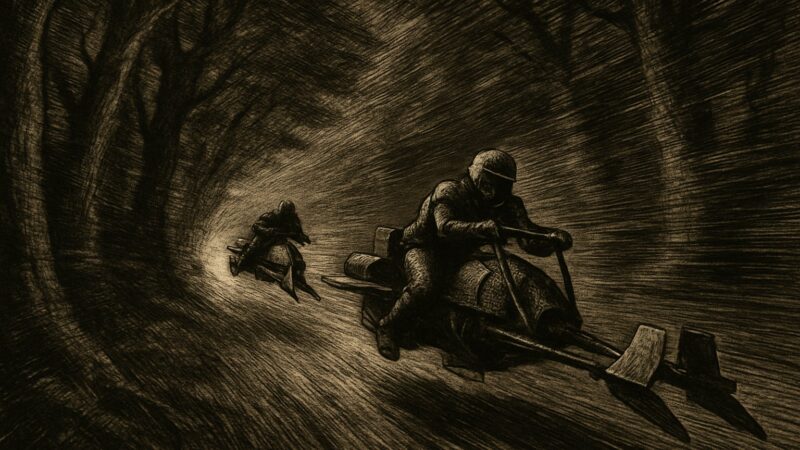
The Club is a blood sport run by wealthy people who bet on who lives. That is the premise Bizarre Creations built its 2008 third-person shooter around, and it is the rare game whose framing and its mechanics actually agree with each other.
Sega published The Club for PlayStation 3, Microsoft Windows and Xbox 360 in February 2008. The player picks from eight competitors and shoots through levels designed around one idea: keep killing, keep the multiplier alive, never slow down.
It scored 8.0 out of 10 across six outlets in the IGDB critic aggregate. That number holds up. The Club is a lean, mean arcade shooter that understands exactly what it is.
Dragov, Renwick, Finn and Seager
The roster is the game’s best trick. Each of the eight characters has their own attributes and their own ending, and the game gives you a reason to run every one of them.
Dragov is a Russian convict rescued by The Club after he tried to escape across the Siberian tundra. He hits hardest and moves slowest. His ending sends him out of the compound by helicopter, guards dead behind him.
Renwick is a former New York detective who lost his job after repeated attempts to locate The Club, then kept looking on his own. He is balanced, with an emphasis on speed. He wakes up dazed in a derelict building and gets a call from The Secretary: released unharmed, but now a fugitive from law enforcement.
Finn is a gambler whose debts put him in the mob’s crosshairs and then in The Club. Balanced, with extra stamina. He pays what he owes inside a briefcase rigged with a bomb.
Seager is a Canadian extreme sports junkie chasing the next high. He trades strength for above-average speed and stamina. When The Secretary hands him his cash reward, he turns it down. “I want to play.”
Kuro is a Japanese double agent posing as a Triad Society assassin, among the fastest in the field. The game leaves him being interrogated by law enforcement.
All of them answer to The Secretary, a middle-aged Englishman watching from above.
Ricochets, Head Shots and Decaying Multipliers
The Club plays from a third person view, and every level asks one of two things. Get through it as fast as possible, or hold one location and survive respawning enemies for a set amount of time.
The score mechanic is the whole game. Each kill feeds a bonus multiplier. Ricochets, head shots and long-range shots pay extra. After a kill you have a few seconds to land another before the multiplier starts to drop, and that window shrinks as the multiplier climbs.
Icons sit around each level offering bonuses. Weapons, ammunition and health exist, but picking them up earns you nothing. That single decision separates The Club from every shooter that treats a pickup as a reward.
It also borrows from racing games, time attack events included. That is not a stray influence. It is the spine.
A Commodity With a Score Attached
The story frames all of this as an underground blood sport controlled by a wealthy elite placing bets on gladiatorial-style combat. The modern setting does the work the premise needs.
You are not a soldier in a war. You are a commodity with a score attached, and the multiplier is the odds. The game never lectures about this. It just lets the structure sit there while you chase the next kill.
That restraint is why the framing lands. A lesser game would cut to a cutscene and explain the cruelty. The Club hands you a timer instead.
Split Screen Is the Sharper Call
Run-and-gun and racing elements share the same level design, and the tension between them is the point. You want to move, because moving finds kills. You also want to stop, because stopping lets you line up a head shot worth more.
The multiplier decay forces that argument every few seconds. It is a clean pressure system, and it never needs a difficulty menu to make its case.
The eight multiplayer modes extend it, with four-player local split screen or up to seven players online. Split screen is the sharper call. Racing games taught designers that a shared couch makes a score chase mean more, and The Club takes the lesson.
The Secretary Stays Off the Floor
The endings are where The Club gets uneven. Dragov flies out shooting. Finn mails a bomb. Seager refuses the money and asks for another round. Those land.
Renwick’s phone call and Kuro’s interrogation are weaker. They close on information rather than action, and the game’s own momentum argues against them.
The Secretary is the connective tissue, and he stays a voice and a watchful presence rather than a character. That is a choice, not an oversight. He is the house, and the house does not compete.
What the Multiplier Is Really Counting
The Club does not waste your time. Levels are short, the multiplier is loud, and the roster gives you eight reasons to replay what you just finished. That is a tight, confident package.
Its weak spots are real. The endings vary in punch, and the reliance on respawning enemies in defense levels can wear thin once you have learned the spawn pattern. Neither sinks it.
What matters is that the score mechanic and the fiction are the same idea. A blood sport watched by wealthy bettors becomes a game where the number on screen is the only thing that survives you. Most shooters of its era bolted a story onto a shooting gallery. The Club made the gallery the story.
Eight of 10. It earned that in 2008, and it has not shrunk since.
The Numbers Behind the Verdict
- Score: 8.0/10, from the IGDB critic aggregate covering six outlets
- Developer: Bizarre Creations
- Publisher: Sega
- Released: February 2008
- Platforms: PlayStation 3, Microsoft Windows, Xbox 360
- Perspective: Third-person
- Roster: 8 playable characters
- Multiplayer: 8 modes; 4-player local split screen, up to 7 online
- Antagonist: The Secretary
Get the Notebook.
The day's best stories and every fresh verdict, in plain English, in your inbox by seven. One email a day, no more.