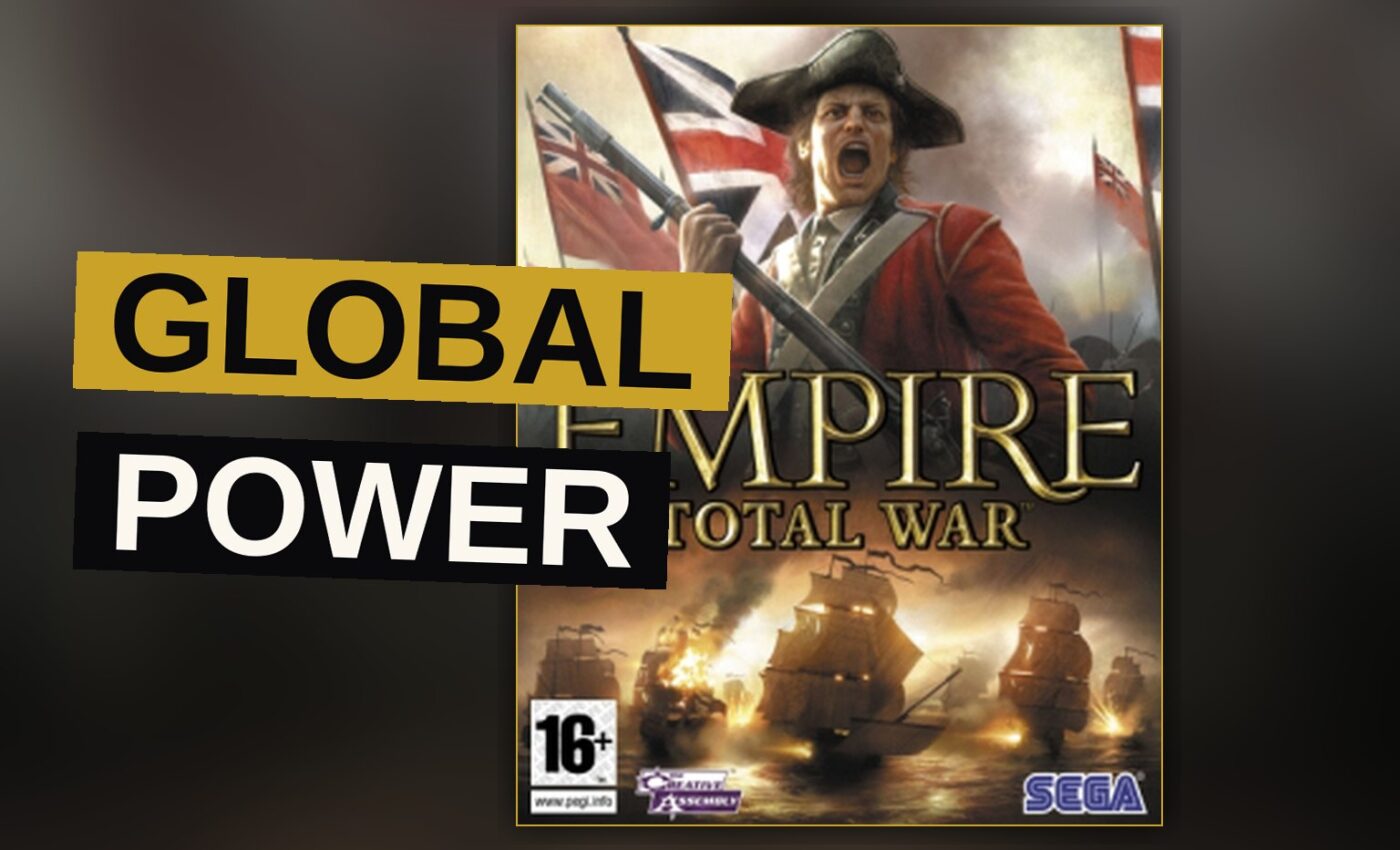
Empire: Total War put the whole 18th century on one map and then made you fight for it twice — once with ledgers, once with cannon. Creative Assembly’s fifth Total War game shipped in 2009 and was met with universal acclaim. It is also the first Total War to let you run a naval battle in real time, and that single change reshapes everything around it.
Trailer, via Feral Interactive.
The Map Runs From Jamestown To The Maratha Confederacy
Empire: Total War is set in the early modern period, opening in 1700 and running to the end of the 18th century. The scope is the pitch: Europe, the Middle East, India, North America and the Caribbean, plus the maritime trade theatres off the South American coast, the Gulf of Guinea, the Mozambique Channel and the East Indies.
The game offers more than fifty 18th-century factions. Eleven are playable. In western Europe: Great Britain, France, the United Provinces, Spain and Sweden. In central and eastern Europe: Prussia, Austria, Russia and Poland–Lithuania. The Ottoman Empire covers the Balkans and the Middle East. On the Indian subcontinent, the Maratha Confederacy is playable and the Mughal Empire is not.
Colonies of the major powers appear as protectorates of their home nation. The establishment of new nations during the era, such as Revolutionary France and the United States, is reflected in the game, though these major events may be averted by player actions. Smaller factions fill in the rest: the German and Italian states, Native American tribes, North African powers.
That is a lot of map. It is also the point. Empire: Total War is about exploration, economics, politics, religion, the founding of colonies and, ultimately, conquest. Every one of those verbs has a system behind it.
Two Games Stacked On Top Of Each Other
Empire: Total War splits into two modes, as earlier Total War titles did. The campaign is turn-based. You move armies and navies across the globe, conduct diplomacy and trade, run espionage, and manage your nation’s internal politics. Battles play out in real time, and you command them on land and at sea.
The land battles are where gunpowder arrives. Cannon and musket change the shape of a fight, and the game asks you to master new formations and tactics because of it. The series’ signature 3D battles get further enhancements here. Real-time battles pose new challenges rather than reheated ones.
The campaign map gets the bigger overhaul. New systems for trade, diplomacy and espionage with agents. A refined and streamlined interface. Improved advisors. For many players the campaign map is the heart of Total War, and Empire: Total War treats it that way.
Then there is the special campaign. It follows the United States from the settlement of Jamestown to the American War of Independence. It is a second game tucked inside the first, with a narrower frame and a different rhythm.
Naval Combat Is The Real Break
The headline feature is true 3D naval combat, and it is the first time the series has allowed naval battles in real time. You command a single ship or a vast fleet on seascapes with water and weather effects that carry real weight in the outcome.
The loop is physical. Pound an enemy with cannon fire, then close in, grapple the ship and prepare to board. You take control of your men as they fight hand-to-hand on the decks of these wooden behemoths.
No prior Total War game asked this of its players. Land battles reward positioning and timing; naval battles reward patience, wind, and knowing when to stop shooting and start climbing. The weather is not decoration. It decides fights.
Empire: Total War also includes five playable historical battles: the Battle of Fontenoy, the Battle of Rossbach, the Battle of Pondicherry (called the Battle of Porto Novo in game), the Battle of Brandywine Creek and the Battle of Lagos. They function as set pieces — fixed scenarios with fixed problems.
What The 9.0 Actually Measures
The published critical score for Empire: Total War is 9.0 out of 10, an IGDB critic aggregate drawn from six outlets. The game was met with universal acclaim, and several critics commended it as one of the foremost strategy titles of recent times.
The praise landed in three places. The extensive strategic breadth. The accuracy of the historical challenges. The visual effects.
Breadth is the easiest to underestimate. Fifty-plus factions, four trade theatres, a diplomacy layer, an espionage layer, a religion layer, a colonial layer. Most strategy games pick two of those. Empire: Total War runs all of them at once and expects them to interact.
Historical accuracy here means the problems are the real ones. You are not fighting a fantasy empire with a reskinned roster. You are managing the Ottoman Empire’s position in the Balkans, or the Maratha Confederacy’s push on the subcontinent, or Britain’s Atlantic holdings.
Visual effects carry more weight than they sound like they should. Naval battles live or die on whether you can read the water. If the sea and the weather do not communicate, the tactics do not either.
Where The Friction Lives
Empire: Total War is not a clean game, and the 9.0 is not a claim that it is. The ambition is the source of both its best and its hardest moments.
The turn-based campaign asks you to hold a lot in your head: armies, navies, agents, trade routes, diplomacy, internal politics, colonial protectorates. The refined and streamlined UI and the improved advisors are there to carry some of that load. They help. They do not make the load light.
The real-time battles ask for a different kind of attention. Musket and cannon formations are not sword-and-shield formations. That is a feature, but it is also a wall.
Naval combat is the steepest wall. Boarding actions require you to shift from fleet command to deck-level command mid-fight. It is the most novel thing in the game.
None of this reads as a flaw in the aggregate. It reads as the cost of the design. A game that tries less would be easier and smaller.
The Five Historical Battles, Ranked By What They Teach
The five playable historical battles are not equally useful. Ranked by what each one actually demonstrates about Empire: Total War’s systems:
- Battle of Lagos — the purest naval test, and the fastest way to learn whether you can read weather and boarding timing under pressure.
- Battle of Brandywine Creek — the clearest look at gunpowder-era land formations and how musket and cannon lines actually function.
- Battle of Fontenoy — a positional puzzle that rewards patience over aggression, and a good check on whether you understand the new tactics.
- Battle of Rossbach — a sharper, more mobile engagement that punishes slow decision-making.
- Battle of Pondicherry (called Battle of Porto Novo in game) — the most geographically specific of the set, and the one whose lessons transfer least to a standard campaign.
That order is ours, not the game’s. The point is that the historical battles function as a curriculum.
The United States Campaign Is The Quiet Achievement
The special campaign tracking the United States from Jamestown to the American War of Independence is one of the more distinctive things in Empire: Total War.
It takes the game’s widest systems and narrows the frame. One region, one arc, one set of escalating pressures. It is the opposite of the grand campaign’s sprawl, and it works precisely because of that contrast.
The grand campaign is about what you choose to do. The United States campaign is about what happened, and whether you can hold it together.
Why 9.0 Holds Up
Empire: Total War earns its score on the strength of one decision: it refused to choose between depth and spectacle. The turn-based campaign is dense enough to satisfy players who want trade routes and diplomacy. The real-time battles are immediate enough to satisfy players who want to watch a ship’s deck fill with fighting men.
The naval combat is the part worth watching. It is the first real-time naval battle in the series, and it remains the feature that most clearly separates Empire: Total War from everything around it. Weather and water are not set dressing; they are the fight.
The historical battles and the United States campaign are the connective tissue. They give the sandbox a way in and a way to end.
The 9.0 out of 10 is the right number. Empire: Total War is not a flawless game, and it does not pretend to be one. It is a game that reaches for the entire 18th century — Europe, India, the Middle East, North America, the Caribbean, the trade theatres — and mostly gets there.
Play the Battle of Lagos first. Then start a campaign as Great Britain or the Maratha Confederacy. Then find out whether you can hold the century together.
Empire: Total War — 9 of 10.
Get the Notebook.
The day's best stories and every fresh verdict, in plain English, in your inbox by seven. One email a day, no more.