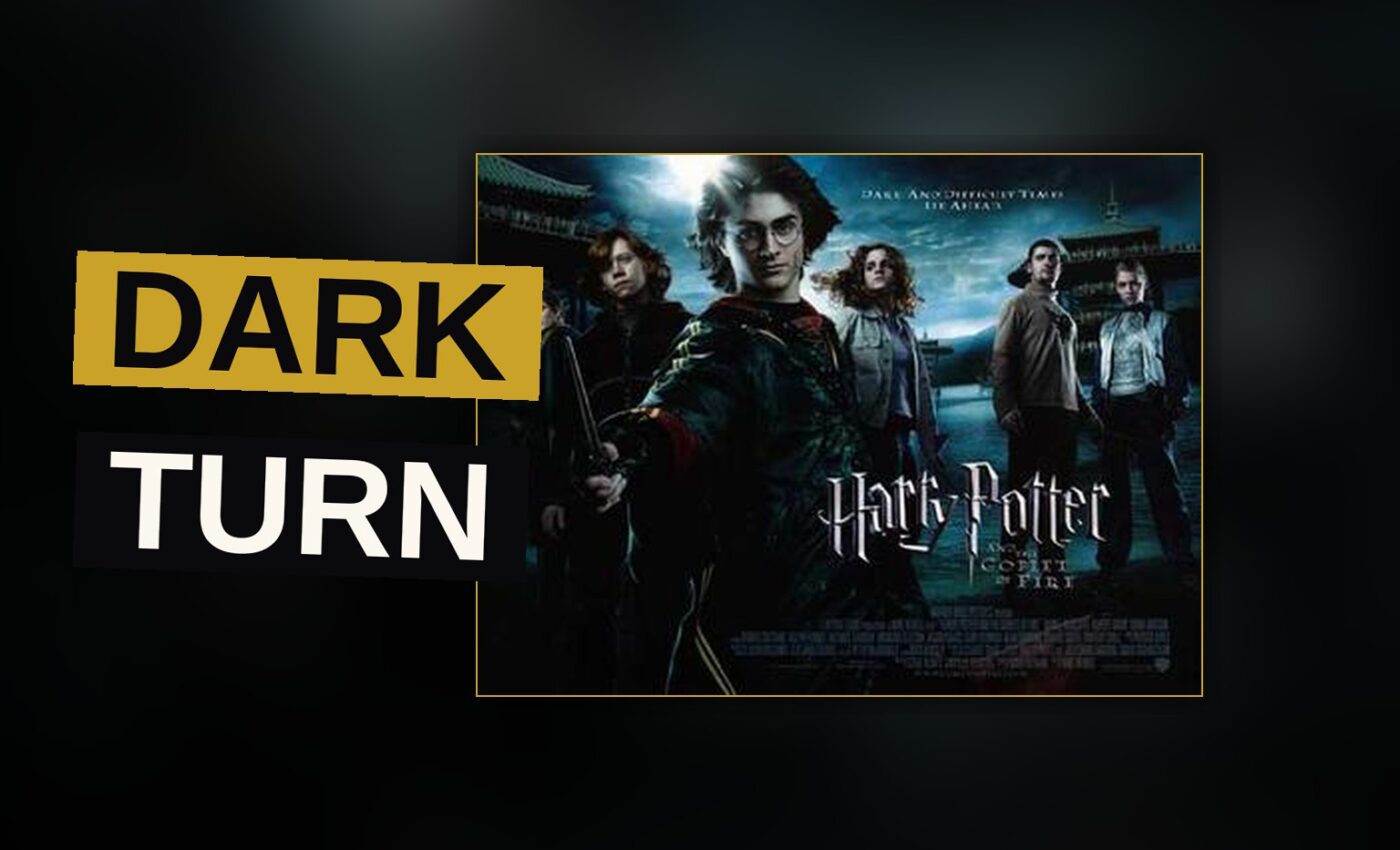
Harry Potter and the Goblet of Fire is the moment the series stops being a children’s story. The fourth film in the franchise, directed by Mike Newell, brings the Triwizard Tournament to Hogwarts, and with it comes the first real taste of death. It is darker, louder, and more urgent than anything that came before it, and it mostly works.
The film opens with a nightmare. Harry Potter dreams of a dark mansion, a snake, and the return of Lord Voldemort. It is a cold opening that sets the tone: the war is coming, and Harry can feel it. The Quidditch World Cup is a brief, chaotic spectacle, and the Death Eaters’ attack in the forest afterwards is the first time the films have shown adult evil in the open.
Trailer, via Warner On Demand.
Triwizard’s Three Tasks
The central engine of the film is the tournament itself. Three tasks, three champions, and one name that should not have been in the Goblet of Fire. Harry Potter is entered against his will, and the film spends its middle act on dragons, merpeople, and a maze that kills.
The first task is the strongest. Harry Potter faces a Hungarian Horntail, and the sequence is a masterclass in tension. The dragon is a practical and digital hybrid that looks genuinely dangerous, and Harry’s broomstick chase around the castle grounds is thrilling. The second task, set underwater, is slower but introduces a genuine moral choice: save the hostage, or let the others drown. The third task, the maze, is where the film stumbles.
The maze is a missed opportunity. In the book, it is a gauntlet of magical obstacles. In the film, it is mostly hedges and fog. The creatures are there, but they are dispatched quickly, and the pacing feels rushed. The film is clearly trying to get to the graveyard, and the maze suffers for it.
Graveyard Return of Voldemort
The graveyard scene is the film’s centerpiece, and it earns that position. Harry Potter and Cedric Diggory arrive at the cup together, and what follows is the darkest sequence in the franchise to that point. Peter Pettigrew kills Cedric on Voldemort’s orders, and the murder is sudden and brutal. It is the first on-screen death of a major character, and the film does not soften it.
Voldemort’s return is handled with care. Ralph Fiennes plays the Dark Lord with a reptilian stillness that is genuinely unsettling. The rebirth ritual, the Death Eaters’ arrival, and the duel between Harry Potter and Voldemort are all faithful to the source material. The film ends with Harry Potter returning to Hogwarts with Cedric’s body, and the grief in the Great Hall is palpable.
Casting the Adults and Teens
The adult cast is excellent. Brendan Gleeson’s Alastor Moody is a paranoid, twitchy presence, and the twist that he is actually Barty Crouch Jr. in disguise is well played. David Tennant makes the most of his brief screen time as the real Crouch Jr., and his confession is a highlight. Michael Gambon’s Dumbledore is more forceful than Richard Harris’s version, and his outburst at Harry Potter in the pensieve—”Did you put your name in the Goblet of Fire?”—is a memorable moment of anger.
The younger cast is where the film struggles. Daniel Radcliffe, Rupert Grint, and Emma Watson are all older, but their performances are uneven. Radcliffe is at his best in the graveyard and the aftermath, but his earlier scenes lack the spark he would develop later. Grint’s Ron is reduced to jealousy and comic relief, and Watson’s Hermione is given little to do beyond the Yule Ball. The romance subplot is thin, and the film knows it.
Yule Ball and Darker Tone
The Yule Ball is a welcome break from the darkness. It is a chance for the characters to be teenagers, and the film leans into the awkwardness. Hermione’s transformation, Ron’s jealousy, and the slow dance between Harry Potter and Parvati Patil are all charming. It is the last moment of innocence before the graveyard.
The tone is the film’s biggest challenge. Harry Potter and the Goblet of Fire is a book about adolescence, but it is also a book about the rise of fascism. The film tries to balance both. The humor is there, but it is darker. The romance is there, but it is fleeting. The horror is there, and it is unrelenting. Newell keeps the plates spinning, and the film never collapses under its own weight.
The biggest problem is the running time. At 157 minutes, the film is long, but it still feels rushed. The book is over 600 pages, and the film has to cut. The subplot involving the house-elves is gone, and the World Cup is a montage. The film is efficient, but it is not patient.
Franchise Crossroads
Harry Potter and the Goblet of Fire is the turning point of the series. It is the film that proves the franchise can handle darkness, and it sets the stage for the final four films. The pacing is uneven, the maze is underwhelming, and some of the performances are rough. But the graveyard scene alone justifies the ticket price, and the film’s ambition is admirable.
Harry Potter and the Goblet of Fire is a strong entry in the series, and it remains a fan favorite for good reason. It is a film about choices, consequences, and the cost of growing up. It is not the best film in the franchise, but it is the most important one.
- Director: Mike Newell
- Runtime: 157 minutes
- Release date: November 18, 2005
-
Audience score: 7.8/10 (TMDB, 22,595 votes)
-
The three tasks: Dragon, lake, maze
- The champions: Harry Potter, Cedric Diggory, Fleur Delacour, Viktor Krum
- The twist: Moody is Barty Crouch Jr. in disguise
- The death: Cedric Diggory, killed by Peter Pettigrew
The film is a solid 7.8 of 10.