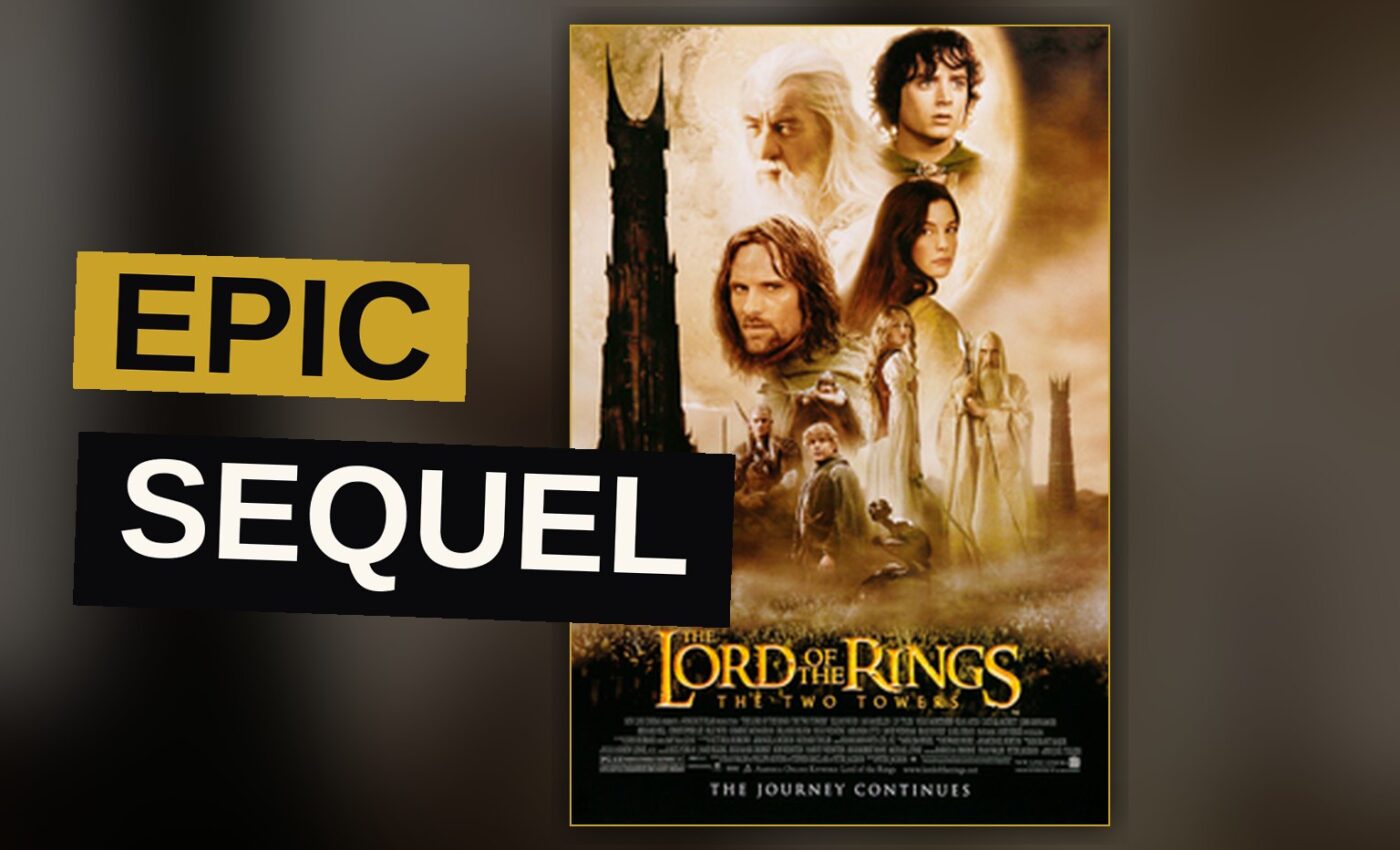
It is the rare sequel that makes the world feel bigger while keeping the story moving at a breakneck pace. The Lord of the Rings: The Two Towers does exactly that. Peter Jackson’s middle chapter of J.R.R. Tolkien’s trilogy takes the grand scale of The Fellowship of the Ring and doubles down, splitting the heroes across a vast map and pushing them toward the war that will define the age.
The film picks up immediately where the first movie left off. Frodo and Sam are lost in the Emyn Muil, Gollum is on their trail, and the rest of the company is scattered. This is not a film that rests on its laurels. It builds, it expands, and it delivers the most spectacular battle sequence ever put on screen at the time.
Trailer, via Warner Bros. Rewind.
Splitting the Party
The biggest risk of The Two Towers is its structure. The book splits the story into two distinct threads, and the film does the same. On one side, Aragorn, Legolas and Gimli chase the orcs who took Merry and Pippin. On the other, Frodo and Sam struggle toward Mordor with Gollum as their guide. The film cuts between them constantly, and it works far better than it has any right to.
The chase thread leads to the kingdom of Rohan, a land stripped of its king’s will. The hobbit thread leads into the dark, creeping landscape of the Dead Marshes. Each thread has its own tone. Rohan is all wind, horses and desperate courage. Mordor is wet, cold and full of dread. Jackson keeps both moving with the discipline of a thriller, never letting one thread go cold while the other heats up.
The film’s greatest structural achievement is making Gollum a central character. He is not a monster of the week. He is a broken, pitiful creature whose split personality drives the entire Frodo and Sam storyline. The performance by Andy Serkis, combined with the motion-capture work, creates a character who feels fully real. He is funny, tragic and terrifying, often in the same scene.
Gollum Carries the Moral Weight
Gollum is the heart of the film. His scenes with Frodo carry the moral weight of the whole story. He calls the Ring his “precious,” and he hates himself for needing it. Frodo sees himself in Gollum, and that recognition is what makes him spare the creature’s life. It is a decision that will haunt the rest of the trilogy.
The film does not soften Gollum. He is a liar and a schemer. He leads the hobbits into a trap, and he nearly gets them killed by the spider Shelob in the next film. But here, his betrayal is more subtle. He sets Sam up as the enemy, turning Frodo’s suspicion away from himself. The scene where the two hobbits argue over the lembas bread is a masterclass in quiet tension, and it works because Gollum has earned the audience’s distrust even as he earns Frodo’s trust.
Serkis gives the performance of the film. His voice work shifts between a soft, pathetic whine and a harsh, guttural growl. The physical performance, captured through the then-nascent performance capture technology, is astonishing. Gollum moves like a starving animal, all elbows and knees, but his eyes carry the intelligence of a ruined man. It is a performance that holds up 24 years later.
Helm’s Deep and the Siege
The centerpiece of the film is the Battle of Helm’s Deep. It is a siege that lasts for the entire final act, and it is a technical marvel. The fortress of Helm’s Deep is a massive, ancient structure carved into a mountain. The army of Saruman throws ten thousand Uruk-hai against it, and the defenders number only a few hundred.
Jackson stages the battle with a clarity that most action films lack. You always know where you are on the battlefield. You know who is fighting whom. The geometry of the fortress matters:
- the causeway
- the gate
- the deeping wall
Every inch of the terrain is used in the fight. The rain pours down, the torches fling sparks, and the mud churns underfoot. It is brutal, exhausting and thrilling.
The battle also gives the film its most iconic image. When the sun rises on the fifth day, Gandalf arrives with Éomer and the riders of Rohan. They crest the hill, and the light breaks over the battlefield. It is a moment of pure cinematic triumph. The music swells, the horses charge, and the tide turns. It is the kind of sequence that makes audiences cheer in theaters.
“Theoden King stands alone.”
That line, spoken by Gandalf at Edoras when he arrives to free Théoden from Saruman’s influence, captures the theme of the entire picture. The Two Towers is about leaders who must stand alone against overwhelming odds. Theoden, Aragorn, Frodo — each of them faces a moment where help is not coming, and they must act anyway.
New Faces in Rohan
The film introduces several major characters from the book. The most important is Theoden, the king of Rohan. Played by Bernard Hill, Theoden begins the film as a broken man, manipulated by the treacherous counselor Grima Wormtongue. His recovery is one of the film’s most satisfying arcs. When Gandalf frees him from Saruman’s influence, he is reborn as a warrior king. Hill plays the role with a weary dignity that makes his final charge at the Battle of the Pelennor Fields in the next film all the more powerful.
Éowyn, Theoden’s niece, is introduced here as well. Miranda Otto plays her with a quiet longing for glory. She is trapped by her role as a woman in a warrior culture, and she watches the men ride off to war while she stays behind. The film gives her a few key scenes that set up her arc, but she remains a supporting figure here. Her moment will come in the final film.
Faramir, the brother of Boromir, is a more controversial addition. In the book, he is a wise and noble man who resists the Ring’s temptation. In the film, he is initially a darker figure, dragging Frodo and Sam toward Osgiliath in a desperate attempt to win his father’s approval. This change frustrated some fans, but it works in the context of the film. It gives the middle chapter a sense of danger and makes Faramir’s eventual choice to let Frodo go feel earned.
March of the Ents
The other major new element is the Ents, the ancient tree-herds of Fangorn Forest. Treebeard, voiced by John Rhys-Davies, is a glorious creation. He is slow, ancient and deeply patient. His scenes with Merry and Pippin provide the film’s comic relief, but they also carry a deep melancholy. The Ents are the last of their kind, and they are watching their forest die.
The film makes a significant change from the book here. In the book, the Ents decide to attack Isengard on their own after seeing the destruction of the forest. In the film, Merry and Pippin trick Treebeard into thinking the forest has already been destroyed. This change is often debated. Some argue it weakens the Ents’ agency. Others say it makes the scene more dramatic.
What cannot be argued is the result. The Ents’ march on Isengard is one of the film’s most thrilling sequences. The trees uproot themselves and walk. They flood the dam, break the walls, and drown Saruman’s armies. The moment where Treebeard realizes the hobbits have deceived him is played for a laugh, but it does not undercut the power of the destruction.
Crafting Middle-earth on Screen
The film is visually stunning. Jackson and his team built the sets on a massive scale, and it shows. Helm’s Deep is a real, physical fortress. Edoras, the capital of Rohan, sits on a hill with the golden hall of Meduseld at its peak. The landscapes of New Zealand stand in for Middle-earth, and they are breathtaking.
The special effects have aged well. The Wargs, the wolf-riders of the orcs, are convincing. The Uruk-hai are heavily armored and brutal. The digital effects, particularly in the battle scenes, blend seamlessly with the practical work. There are a few moments where the CGI shows its age, but they are rare.
Howard Shore’s score is a masterpiece. He builds on the themes from the first film and adds new ones. The Rohan theme, with its mournful violin, is one of the best pieces of film music ever written. The music for the Ents is deep and rumbling. The battle music is relentless. Shore’s score carries the emotional weight of the film as much as the performances do.
A Middle Chapter That Stands Alone
Most middle chapters in trilogies suffer from a lack of resolution. They are often just setup for the finale. The Two Towers avoids this trap. It has a beginning, a middle and an end. The Battle of Helm’s Deep is a complete story. The destruction of Isengard is a complete story. The characters grow and change.
The film also ends on a note of hope. The war is not over, but the tide has turned. Frodo and Sam continue their journey, but they have survived. The final shot of the film is a wide view of Mordor in the distance, with the hobbits walking toward it. It is a quiet, ominous image that sets up the final film perfectly.
It is a remarkable achievement. The film takes a story that is essentially a series of marches and sieges and turns it into a thrilling adventure. It respects the source material while making it work as cinema. It is a film that demands to be seen on the biggest screen possible, with the loudest sound system available.
The two towers of the title refer to Orthanc, the fortress of Saruman, and Barad-dûr, the dark tower of Sauron. The film does not dwell on the symbolism. It simply shows the war between them and the people caught in the middle. It is a war story, a character study and a spectacle all at once.
The film is not perfect. The changes from the book will always be debated. The pacing of the Faramir subplot is a little rushed. The film’s length can be exhausting. But these are minor complaints against a film that achieves so much.
The Lord of the Rings: The Two Towers is a triumph. It is bigger, darker and more ambitious than its predecessor. It delivers on every promise of the first film and sets the stage for the finale. It is a film that works as a sequel, as a standalone epic, and as a piece of cinema history.