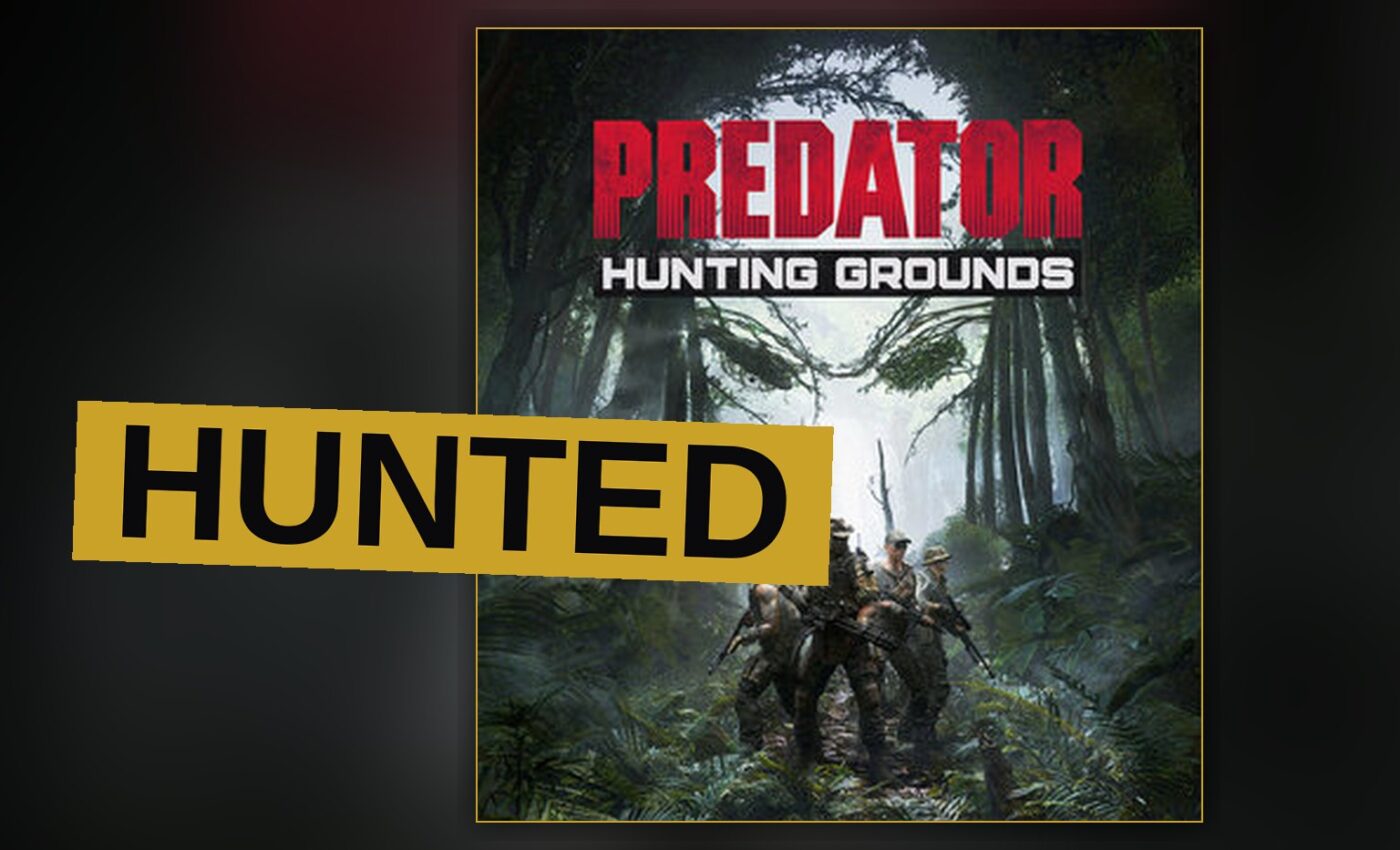
Predator: Hunting Grounds never solved its hardest problem. The game asks four players to work as a team while a fifth hunts them through a jungle, and that idea is genuinely good. Illfonic built the whole thing around it, shipped it in April 2020, and has spent the years since adding to it. What’s here now is broader and better-looking than what launched. It is also still held back by the same unevenness that made the original release such a mixed bag.
Fireteam Voodoo and the Yautja
The setup is clean. Four players form a squad of special operations operators called Fireteam Voodoo. They drop into remote jungle locations with a mission: collect intel, sabotage shipments, retrieve VIP targets, or take out a drug lord. A fifth player controls the Predator, a Yautja who wants them dead.
The two sides are playing different games. Fireteam Voodoo fights computer-controlled NPC enemies, works through objectives, and tries to finish before the Predator finds them. The Predator stalks, picks off stragglers, and forces a fight on its own terms. When the humans kill the Predator, the mission flips. The Other Worldly Life Forms Program (OWLF) takes over the operation, and the squad is told to guard the body against hostiles until extraction arrives.
That flip is the best idea in Predator: Hunting Grounds. It turns a win into a second job.
Fighting a Predator Who Won’t Fight Fair
The Predator side is where the game’s identity lives. Illfonic has added a roster of Yautja over the years, and the Oni Predator is one of the more interesting ones. The Oni specializes in stealth. It pours its resources into technology, which lets it engage prey from the shadows. Speed and ranged combat come first for this warrior, and the result is a foe built to avoid the straight fight.
That design is a problem for Fireteam players who want a duel. The Oni doesn’t give them one. It thins the squad from a distance and disappears. When it works, the jungle feels genuinely hostile. When it doesn’t, you spend a long match scanning trees for a target that never commits.
The asymmetry cuts both ways here. A Predator player who plays patiently can make the match feel like a horror film. A Predator player who plays badly makes the whole thing feel like a shooting gallery with a clumsy monster in it.
Arnold Schwarzenegger Returns as Dutch
The franchise history is part of the pitch. Predator: Hunting Grounds was the first Predator video game since the 2010 mobile title Predators. It was the first console entry since 2005’s Predator: Concrete Jungle. That’s a long gap, and Illfonic filled it with fan service that mostly lands.
Arnold Schwarzenegger came back as Alan “Dutch” Schaefer, the character he played in the original Predator. Alice Braga returned as Isabelle from Predators. Jake Busey reprised Sean Keyes from The Predator. For a game built on hunting in jungles, having Dutch in the mix is the right kind of nostalgia — it ties the new thing to the old thing without pretending the old thing was high art.
The game also lets players control a female Yautja for the first time in a Predator game. That’s a small addition on paper and a meaningful one in practice, because the Predator roster is the part of this game players spend the most time customizing.
Field Lockers and the Grind
Customization runs through Field Lockers, the game’s loot crate system. Lockers unlock during play and hand out appearance and weapon options for both Fireteam and Predator characters. They can contain duplicates, and duplicates convert into additional in-game currency. They can also be bought.
The good news is that Field Lockers can include genuinely great items, like the flintlock pistol of Raphael Adolini from Prey. The bad news is that randomized lockers are randomized lockers. If you want a specific look for your Yautja, you are rolling dice, not shopping.
This is the least interesting part of Predator: Hunting Grounds, and it’s the part that ages worst. The game’s best rewards are the ones tied to rank and play. The lockers are a tax on players who care about cosmetics.
Maps, Modes, and the Squad Problem
The maps give Fireteam players real choices. Squads can stay together as a unit or split up to cover more ground. Staying together is safer against the Predator. Splitting up is faster against the objectives. That tension is the actual game, and it’s a good one.
Multiplayer is the only mode, and that’s fine for what this is. Predator: Hunting Grounds doesn’t need a campaign. It needs a healthy player base, and that’s the thing it has struggled with most. An asymmetrical game lives or dies on matchmaking, and a Predator who queues into a lobby of four coordinated operators is having a different experience than a Predator who queues into four strangers.
The best matches are the ones where both sides are communicating. The worst are the ones where nobody is.
What the 6.7 Actually Measures
The published critical score for Predator: Hunting Grounds sits at 6.7 out of 10, drawn from an aggregate of 10 outlets. That number is fair, and it’s fair for reasons that haven’t changed much since launch.
Here’s what the game gets right, ranked by how much it matters:
- The core asymmetry. One Predator against four operators is a strong premise, and the game commits to it.
- The OWLF flip. Killing the Predator and then defending the body is a smart second act.
- The franchise cast. Dutch, Isabelle, and Sean Keyes give the game a spine of continuity.
- The Predator roster. Playing as a female Yautja for the first time matters to the people who care about this series.
- The maps. Real tactical choices about grouping up or spreading out.
And here’s what holds it back:
- Field Lockers. Randomized cosmetics with duplicates and paid purchases are a drag on a game that doesn’t need them.
- Match quality. The experience swings hard depending on who you’re playing with.
- The Predator’s patience problem. A stealth-focused Yautja like the Oni can make matches feel empty rather than tense.
The score reflects a game that is more interesting than it is polished. Predator: Hunting Grounds has a real idea at its center and a lot of small frustrations around the edges.
Why the Jungle Still Works
The setting does a lot of heavy lifting. Remote jungle locations give the Predator places to hide and give Fireteam Voodoo places to feel watched. The game understands that the Predator franchise is about terrain as much as it is about the monster.
Illfonic took over publishing duties from Sony Interactive Entertainment in March 2024, and ports for PlayStation 5 and Xbox Series X/S arrived on October 1, 2024. The game is still being supported. That matters for a multiplayer title that depends on a live population.
The Oni Predator is a good example of where the game’s design instincts point. A Yautja that prioritizes speed and ranged combat over a straight brawl is a Yautja that forces players to adapt. It’s a more interesting addition than another heavy hitter would have been.
The Verdict on Predator: Hunting Grounds
Predator: Hunting Grounds is a 6.7 out of 10. That’s the number, and it’s the right number.
This is a game with a strong premise, a solid cast of returning characters, and a genuinely clever twist in the OWLF extraction phase. It’s also a game that asks you to tolerate randomized loot, uneven matches, and a Predator who sometimes refuses to give you the fight you came for.
The parts that matter most are the parts that work. When a squad of four is moving through the jungle, watching the trees, and a Yautja drops out of nowhere, Predator: Hunting Grounds does something no other game in this franchise has done. It makes you the prey.
That’s worth 6.7. It’s worth playing, especially if you have three friends and a headset. It is not worth pretending the lockers and the matchmaking aren’t there.
Get the Notebook.
The day's best stories and every fresh verdict, in plain English, in your inbox by seven. One email a day, no more.