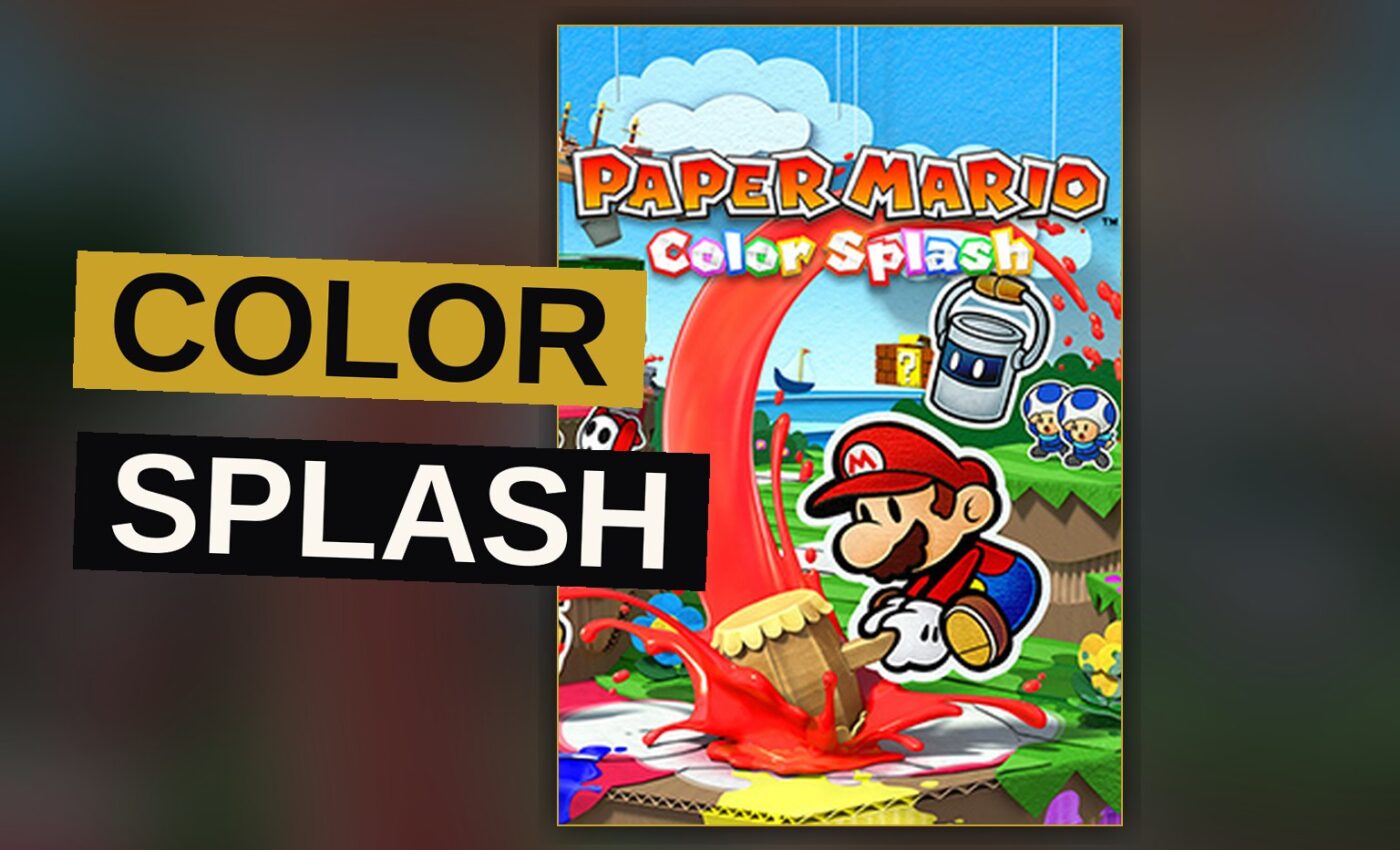
Nintendo had a problem with the Paper Mario series, and Paper Mario: Color Splash is where the company stopped pretending otherwise. After Paper Mario: Sticker Star, the developers decided the paper adventures needed to stay separate from the Mario & Luigi RPGs. The fix was a gimmick per game. For Color Splash, out in 2016 on the Wii U, that gimmick is paint, and the whole game is built around it.
Intelligent Systems developed Color Splash, with Nintendo EPD Production Group No. 6 and Nintendo itself attached. It is the fifth Paper Mario game. The pitch: Mario and Huey, a talking paint can, cross Prism Island to recover six Big Paint Stars and rescue Princess Peach from Bowser. It is a role-playing game and an adventure game at once, played in single player, from a side view.
That last part matters more than any mechanic. Nintendo built its paint ideas around the Wii U GamePad, and the GamePad is the kind of controller that shapes a design. The result is a game whose best trick is welded to hardware-specific controls. Judged on its own, Color Splash is a handsome, funny, stubbornly uneven adventure that lands at 7.5 of 10.
Trailer, via Nintendo of America.
A Toad Folded Into a Letter
The story opens with a hook the series had earned. Mario and Princess Peach get a strange letter. It turns out to be a Toad drained of all its color and folded into paper. Curious and concerned, they sail to Prism Island.
They find the town deserted. Colorless spots and faded objects dot the streets. At the heart of the island, the Prisma Fountain has run dry, and its six Big Paint Stars are gone. A vault appears in the fountain, holding a paint can. Mario tries to open it. The can wakes up.
That is Huey, the fountain’s guardian. He explains the stars supply the island with infinite paint and color. Mario agrees to help recover them. Soon Bowser snatches Peach, and the quest widens across six regions.
The setup is thin but clean. The letter is a genuinely good image, and the drained island gives Mario a reason to use his new tool everywhere. Color Splash does not waste time pretending to be an epic. It wants to move you from one colorful region to the next.
The Paint Hammer and the Cards
The paint hammer is the center of the game. Mario uses it to fill colorless spots scattered through the world. Filling them pays out items like coins. The hammer runs on red, blue and yellow paint, which Mario refills by striking objects. The area you fill decides the color and the amount of paint spent.
Hammer scraps raise the maximum paint Mario can carry. Huey is on hand for assistance. A second ability, the cutout, lets Mario trace a dotted line on the GamePad touchscreen so part of the environment peels off, exposing secrets and new areas.
Levels are made to look like craft materials. Mario moves through a world map of stages, each ending at a Mini Paint Star. Reaching one for the first time unlocks new stages. Some stages hide more than one Mini Paint Star.
- Six Big Paint Stars to recover, one per region
- Mini Paint Stars that unlock new stages
- Red, blue and yellow paint to refill and spend
- Hammer scraps that raise paint capacity
- The cutout, traced on the GamePad touchscreen
- Battle Cards that grant attacks and abilities
Combat is turn-based, and it runs on cards. Mario picks from a hand that endows him with attacks and other abilities. The GamePad touchscreen is how you sort, paint and flick them. The director at Intelligent Systems, Atsushi Isano, conceived the paint theme to take advantage of the GamePad in the first place.
What the GamePad Actually Bought
Here is the honest accounting of that decision. The paint theme is a real idea, not a coat of varnish. Filling in a blank spot with the hammer is satisfying in a way that most Mario busywork is not, because the world visibly changes and your paint supply visibly drains. The cutout is clever too, a small act of vandalism that reveals what the level was hiding.
The card system is where the design gets shaky. Sorting, painting and flicking cards is a fine use of a touchscreen. It is also slow. Every battle asks you to manage a hand before you can act, and the pace of a turn-based fight depends on how fast you can shuffle. Nintendo’s team implemented cards specifically to use the GamePad. That is a hardware answer to a design question, and you can feel the seam.
The artists did their part. The brief was to make the paper textures as realistic as possible, and Color Splash is one of the best-looking games on the Wii U. Cardboard, crepe paper and paint read as physical objects. The craft-store look holds up.
Bowser, Black Paint and the Koopalings
The plot escalates in a way that is genuinely strange, which is a compliment. As Mario collects the Big Paint Stars, each one reveals a fragment of memory about an attack on Port Prisma. The stars are witnesses, and the game doles out their testimony piece by piece.
Once all six are recovered, the truth lands. Bowser tried to dye his shell a rainbow color using the Prisma Fountain. He mixed the colors together by mistake, creating black paint, a toxic substance that possessed him and turned him into Black Bowser. He summoned his army, stole the Big Paint Stars and drained Prism Island.
Bowser also sent the color-drained Toad to lure Mario and Peach to the island. That is a better villain plan than the series usually bothers with.
Mario fights his way through the Koopalings, who serve as bosses, and helps stranded Toads along the way. With the Big Paint Stars in hand and Luigi joining later, the group reaches Black Bowser’s Castle. Inside, Bowser is mass-producing weaponized black paint in a factory, aiming to paint the world black.
The finale is loud and a little grim, and it earns the escalation. A game about restoring color ends in an industrial plant churning out the stuff that erases it. That is the sharpest thing Color Splash does.
Where the Gimmick Runs Out
Color Splash was announced through a Nintendo Direct, and it arrived into a franchise argument it could not settle. Nintendo wanted the Paper Mario games differentiated from Mario & Luigi, so it leaned on puzzle-solving, comedy and an overarching gimmick per entry. Color Splash follows that template faithfully.
The cost is visible. Sticker Star set the template, and Color Splash refines it rather than challenging it. The puzzle-solving is pleasant. The comedy lands often enough. But the game keeps stopping so you can fiddle with cards, and the paint economy never becomes a real pressure. You rarely feel short of anything.
The GamePad is the other half of the problem. Sorting and flicking cards on a touchscreen is the kind of idea that only exists because the console had one. On hardware with a conventional controller, that trade might have paid off. Here, it tied a good-looking adventure to a controller most players never held.
None of this makes Color Splash a failure. It makes it a game with one strong idea, one slow system and one beautiful art direction, released at the worst possible moment.
What the Score of 7.5 Buys
Paper Mario: Color Splash earns its 7.5 of 10. The paint hammer and the cutout are the reasons to play. The card battles are the reason you will put it down between sessions. The story about a fountain, six stars and a Bowser turned black is more inventive than the series had been in years, and the paper-craft art is close to flawless.
The aggregate score sits at 7.5 of 10, and that number is fair rather than generous. This is a good game with a slow spine, and the slowness is not a matter of taste. It is the GamePad’s fingerprint on the design.
Ten Years of Paint
What matters most, though, is not the score. It is that Color Splash follows the gimmick-first template Sticker Star established, and it follows it without much argument. The paint idea is the series’ sharpest gimmick so far. The card system is its clumsiest.
Ten years on from 2016, the game still looks better than it plays.
Get the Notebook.
The day's best stories and every fresh verdict, in plain English, in your inbox by seven. One email a day, no more.