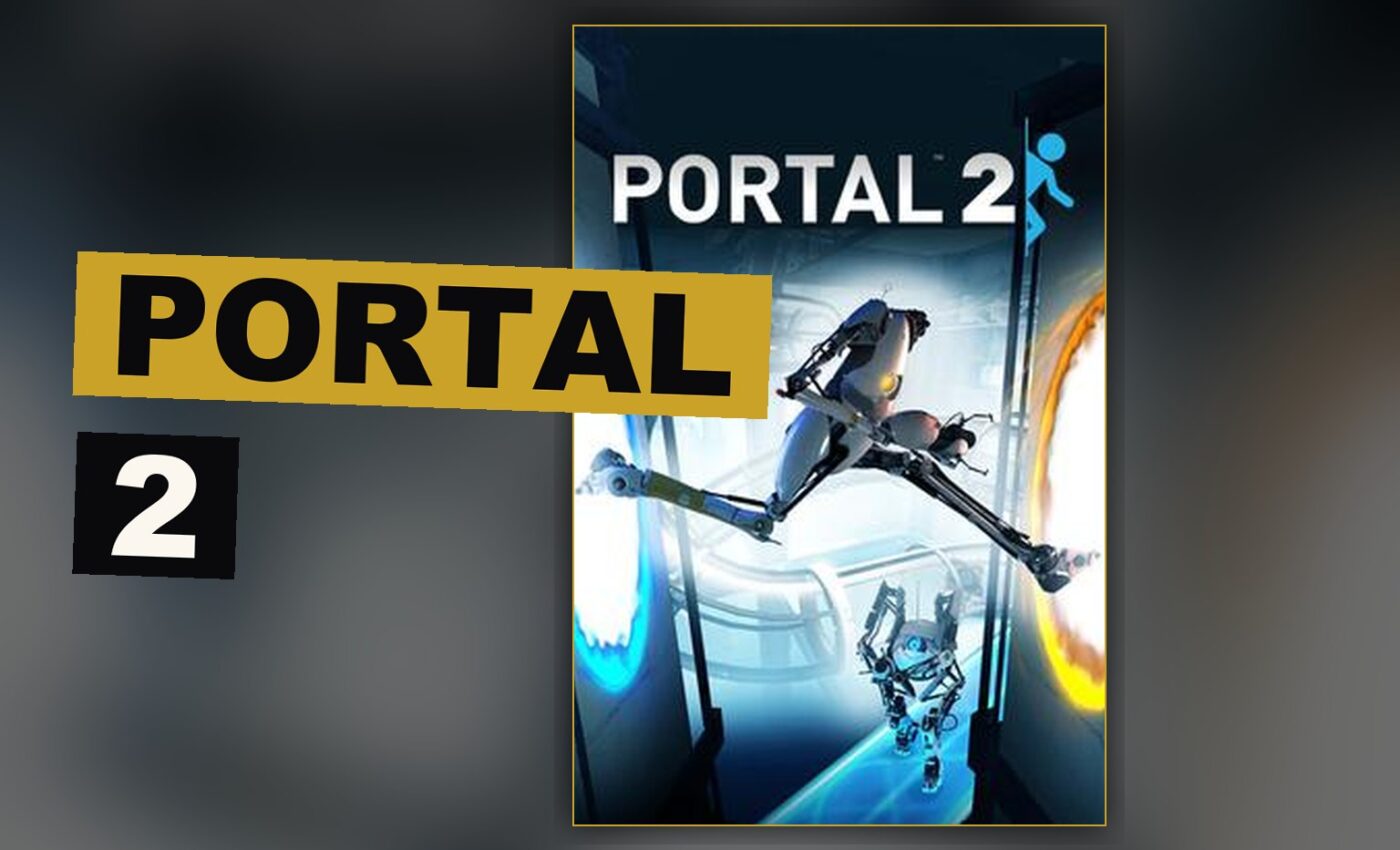
Valve built a puzzle game about a gun that makes holes in walls, and then it built a sequel that made those holes feel like the whole world. Portal 2 arrived in 2011 for Windows, macOS, Linux, PlayStation 3 and Xbox 360, with retail copies and the console versions distributed by Electronic Arts. A Nintendo Switch port followed in June 2022 as part of the Portal: Companion Collection. The first Portal was a short, sharp joke that turned into a horror story. Portal 2 is longer, louder and stranger, and it is the better game for all three.
Chell Wakes Up in the Aperture Science Enrichment Center
The single-player campaign puts you back in control of Chell, the silent protagonist of the original. She wakes into a ruined facility. The Aperture Science Enrichment Center is being rebuilt around her by GLaDOS, the supercomputer she destroyed at the end of Portal. GLaDOS is voiced by Ellen McLain, and she returns with the same calm, murderous manners. Her stated purpose is testing the Portal Gun’s mechanics. Her real purpose is revenge.
Chell does not escape alone. She picks up Wheatley, a chatty robot voiced by Stephen Merchant, who bumbles through the early chambers with her. Wheatley is the funniest thing Valve has written, and Merchant plays him as a man who has never once been in charge of anything. The two of them push through the labs together until the story turns and the game hands you a new set of problems.
The setting is not just a backdrop. The Portal series shares a universe with Half-Life. The events of Portal sit between the first and second Half-Life games, while most of Portal 2 takes place “a long time after” the original. Before Portal, Aperture Science ran experiments on whether human subjects could survive its test chambers. Then GLaDOS killed the employees. A promotional comic shows Doug Rattmann, the estranged Aperture employee who used graffiti to guide the player in Portal, putting Chell into suspended animation to save her life. That is where Portal 2 begins.
Lasers, Funnels and Gels That Rewrite the Rules
The core of Portal 2 is unchanged. You place two portals on suitable surfaces and move between them. You fling yourself across rooms. You solve the puzzle. What changed is everything around that core.
Valve added excursion funnels, which the files call tractor beams. It added lasers, light bridges and paint-like gels that alter movement or let portals stick to any surface. Thermal Discouragement Beams, Excursion Funnels and Hard Light Bridges can all pass through portals, which means every new toy multiplies the old ones. Aerial Faith Plates catapult you through the air. Sentient turrets still shoot you if you stand in their line of sight, and you still have to disable them or avoid them.
The Weighted Storage Cube got a redesign, and Valve added new versions: Redirection Cubes with prismatic lenses that bend laser beams, spherical Edgeless Safety Cubes, an antique cube used in the underground levels, and a cube-turret hybrid that Wheatley builds after taking over. That last one is a joke and a threat at the same time.
The learning curve is the quiet achievement here. Portal 2 teaches without a tutorial voice nagging you. Each chamber introduces one idea, lets you break it, then takes it away. The pacing never sags.
Cave Johnson and the Cooperative Robots
J. K. Simmons voices Cave Johnson, the founder of Aperture Science, and his audio logs carry the game’s middle act. Johnson is a salesman, a crank and a dying man, and Simmons plays all three without blinking. His sections give Portal 2 a history the first game never had.
The cooperative campaign is a separate game. Two players take control of Atlas and P-Body, both voiced by Dee Bradley Baker, and solve chambers built for four hands instead of two. The puzzles require callouts, timing and trust. Valve built the mode so that neither player can carry it alone, which is the right call and the harder one.
Jonathan Coulton and the band National produced songs for the game. Valve announced Portal 2 in March 2010 and promoted it with alternate reality games, including the Potato Sack, a collaboration with several independent developers. After release, Valve put out downloadable content and a simplified map editor so players could build and share their own levels. That editor is the reason people are still playing.
Here is the order of what matters in Portal 2, from the thing that will keep you here to the thing that is merely pleasant:
- The puzzle design, which teaches, tests and then breaks its own rules without ever losing you.
- GLaDOS, whose revenge plot gives the comedy a spine.
- Wheatley, the best new character Valve has written.
- The cooperative campaign, which is a real second game and not a bonus mode.
- Cave Johnson’s audio logs, which fill in Aperture’s history.
- The gels, funnels and lasers, which are excellent but are still just new verbs for an old sentence.
What Portal 2 Gets Right
The first Portal was a experiment that got lucky. It was short, it was cheap, and it ended with a song. Portal 2 is a full-priced sequel that had to justify itself, and it does that by refusing to repeat the trick.
GLaDOS is the proof. In Portal she was a monster with a pleasant voice. In Portal 2 she is a monster with a grievance, and the game lets her win for a while. The middle act, where Wheatley takes control and immediately makes everything worse, is the smartest thing in the script. Valve understood that the villain was never the point. The point is that nobody in this facility should be trusted with power, including the robot you like.
The new mechanics are not padding. Excursion funnels and light bridges exist because the portal gun alone had run out of room. Gels that let you place portals on any surface are the biggest change, because they remove the one rule the first game depended on. That is a confident move from a studio that could have shipped more of the same.
The cooperative mode is the part that will outlast the campaign. Atlas and P-Body cannot talk. They can only point, and the puzzles are built so that pointing is not enough. That is a design choice that respects the player.
The Verdict on Portal 2
Portal 2 is not a perfect game. The underground sections with Cave Johnson run long, and the antique cube and the old Aperture offices are more atmosphere than puzzle. The single-player campaign front-loads its best jokes and its cleanest chambers, and the back half trades precision for scale.
None of that costs it much. Portal 2 took a short, clever game and built a full-length one around it without losing the voice that made the first one work. The puzzles are better. The cast is better. The cooperative campaign is a genuine second game. Valve announced it in March 2010, shipped it in 2011, and then handed players a map editor so the game would never really end. That is the mark of a studio that knew what it had.
The published critical average for the PC version sits at 9.5 out of 10 on Metacritic. That number is earned. Portal 2 is the rare sequel that understands its own predecessor well enough to argue with it.
Get the Notebook.
The day's best stories and every fresh verdict, in plain English, in your inbox by seven. One email a day, no more.