
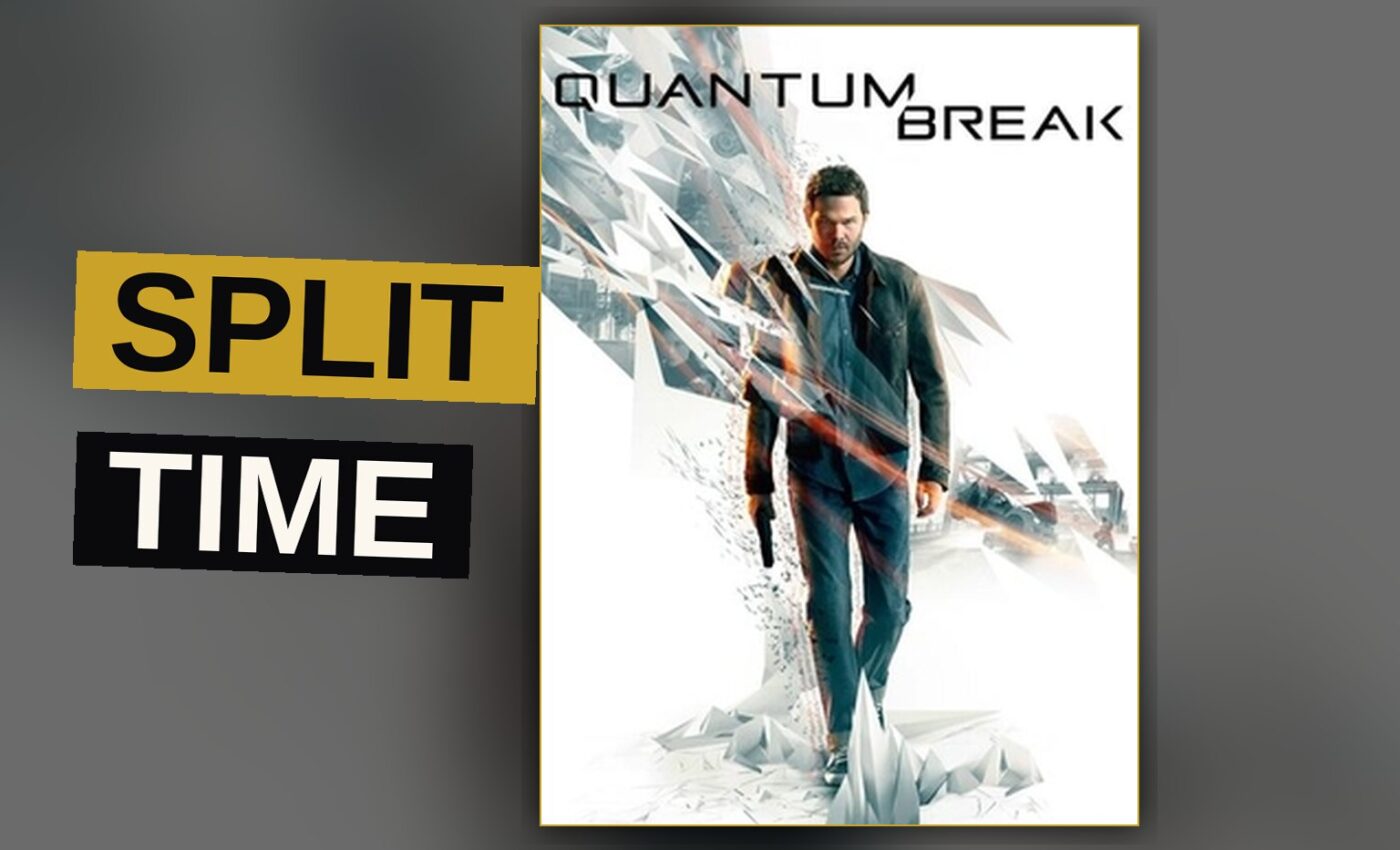
Quantum Break opens with a man on the ground and a world that has stopped moving. Jack Joyce, played by Shawn Ashmore, can still walk through it. Everyone else is frozen mid-stride. That image is the whole pitch of Remedy Entertainment’s 2016 action-adventure shooter, and it is the reason the game still holds attention a decade after Microsoft Studios published it for PC and Xbox One.
The setup comes from a failed experiment. Paul Serene, Jack’s best friend, has built a time machine using chronon particles and activated it at a university in Riverport, Massachusetts. The machine jams shut, breaks, and douses both men in chronon radiation. It also fractures the structure of time itself.
Trailer, via IGN.
Jack Joyce and the Fracture
The story is blunt about stakes. Time is stuttering to a halt and restarting, turning the world into a frozen tableau. Most people never notice. Jack does, because the same accident that broke time gave him the power to move inside it.
His goal is to stop the Fracture before it reaches its conclusion, the moment time ends. Standing in his way is Serene, now running Monarch Solutions, a corporation willing to use whatever means necessary to stop him. Aidan Gillen plays Serene. Lance Reddick has an important role. Beth Wilder fights alongside Jack.
The rules of the fiction are stricter than most time-travel stories. The game leans on the Novikov self-consistency principle: a traveler cannot change the past through his own actions. Serene demonstrates this by trying to save a vagrant he and Jack found dead in their youth. He goes back, startles the man, and causes the fall that kills him.
Travel between machines only works when they share the same core. That closes off the usual paradox escape hatches. It is a clean piece of design.
Time Stop, Time Rush, and Monarch’s Strikers
Combat runs from a third-person perspective and gives Jack four firearms: pistols, assault rifles, shotguns, and carbine rifles. The better tools are his powers.
Time Stop traps enemies in a bubble. Shoot someone inside it and the damage amplifies, killing them when the bubble vanishes. Time Rush dashes Jack next to an enemy for an immediate melee takedown, or speeds him between cover so confused enemies lose track of where he is. Time Blast levitates and freezes. Time Shield deflects incoming damage. Time Dodge is a quick evasive dash. Most carry a short cooldown.
Enemies are built to answer those tools. Monarch security guards are the baseline. Strikers wear suits that let them manipulate time. Juggernauts are heavily armored and carry very strong firearms. Each type behaves differently, and the game pushes players to switch tactics rather than repeat one combo.
Cover works automatically when Jack stands near an environmental object, but the enemy AI is designed to coordinate and flush him out. That single decision does more for the shooting than any of the powers.
| Element | What Quantum Break does |
|---|---|
| Protagonist | Jack Joyce, played by Shawn Ashmore |
| Antagonist | Paul Serene, played by Aidan Gillen |
| Enemy types | Monarch guards, Strikers, Juggernauts |
| Weapons | Pistols, assault rifles, shotguns, carbine rifles |
| Key powers | Time Stop, Time Rush, Time Blast, Time Shield, Time Dodge |
| Setting | Riverport, Massachusetts |
A Television Show Inside the Game
Quantum Break’s strangest bet is structural. Episodes of a live-action television show are built into the game, using the same actors who play the characters. Segments change based on what the player did.
The game was made to reach a broad audience. Remedy described the story as a “summer blockbuster movie.” The video game side was developed internally by Remedy and directed by Sam Lake. The TV side was produced with Lifeboat Productions and directed by Ben Ketai.
The project did not start here. It was originally envisioned as a sequel to Remedy’s Alan Wake. The focus shifted to time travel because Microsoft wanted a new intellectual property with interactive storytelling. The team consulted scientists while building the fictional science.
“Junction points” let player choices affect the outcome. The game runs on Northlight, a new engine developed by Remedy.
What Holds and What Slips
The powers are the strongest part of Quantum Break, and Time Stop is the reason. Freezing a room, firing into the bubble, and watching the damage land all at once is a genuinely good piece of combat design. Time Rush solves the problem most shooters have with closing distance, turning a dash into a takedown instead of a chore.
The enemy roster earns its keep too. Strikers and Juggernauts force different answers, and the AI’s habit of pushing Jack out of cover keeps fights from settling into a rhythm. That is more than most third-person shooters of this period manage.
The live-action episodes are the weaker half. Integrating a television show into a game is an ambitious idea, and the shared cast is the right call, but the two halves never quite fuse. The show stops the game, and the game interrupts the show. Neither gets to be what it wants to be.
The story’s refusal to let travelers change the past is the smartest thing in the script. It removes the cheap fix and forces Jack and Serene into a conflict about what to do rather than what to undo. Serene’s ability to see the future and choose in the present makes him a real opponent instead of an obstacle.
What does not land is the pacing. The Fracture premise promises catastrophe on a massive scale, and the game delivers frozen set pieces rather than the slow dread the premise suggests. The narration from Jack holds the plot together but rarely adds a thought the scene has not already given.
Quantum Break sits in an odd place in Remedy’s catalog. It is not as tight as the studio’s best work, and the television experiment did not become a template anyone else followed. It is still worth playing for the combat alone, and the time-travel rules are more disciplined than most games that try the same trick.
A 7.7 of 10 fits. Good powers, a strong antagonist, and one structural gamble that does not pay off.
Get the Notebook.
The day's best stories and every fresh verdict, in plain English, in your inbox by seven. One email a day, no more.


