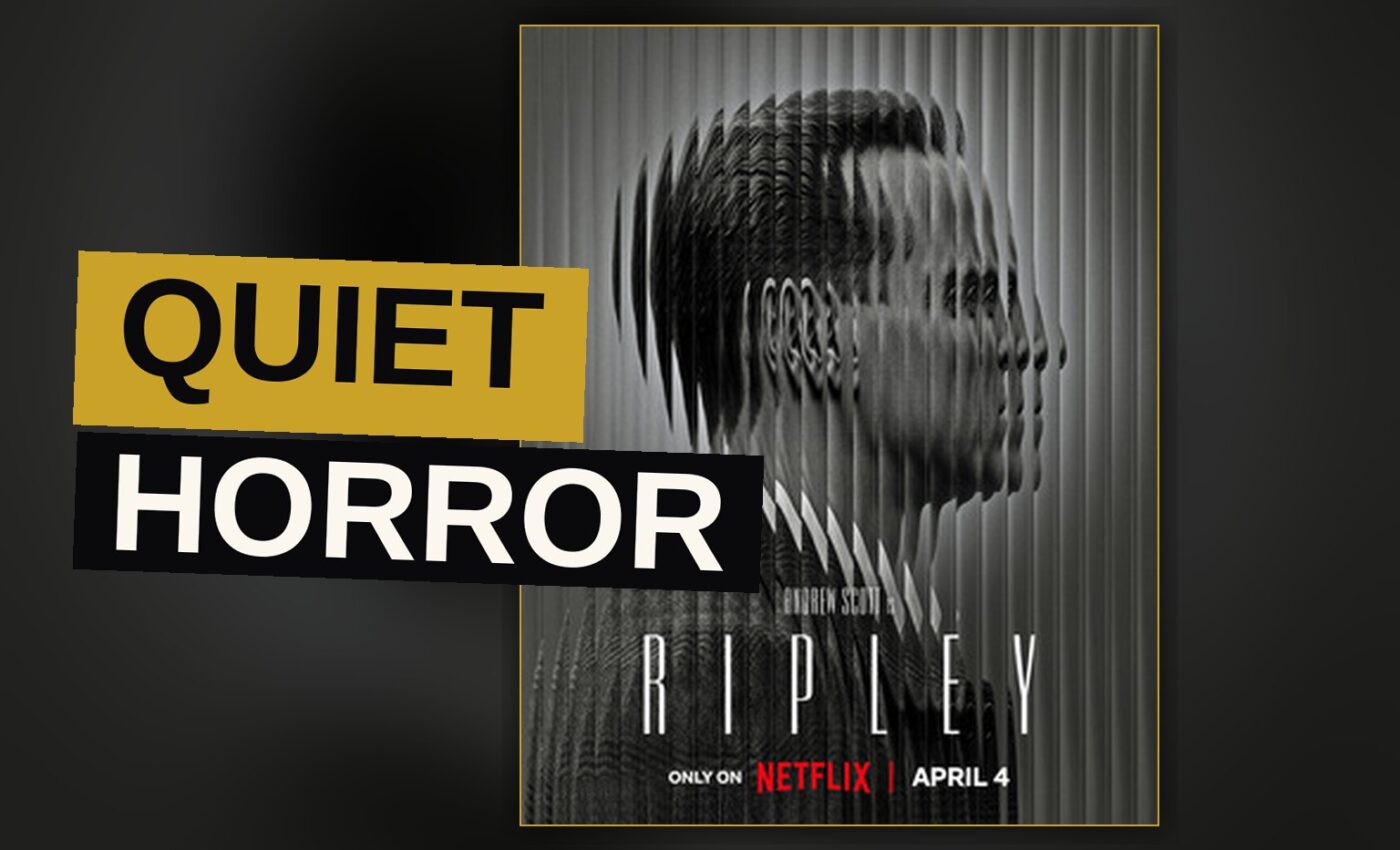
Andrew Scott carries a heavy silence through Steven Zaillian’s Ripley, an eight-episode series that turns Patricia Highsmith’s con man into a study in patience. This is not a fast thriller. It is a slow, deliberate portrait of a man who learns to become someone else, one small lie at a time.
The show follows Tom Ripley, a small-time grifter in 1960s New York, who is sent to Italy to bring home a wealthy man’s son. The job goes wrong. Ripley kills the young man, Dickie Greenleaf, and then decides to take over his life. What follows is not a chase but a careful, creeping process of imitation, fraud, and murder.
Trailer, via Netflix.
Scott’s Still Performance
Scott plays Ripley with a flat, watchful calm. His face rarely moves, but his eyes track everything. He is not charming in the way Matt Damon was in the 1999 film The Talented Mr. Ripley. He is colder, more mechanical, a man who treats other people as obstacles to be removed.
The performance works because the series gives it room. Zaillian lets scenes breathe. A conversation about a painting runs for several minutes. A murder takes nearly a full episode to unfold, step by step, from the crime to the cleanup. The result is tense in a way that loud action never is.
Black-and-White Italy
The series is shot in black and white, a bold choice for a story set in sunny Italy. It works. The shadows are deeper, the marble harder, the sea darker. Every frame looks composed, like a photograph from the era.
Zaillian, who also wrote the script, uses the visual style to reinforce Ripley’s world. He sees things in terms of surfaces and reflections. The show lingers on staircases, mirrors, and the play of light on water. It is a beautiful series, but the beauty is cold. There is no warmth here, only geometry.
Supporting Cast
Johnny Flynn plays Dickie Greenleaf as a spoiled, careless young man who never thinks about consequences. He is not a villain. He is simply someone who has never had to pay for anything, and that carelessness makes him easy prey.
Dakota Fanning plays Marge Sherwood, Dickie’s girlfriend, who suspects something is wrong but cannot prove it. She is the closest thing the show has to a moral center, and Fanning gives her a sharp, frustrated intelligence. Eliot Sumner appears as Freddie Miles, a friend of Dickie’s who sees through Ripley’s act. His death is the show’s most brutal scene.
The Pace Problem
The series is not for everyone. It is slow, deliberately so, and some episodes feel stretched. A sequence about forging a passport runs long. A trip to a small town to retrieve a typewriter takes an entire episode. The patience that makes the best scenes work also makes others drag.
At eight episodes, Ripley could have been tighter. The story is essentially a single con, and the middle chapters repeat the same beats. Ripley makes a mistake, covers it up, and moves on. The repetition is realistic, but it is not always gripping.
Craft of the Con
What keeps the show compelling is the detail. Zaillian shows the work of deception. Ripley does not just decide to impersonate Dickie. He practices signatures, studies photographs, and learns to answer to a new name. The show treats fraud as a craft, and it shows every step.
This is where the series excels. A lesser show would skip over the logistics. Ripley lingers on them, and the attention pays off. The tension comes from watching him improvise, knowing that one wrong word could end everything.
Ending and Score
The final episode brings the story to a close without a grand confrontation. Ripley gets away. He is not caught, and he is not punished. He simply moves on, a little richer, a little more practiced at being someone else. This is faithful to Highsmith’s novel, but the series makes the ending feel less triumphant and more hollow.
Ripley’s method, as Zaillian presents it, comes down to a few practiced steps:
- Forging signatures until they pass casual inspection
- Studying photographs to memorize Dickie’s posture and habits
- Answering to a new name without hesitation
- Cleaning up every trace of the crime before moving on
The IMDb score for the series sits at 8.1 out of 10. That feels right. It is a well-made, intelligent show that rewards patience, but it is not a crowd-pleaser.
The show’s strengths, in order of what lands hardest:
- Scott’s controlled, watchful lead performance
- The black-and-white cinematography that turns Italy into a cold grid
- The patient, step-by-step depiction of fraud as manual labor
- The supporting turns from Fanning and Sumner
Ripley is a success on its own terms. It is not trying to be a thriller, and it does not apologize for being slow. It is a portrait of a man who becomes a ghost, and it trusts the audience to watch the process without needing a chase scene every few minutes.
The final shot stays with you. A man alone in a room, looking at himself, already planning his next move. There is no relief in his escape, only more work ahead. That is the quiet horror of Ripley, and the show earns it.