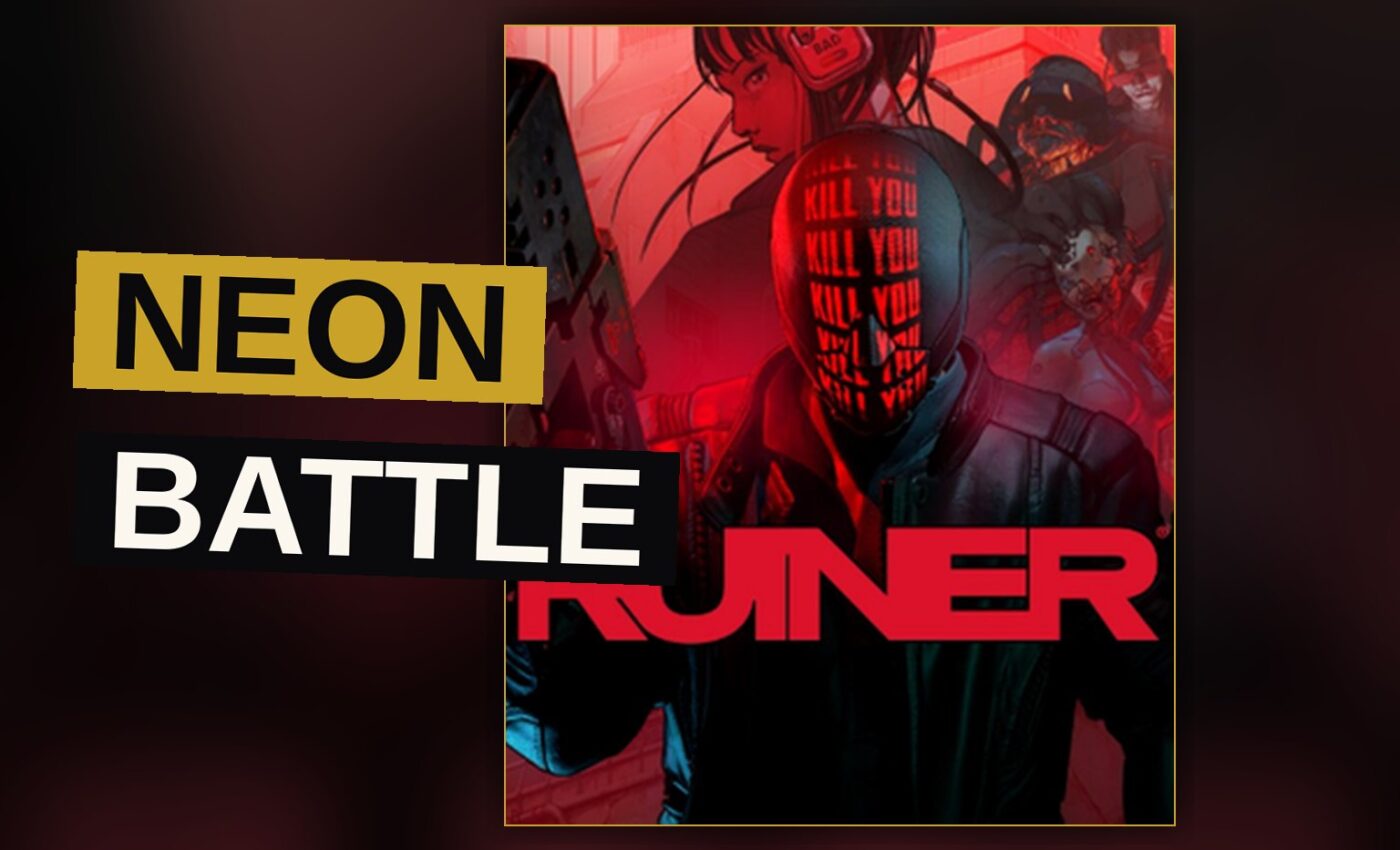
Ruiner is a fast, loud, and brutal action game built around one question: how far can you push a simple shooting loop before it breaks apart? The answer, according to developer Reblo, is pretty far. Released in 2017 for PS4, Linux, PC, and Mac, the game puts you in control of a lone hacker named 2B-G, fighting his way through the neon-drenched city of New Tokyo to take down the corporation that destroyed his life.
The premise is thin. You are told almost nothing about who you are or why you fight. That lack of context works in Ruiner’s favor, because the game is not interested in story. It is interested in movement, in guns, and in the rhythm of a bullet-hell shooter that never stops moving.
Trailer, via IGDBcom.
The City and Its Enemies
New Tokyo is a vertical sprawl of corporate towers, neon signs, and empty streets. The game drops you into this world with a gun, a dash ability, and a mission to find your sister, who was taken by the corporation. Along the way, you face off against waves of enemies, boss fights, and checkpoints that reset your progress if you die.
The level design leans heavily on repetition. You will walk the same streets, climb the same buildings, and dodge the same bullets again and again. That repetition is not a flaw. It is the point. Ruiner is a game about momentum, and it asks you to keep moving, even when the screen fills with red.
“It’s a bullet-hell shooter that never stops moving.”
Combat and the Bullet Hell Loop
Combat in Ruiner is built around a tight feedback loop. You move forward, you fire your weapon, you dodge enemy attacks, and you repeat. The game rewards aggression. Standing still gets you killed. Moving gets you through.
The weapons are simple but effective. You have a standard pistol, a shotgun, and a machine gun, each with a distinct feel. Switching between them mid-combat is quick, and the game encourages you to cycle through your arsenal as the situation changes. Boss fights scale up the chaos, adding more enemies, more projectiles, and more pressure.
Here is what the combat loop typically includes:
- Dashing to avoid incoming fire
- Firing a mix of weapons at close range
- Clearing rooms of enemies before moving forward
- Managing health with pickups scattered through levels
The dash ability is essential. It lets you slide through narrow spaces, dodge bullets, and close the distance on enemies. It is the difference between survival and death, and it is the one thing that keeps Ruiner from becoming a wall of numbers.
Difficulty and the Reset Mechanic
Ruiner is not an easy game. The difficulty curve is steep, and the game does not hold your hand. Checkpoints exist, but they are not kind. Die enough times in a row and you lose progress, forcing you to start over from the last checkpoint. This creates a tension between pushing forward and playing it safe, and it is a deliberate design choice.
Some players will find this frustrating. Others will find it exhilarating. The game wants you to feel the cost of failure, and it delivers on that promise.
Sound, Style, and the Neon Aesthetic
The visual style is the star of Ruiner. New Tokyo is rendered in a bold, saturated palette of neon colors, with sharp angles and a clean, minimalist layout. The lighting is used to great effect, creating depth and contrast in every scene. It is a city that feels lived-in, even when it is empty.
The soundtrack matches the aesthetic. It is electronic, driving, and repetitive, designed to keep you locked into the rhythm of combat. There is no music that stands out on its own, but the score works within the game’s world.
What Ruiner Gets Right
Ruiner succeeds because it commits fully to its own vision. It is not trying to be a story-driven epic. It is trying to be a pure arcade experience, and it achieves that goal. The shooting is precise, the movement is fluid, and the sense of speed is constant.
Where it falls short is in the details. The story is thin, the character work is minimal, and the world beyond the combat is underdeveloped. It is a game that knows exactly what it is and what it is not, and it does not apologize for either.
Final Word
Ruiner is a solid, if unremarkable, entry in the genre. It does not reinvent the bullet-hell shooter, but it executes it with skill and confidence. The difficulty is high, the checkpoints are harsh, and the payoff is a steady stream of action that rarely lets up.
It is a game for players who want to feel competent and challenged at the same time. For everyone else, it is a niche product.
Get the Notebook.
The day's best stories and every fresh verdict, in plain English, in your inbox by seven. One email a day, no more.