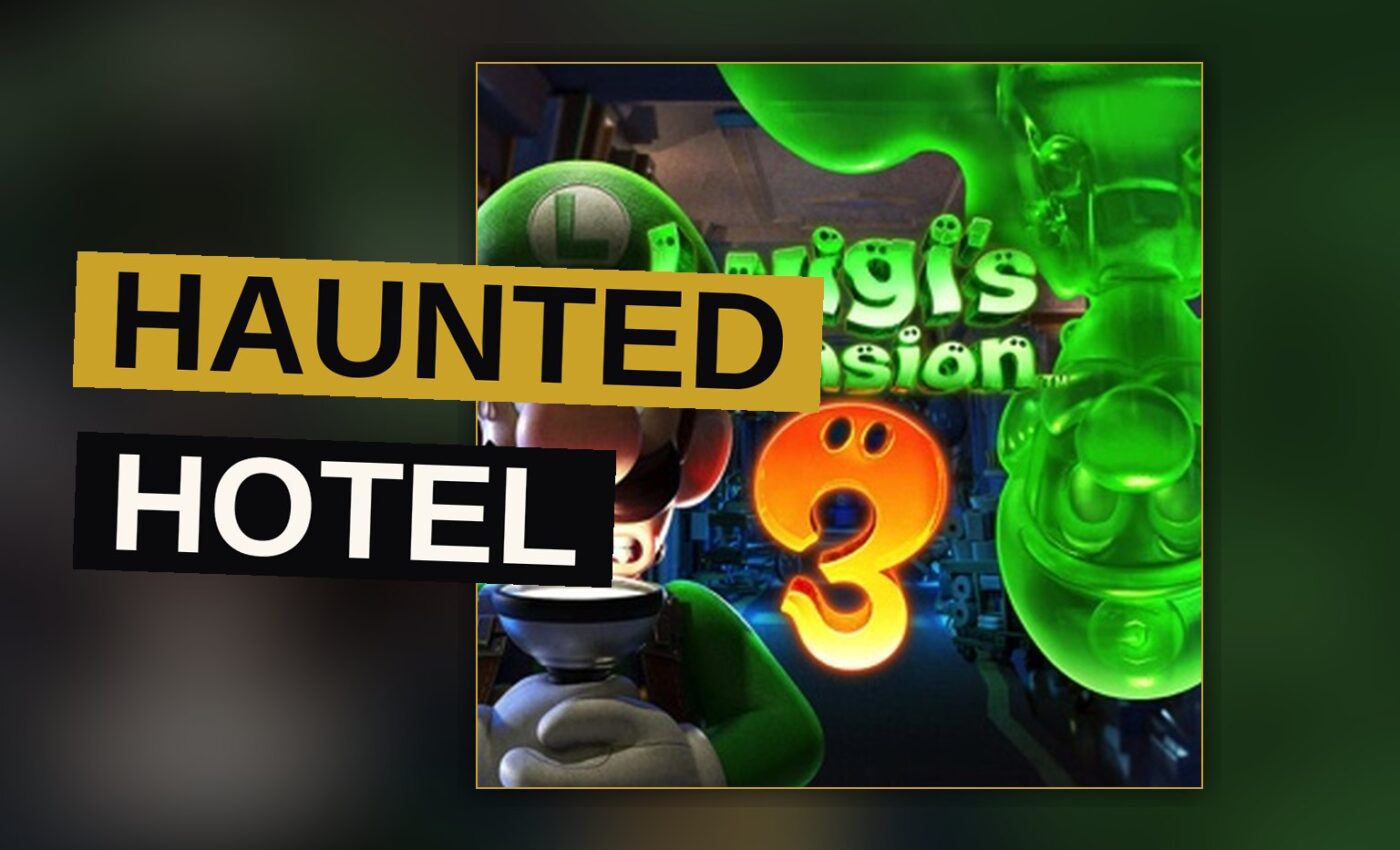
Luigi’s Mansion 3 is the rare sequel that understands the assignment. It takes the haunted-house formula that made the GameCube original a cult favorite and the 3DS follow-up a solid outing, then polishes every creaky floorboard to a gleam. The result is a puzzle-box adventure that is generous, inventive, and frequently hilarious, and it earns its place among the best games on the Switch.
The setup is classic Nintendo. Luigi, his brother Mario, and a crew of friends are invited to a luxury hotel for a free vacation. The trap snaps shut almost immediately. The hotel is a front for King Boo, who has captured the gang and framed their portraits on the walls. Luigi, armed with his trusty Poltergust G-00, must rescue everyone by clearing each floor of its ghosts and solving the puzzles that bar his way.
Trailer, via Nintendo of America.
A Hotel Built on Themes
The game’s structure is its smartest decision. Each of the hotel’s floors is a distinct theme: a medieval castle, a pyramid, a movie set, a garden. This is not mere set dressing. Every floor is a self-contained puzzle that requires you to use the Poltergust’s abilities in new combinations. The game teaches you a mechanic, lets you master it, and then moves on before it ever feels tired.
This pacing is the key to the game’s success. A floor might take you forty minutes to clear, and by the end you are ready for the next theme. The developers at Next Level Games have a firm grasp on the rhythm of discovery. They never let a single trick overstay its welcome. The result is a game that feels consistently fresh from the opening lobby to the final boss.
The hotel also rewards curiosity. Hidden gems and gold bars are tucked into corners, behind paintings, and under rugs. Finding them is not required, but it feeds the game’s core loop of exploration. You are never punished for poking around, and the game is generous with its secrets. It respects the player’s time while still offering a reason to look under every bed.
Poltergust G-00 and Its Tricks
The star of the show is the Poltergust G-00, Luigi’s upgraded vacuum cleaner. It sucks up ghosts, but it also fires a plunger, a burst of air, and a strobe light. The plunger is the standout addition. You can attach it to distant objects, then yank them toward you or use them as anchors to pull apart the environment. This opens up a range of puzzles that feel tactile and satisfying.
Combat is a dance. You stun a ghost with the strobe, then suck it in. The game throws multiple ghost types at you, each requiring a different approach. Some shield themselves, some split into pieces, and some charge at you. The boss fights, which cap off each floor, are clever set pieces that test your mastery of the tools you have just learned. They are not brutally difficult, but they demand attention.
The game’s controls are tight. The Switch’s analog sticks handle Luigi’s movement well, and the aiming for the Poltergust is responsive. There was a moment, early on, where I struggled to line up a plunger shot on a moving target. That frustration faded as I got used to the game’s rhythm.
“By the third floor, I was pulling off multi-step combos without thinking.”
The game trusts you to learn, and it rewards that trust.
Gooigi and the Co-op Twist
The other major addition is Gooigi, a green, gelatinous clone of Luigi. He is controlled by a second player in co-op mode, or by Luigi himself in single-player. Gooigi can slip through bars, cross spiked floors, and take hits that would send the real Luigi flying. He is a clever solution to the game’s puzzle design, which often requires two bodies in two places at once.
In single-player, you switch between Luigi and Gooigi with a button press. This works well, and the game is careful to never require you to control both at the same time. In co-op, the game becomes a different beast. Two players can tackle puzzles together, and the game’s difficulty scales to accommodate the chaos. The co-op mode is a joy, though it can get frantic when both players are trying to suck up the same ghost.
The only real complaint about Gooigi is that he is underused in the main story. He appears in specific rooms and sections, but the game often locks him away during the exploration segments. This is a minor issue, as the puzzles that do use him are some of the best in the game. But there is a sense that the developers could have pushed the mechanic further.
Scares and Laughs in Equal Measure
Luigi’s Mansion 3 is not a scary game. It is a spooky game, with a light touch. The ghosts are more goofy than menacing, and the game’s humor is consistently on point. Luigi’s terrified animations are a highlight. He flinches, he trembles, he looks around nervously. The game never lets you forget that he is a coward, and that makes his bravery all the more endearing.
The game’s presentation is superb. The hotel is rendered in gorgeous detail, with lighting that sells the mood of each floor. The music is catchy, and the sound design is full of little touches that bring the world to life. The game runs smoothly on the Switch, with only minor loading times between floors. It is a technical showcase for the hardware.
The voice acting is minimal, as is typical for the series. Luigi communicates in grunts and yelps, and the ghosts speak in gibberish. This works in the game’s favor. It keeps the focus on the action and the visuals, and it allows the game’s physical comedy to shine. The game knows when to be quiet and let a joke land, and it knows when to ramp up the tension with a sudden noise.
Boss Fights and Set Pieces
The boss fights are the game’s best moments. Each one is a themed encounter that uses the floor’s mechanics in a creative way. The medieval floor ends with a knight who guards his weak point. The pyramid floor ends with a mummy that you must unwrap. These fights are not just battles; they are puzzles in their own right.
The game saves its best for last. The final boss is a multi-phase encounter that pulls together everything you have learned. It is challenging, but fair, and it provides a satisfying conclusion to the adventure. The credits roll after a final sequence that is equal parts thrilling and silly, and they are worth sitting through for the post-credits scene alone.
The set pieces between floors are also memorable. The game frequently drops you into a chase sequence or a timed puzzle that breaks up the exploration. These moments are well-paced, and they never feel like filler. They are the game’s way of keeping you on your toes, and they work.
Post-Game Modes and Replay Value
No game is perfect, and Luigi’s Mansion 3 has its flaws. The game is a little too easy in its opening hours. The first few floors are simple, and the game is slow to introduce its more complex mechanics. This is a common issue with Nintendo games, which tend to front-load their tutorials, but it is noticeable here.
The game also lacks a strong incentive for replay. Once you have cleared the hotel, there is little reason to go back. The game does ship with extra modes — ScareScraper, a standalone co-op tower where you climb a randomized multi-floor structure with up to eight players, and ScreamPark, a competitive multiplayer mode where teams of ghosts and Luigis face off in arena-style challenges. These are fun diversions, but they feel like afterthoughts compared to the main story. The main story is the draw, and it is a one-and-done experience for most players.
The co-op mode in the campaign is a highlight, but it is limited to the main story. ScareScraper offers a separate co-op experience outside of the campaign, and ScreamPark adds a competitive twist, but neither has the depth of the main adventure. The game could have benefited from a more robust set of challenges or a wave-based survival mode. As it stands, the extra modes are fun additions, but they are not a reason to buy the game on their own.
A Weekend Well Spent
Luigi’s Mansion 3 is a triumph of design. It takes a simple premise and wrings every ounce of fun out of it. The puzzles are clever, the combat is satisfying, and the presentation is top-notch. It is a game that respects its player’s intelligence while still being accessible to newcomers.
The game is not a revolution. It does not break new ground for the series or for the genre. But it does not need to. It is a polished, confident piece of work that knows exactly what it wants to be. It is a game about exploring a haunted hotel, and it does that better than almost anything else on the market.
The short length is a feature, not a bug. The game tells its story, delivers its scares, and ends on a high note. It does not overstay its welcome. In an era of bloated open worlds and endless side quests, it is refreshing to play a game that knows when to stop.
The Score
Luigi’s Mansion 3 is a masterclass in game design. It is clever, charming, and endlessly entertaining. It is a game that will appeal to veterans and newcomers alike, and it is a game that will be remembered as one of the best on the Switch.
The game is not without its flaws, but they are minor in the face of its achievements. It is a game that understands its audience and delivers on every promise it makes. It is a game that deserves to be played, and it is a game that deserves to be celebrated.
If you own a Switch, you owe it to yourself to play this game. It is a shining example of what the medium can do, and it is a joy from start to finish. It is a game that I will recommend without hesitation.
Luigi’s Mansion 3 earns a score of 8.9 out of 10.
- Game: Luigi’s Mansion 3
- Platform: Nintendo Switch
- Release Date: October 31, 2019
- Developer: Next Level Games
- Publisher: Nintendo
- Mode: Single-player, local co-op
- Score: 8.9 out of 10
Get the Notebook.
The day's best stories and every fresh verdict, in plain English, in your inbox by seven. One email a day, no more.