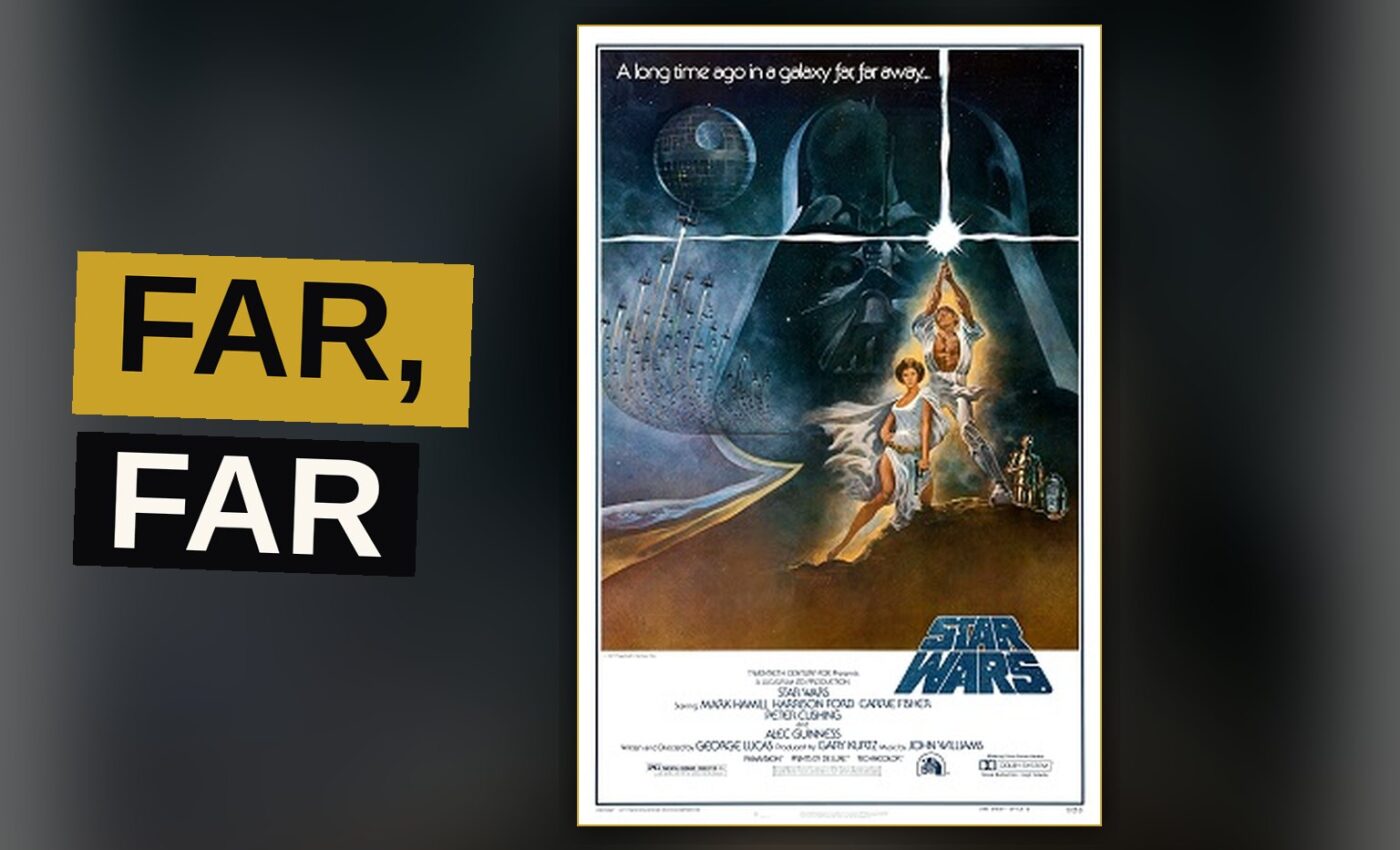
In 1977, a film arrived that rewired what a blockbuster could be. Star Wars was not the first science fiction movie, nor the first space adventure, but it became the measuring stick for both. George Lucas’s picture took the serial thrills of old matinees and gave them a scale and polish no one had seen before. Watching it now, the seams show, but the wonder does not fade.
Trailer, via Star Wars.
Opening Crawl and First Contact
The film announces itself with a text scroll that has become its own cultural artifact. “A long time ago in a galaxy far, far away” sets the tone before a single ship appears. The words rise and vanish into a starfield, then the camera tilts down to reveal a massive vessel in pursuit of a smaller one. It is a simple trick, but it works every time.
That opening sequence, with the Rebel blockade runner and the Imperial Star Destroyer, remains a masterclass in scale. John Williams’s score swells underneath, and the promise is made: this will be big.
Luke Skywalker’s Slow Start
Luke Skywalker, played by Mark Hamill, is a farm boy on Tatooine, stuck with his uncle and dreaming of adventure. The first act is deliberately slow. We meet droids, a hermit, and a moisture farm. There is no rush to the stars.
That patience pays off. When Luke finds the message from Princess Leia, hidden in R2-D2, the plot snaps into motion. The call to adventure is a hologram, and it is enough.
Droids, Smugglers, and Wookiees
R2-D2 and C-3PO are the film’s emotional anchors. One is a fussy protocol droid, the other a brave little astromech. Their banter is simple, but it gives the film a comic heartbeat. C-3PO’s complaints and R2’s beeps are a running joke that never wears thin.
The other great pairing is Han Solo and Chewbacca. Harrison Ford’s Han is a smuggler with a price on his head, and Chewbacca growls his way through every scene. Their entrance, in a cantina full of aliens, is one of the film’s most famous moments. Han shoots first, or at least he did in 1977.
Vader and Leia
Darth Vader is a presence before he is a person. The black armor, the breathing, the deep voice of James Earl Jones — it all adds up to a villain who commands every scene. He does not have much screen time, but he does not need it.
Princess Leia, played by Carrie Fisher, is not a damsel in distress. She talks back, she fires a blaster, and she runs the rebellion from a cell. Her rescue is the film’s midpoint, but she is never passive.
The Trench Run
The climax is the attack on the Death Star. The Rebel pilots fly down a narrow trench, dodging turrets and Vader’s fighter, to drop a torpedo into a tiny exhaust port. It is a sequence built on tension, not spectacle.
Luke’s final shot comes after he switches off his targeting computer and trusts the Force. That moment, with Obi-Wan Kenobi’s voice in his ear, is the film’s thesis. Faith beats technology.
Score and Sound Design
John Williams’s music is half the movie. The main theme, the Force theme, the Imperial motif — these are melodies that have outlived the film itself. The sound design is just as important. The lightsaber hum, the blaster fire, the TIE fighter shriek: all of it is instantly recognizable.
The cantina band plays a strange, off-key tune that feels alien. Nothing is silent, and everything has texture.
Legacy and Flaws
Star Wars is not a perfect film. The dialogue is often clunky, and the special effects have aged in visible ways. The pacing drags in the middle.
But the flaws are part of the charm. The film is handmade, not manufactured. It launched a franchise, a merchandising empire, and a thousand imitators, but none of that matters when the screen goes dark.
Running Order of the Death Star Attack
The final sequence follows a tight structure, moving from preparation to execution.
| Stage | Action | Result |
|---|---|---|
| Briefing | Rebel commanders explain the exhaust port weakness | Pilots assigned to attack runs |
| Approach | X-wings and Y-wings enter the Death Star’s orbit | Turrets open fire |
| First run | Gold Squadron’s Y-wings attempt the trench | Several ships destroyed |
| Second run | Red Leader’s X-wings follow | More losses, no hit |
| Final run | Luke flies the trench with Han’s help | Torpedo strikes the port |
| Escape | Death Star explodes | Rebels celebrate |
- The opening crawl sets the tone perfectly
- Luke’s journey from farm boy to hero is the spine
- Han Solo is the coolest character in the film
- The trench run is a masterclass in suspense
- John Williams’s score is essential
Star Wars is a film that does not need defending. It has been watched, quoted, and re-released more times than anyone can count. The story is simple, the characters are clear, and the adventure is pure.
It scores 8.2/10.