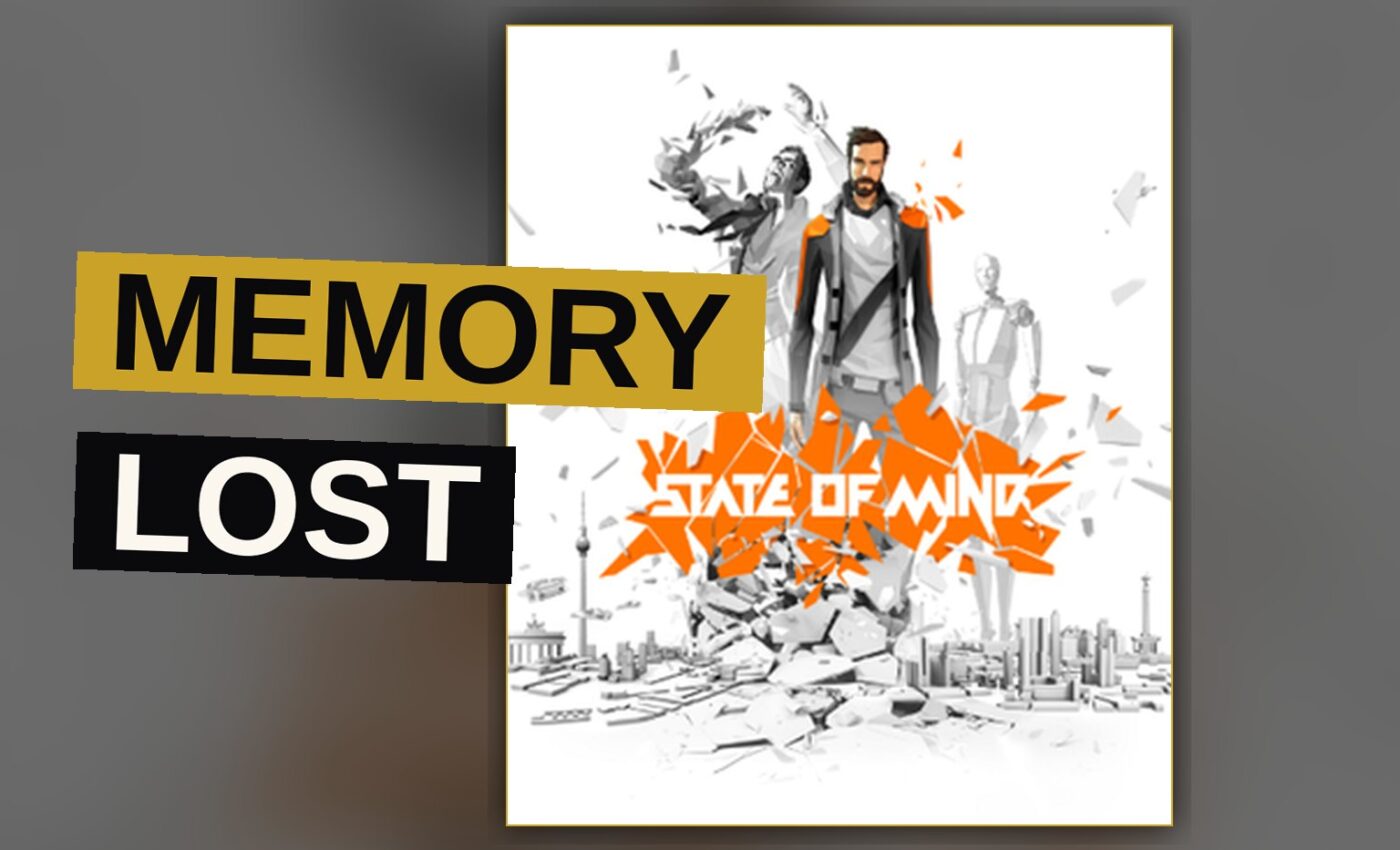
State of Mind asks players to fight a mind parasite while watching their own memories slip away. That premise sounds simple on paper. In practice, it rarely lives up to it.
Trailer, via IGDBcom.
The Memory System
The core idea behind State of Mind is memory loss. Players take on the role of a man whose mind is slowly failing, and each level forces him to remember skills and locations through flashbacks. It is a clever concept, but the execution drags.
The system relies on a series of puzzles tied to past events. Players must recall items, routes and dialogue choices to progress. The trouble is that these memories are often buried under layers of text and menus, which turns a potentially sharp design into a grind.
Combat and Controls
Fighting in State of Mind is built around hand-to-hand combat. Players strike, block and dodge to survive waves of enemies. On paper, this should work. In practice, the controls feel loose and imprecise, especially during boss fights where timing windows shrink fast.
Boss encounters tend to punish mistakes harshly. One wrong input can cost the player dearly, and the game offers little room for correction once a mistake happens. This creates a frustrating loop where players learn enemy patterns through repeated failure rather than skill.
Story and Atmosphere
The narrative tries to build tension around the protagonist’s deteriorating mind. Flashbacks reveal family trauma, career stress and personal guilt. These threads are promising, but the pacing suffers from long stretches of text-heavy exposition.
State of Mind leans heavily on written dialogue to convey emotion, and this approach does not always serve the game well. Some scenes land powerfully, while others drag on for minutes without giving players much to do beyond reading. The contrast between the game’s ambitions and its delivery is the clearest weakness in the package.
Technical Issues
On PC, Mac and Linux, State of Mind runs with visible technical problems. Frame drops occur during busy action sequences, and some menus suffer from stuttering animations. None of these issues are fatal, but they chip away at immersion when the game is trying hardest to engage players.
Performance on PS4 holds up better overall, though it too shows signs of strain during demanding moments. The game’s ambition exceeds its hardware capacity in places, and that mismatch is most obvious in the combat sections.
What Works
Not everything fails here. The setting, a near-future city collapsing under environmental pressure, offers a distinct visual identity. The music, a mix of electronic and orchestral scores, shifts tone effectively across different chapters. And the core idea of memory decay, when the game commits to it fully, carries genuine weight.
- The near-future city setting
- The electronic score
- The central memory-loss concept
- The occasional strong scene of character drama
These elements show what State of Mind could have been. They also highlight what is missing.
Final Word
State of Mind has a strong idea at its heart, but the game struggles to deliver on that promise across its full runtime. The memory system, while novel, gets buried under excess text and awkward menus. Combat feels punishing rather than precise. And the story, for all its ambition, sometimes loses pace in its middle stretch.
Taken together, these weaknesses keep the experience from reaching its full potential. Players who push through the rough patches will find moments of genuine quality, but the journey there is uneven enough to test patience.
State of Mind is a game of highs and lows, with the highs scattered among too many lows. It is worth a look for players interested in narrative experimentation, but it demands patience that the game itself does not always grant.
Get the Notebook.
The day's best stories and every fresh verdict, in plain English, in your inbox by seven. One email a day, no more.