
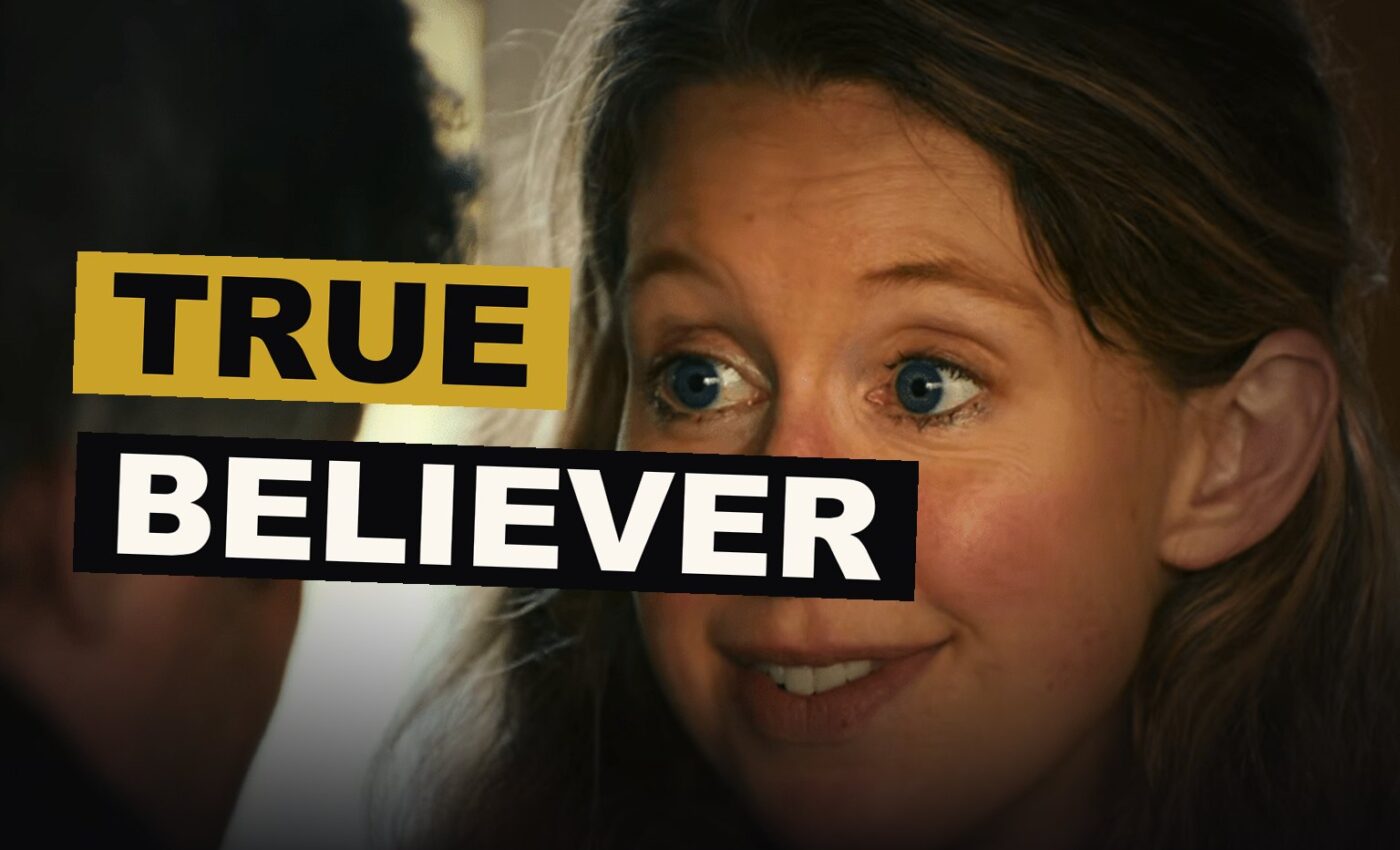
A surprise documentary about Elizabeth Holmes just became the talk of the Telluride Film Festival. The film, “You Can See Everything,” screened without advance notice as a mystery title. It runs 174 minutes and was made together with Nathan Fielder, the performer known for “The Curse” and “The Rehearsal.”
The subject is Holmes, the former CEO of Theranos, who is now serving an 11-year sentence of confinement after being found guilty of deceiving her investors. Fielder’s film does not try to settle the question of her guilt. Instead it asks what moved her.
A Camera Team, Before Confinement Began
Holmes stayed out of public view after being found guilty. Then, shortly before her sentence was set to begin, she decided she wanted someone to keep a record of her last days of freedom.
Fielder had been looking for a project with Lance Oppenheim, a director he had grown friendly with, who became the other director on the film. With support from A24, the two brought a camera team to a wooden house near the sea in Del Mar, not long before her sentence started in 2023. Holmes was living there with her partner, California hotel heir Billy Evans, and their two children, including an infant daughter.
Who Holmes Seems to Be On Camera
The Holmes we see has a gentle, pleasing presence, with a mouth shaped like a small bow and eyes that barely blink. The film notes she resembles the ’80s and ’90s actress Kim Greist, with a manner that comes across as gentle and easy.
When Fielder asks about the crimes she was found guilty of, she claims she did nothing wrong. The film makes clear she believes it.
The Theranos Story, in Brief
In 2015, Holmes was a celebrity entrepreneur riding a valuation of $9 thousand million for Theranos, a health technology company that turned out to be built on a false scheme. She had convinced the world she had built a device that could run blood tests from just a very small drop of blood.
Investors including Rupert Murdoch and Larry Ellison poured millions into the company. Her board of directors included Henry Kissinger and James Mattis. The technology did not exist.
Stanford medical professor Phyllis Gardner had warned Holmes early on that the idea would not work — you could not draw large amounts of data from a few drops of blood. Holmes and her business and romantic partner, Ramesh “Sunny” Balwani, sold the idea regardless. The idea of testing from a single small drop, according to the film, grew out of Holmes’ own fear of pointed instruments used to draw blood — a personal fantasy turned into a supposed invention.
Her Explanation for Fielder
Holmes tells Fielder, with what the film frames as a firm and unmoved belief in her own account, that the Theranos device, which she described in grand terms as a small marvel for the whole of health care, could in fact run any blood test that existed. The only missing piece, in her telling, was the science behind the tests.
That means the device was built around a method that had not been worked out yet. Fielder keeps pressing, and Holmes keeps answering as though the missing science were a small problem, the kind a team could just fix by next week.
The “Who’s On First?” Scene
At one point Fielder shows Holmes and Evans the Abbott and Costello comic act “Who’s on First?” Then he asks Holmes to explain the joke — that “Who” is the name of the man playing first base, which sounds like a question, producing the act’s play on words.
She cannot do it.
According to the film, she cannot grasp the joke at all.
Comparing the Two Sides of the Story
| Elizabeth Holmes’ Account | Established Facts Per the Film | |
|---|---|---|
| The device | Could run any blood test; only the science was unfinished | The science, and the device itself, did not exist |
| Company valuation | Built on a new and different technology | Theranos was valued at $9 thousand million on a false scheme |
| Investors | Backed a working invention | Rupert Murdoch and Larry Ellison put in millions on false claims |
| Board standing | Assembled figures like Kissinger and Mattis | Board added standing |
| Early warnings | Believed her idea would work | Phyllis Gardner told her directly it could not |
| Her manner on camera | Quiet, gentle, sincere | Fielder’s questioning stays doubtful throughout |
The film’s power, per the account of the Telluride screening, comes from that difference between Holmes’ calm certainty and the facts arrayed against her. Fielder never plays along with her version of events, but he also never pushes past a certain calm, unmoved manner, letting her reasoning unfold on its own.
“You Can See Everything” is described as far from a conventional documentary — closer to a reality-TV-as-hangout-movie built around Fielder’s quiet, questioning presence, which draws comparisons to performer Steven Wright. It was made, by all accounts, in a spirit of true inquiry, even as its subject remains, on screen, almost impossible to fully read.
Source: variety.com
Get the Notebook.
The day's best stories and every fresh verdict, in plain English, in your inbox by seven. One email a day, no more.